

After a series of mishaps, retailers are learning the hard way that agentic commerce is shaping up to be harder than expected.
When OpenAI launched Instant Checkout last fall, expectations were high. Walmart tested ChatGPT as a checkout channel for about 200,000 products, but found in-chat purchases converted 3X worse than on their own site. Daniel Danker, Walmart’s EVP of product and design, called the experience “unsatisfying” and confirmed Walmart was backing out.
OpenAI rolled back the feature, admitted in an article that “the initial version of Instant Checkout did not offer the level of flexibility that [we] aspire to provide,” and shifted toward retailer-controlled apps inside ChatGPT. The company handed checkout back to merchants and refocused on product discovery.
The lesson for retail CIOs is that agentic commerce doesn’t work without a solid data layer. Who is this shopper across every channel they have touched? What is in stock, where, and for how long? What is in their cart from three days ago on a different device? An agent that cannot answer those questions in real time is an expensive search bar with a checkout button attached.
The rise of agentic commerce and challenges ahead
Bain projects that the agentic commerce market could reach $300 to $500 billion by 2030 in the U.S. alone, making up roughly 15% to 25% of overall e-commerce. This means a growing share of those journeys will include at least one step where an AI agent acts on the customer’s behalf.
The issue is that most retail systems were not built for how customers actually shop. They were built for how retailers wish customers shopped.
Most retail tech assumes a clean shopping session: arrive, browse, add to cart, check out, leave. Analytics and recommendation engines all operate based on that model. When agentic AI systems inherit the same assumption, they break under it, because the customer is the ongoing thread, not the session.
Shoppers start researching on a phone during a commute, add to a cart on a laptop that evening, compare prices on a marketplace the next morning, ask an AI assistant at lunch, and buy in-store the following weekend. That is one journey, not five. Retailers who treat each touchpoint as a fresh session will watch their agents surface recommendations that ignore the cart, promotions that clash with loyalty status, and answers that contradict what the customer was told yesterday.
What fragmented data looks like in an AI experience
When the customer journey is disconnected, and the data behind it is fragmented, the cracks show up in the places customers see them first.
An agent recommends an item that the customer returned last month. A bundle ships in two pieces from two fulfillment nodes because inventory visibility is siloed. A promotional offer applies to a product already in the customer’s cart on another device. An agent commits to a delivery window that the supply chain cannot honor.
Each is a data problem dressed up as an AI problem, and each chips away at the trust that makes the agent useful.
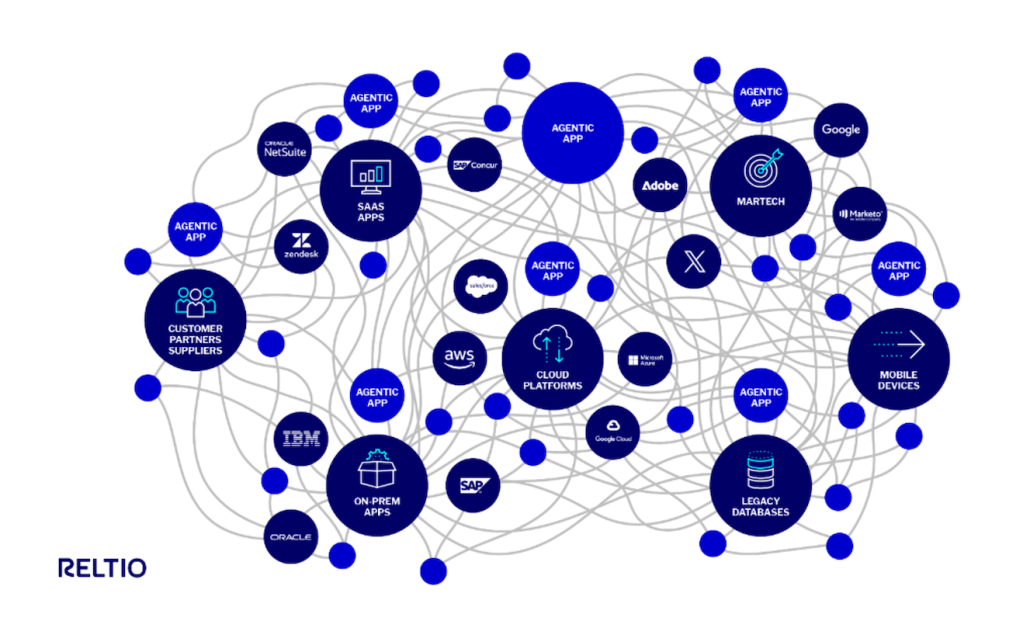
A 2025 Gartner survey of technology leaders found that half report their organizations lack the technical and data stack readiness required for AI agent deployment. That gap does not close by adding another model. It closes when customer, product, inventory, and fulfillment data are unified into a single, trusted view that the agent can draw from.
Figure 1: Fragmented and siloed data stymies AI initiatives
Reltio
Context is the new competitive moat
If fragmented data is the problem, unified context is the advantage. Every retailer in the next wave of agentic commerce will have access to roughly the same foundation models and protocols. OpenAI’s ACP, Google’s Universal Commerce Protocol, and whatever comes next will be broadly available. The model is the commodity layer.
What will not commoditize is the quality of a retailer’s context. Customer identity that persists across channels and devices. Product data that is accurate, enriched, and synchronized in real time. Inventory that reflects what is actually available right now, not what was available when the overnight batch ran. Order history, return history, loyalty status, and preference signals that make a recommendation feel considered rather than generic. That connective tissue turns a generic agent into a brand-differentiated experience.
The retailers who figure this out first will be those who have successfully built the data foundation that lets the model do its job.
What this means for the CIO agenda
For technology leaders in retail, the implications are concrete:
- Identity resolution stops being a back-office project. If an agent cannot recognize the same customer across web, app, store, loyalty program, and third-party surfaces like ChatGPT or Gemini, it cannot personalize anything meaningful. Cross-channel identity becomes a customer-facing capability.
- Real-time product and inventory synchronization becomes table stakes. Batch updates were tolerable when humans did the browsing. Agents act on whatever the data says at the moment of the query, and stale data shows up as broken promises.
- Data unification moves from efficiency play to experience layer. Successfully consolidating customer, product, and operational data decides whether AI experiences feel coherent or fragmented to the customer.
- AI investment exposes existing data debt. Every AI investment amplifies the consequences of whatever data gaps already exist. The more you invest in the model layer, the more exposed the data layer becomes.
The data layer is the AI strategy
The retailers who win in agentic commerce will be the ones whose agents can act on a complete, trusted, real-time picture of the customer and the business, every time. AI is only as good as the data context that informs it.
At Reltio, we call this “context intelligence”: the ability to connect customer, product, and operational data into a unified, real-time foundation that supports better decisions and better experiences across every channel, every touchpoint, and every agent.
The checkout button was never the hard part. The context behind it is where the next decade of retail will be won.
Explore the new rules of intelligent data. See how industry leaders are unifying trusted data to stay ahead in the AI era.
Read More from This Article: Retail AI has a data problem: Here’s how to fix it
Source: News