

The digital twin concept earned its credibility in engineering. Its origins trace to a 2002 University of Michigan presentation in which Michael Grieves described a “Mirrored Spaces Model”: a virtual system holding the information about a physical one, linked to it throughout its life.
For example, a jet engine manufacturer builds a precise virtual replica of a physical turbine, feeds it real-time sensor data, and runs simulations that predict failure before it occurs, optimize maintenance intervals, and test design modifications without touching the physical asset. This model is invaluable because the cost of being wrong about a turbine is high, the variables are measurable, and the physics are well understood. Organizations have applied the same principle to factory floors, supply chains and urban infrastructure, each time with the same underlying logic: a dynamic model of a complex system allows continuous optimization that periodic review cannot match.
However, the enterprise itself has received only part of that treatment. Even Gartner now evaluates organizational digital twin platforms as a category, describing them as dynamic models of how an organization operationalizes its business model, deploys resources and delivers customer value. Yet most of these twins model how work flows, not what it is worth, and that gap is consequential.
A dynamic model of the enterprise
Still, most large organizations still navigate strategic decisions with a picture of themselves that is static, incomplete and economically unattributed. Org charts describe reporting relationships as they were drawn at the last reorganization rather than how people actually interact. Process maps describe intended or designed workflows, not actual ones. And planning documents describe resource allocations as they existed at the time of the last budget cycle. None of these artifacts answer the question that matters most for strategic decision-making: what is the work actually worth, at the level of granularity required to improve it?
A living model of the enterprise changes what is possible. Imagine a representation of how work actually flows across functions (not as designed or conceived, but as executed), where decisions accumulate and slow, where handoffs lose information, where risk concentrates until it surfaces as an incident, and where resources are applied to activities whose economic contribution has never been examined. Connected to real-time operational data, that model moves leaders beyond the static artifacts that currently substitute for organizational self-knowledge.
But a model of how work flows is useful only for operational diagnosis, not a complete economic understanding. Strategic redesign requires knowing what the work measurably produces at the level of individual activities, decision points and handoffs.
Enriching the digital twin with economic process modeling
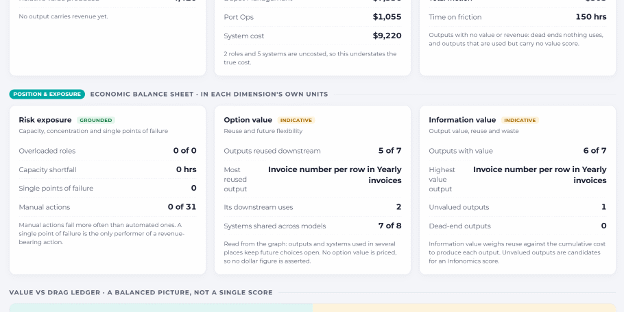
As I have discussed in previous pieces, Economic Process Modeling (EPM) provides that additional layer. By decomposing processes into their constituent components and attributing value across five dimensions (revenue contribution, cost and friction, risk exposure, option value and information value), EPM transforms a process map from a descriptive artifact into an economic instrument.
The output is not a flowchart but a value ledger: which components are value drags that cost more than they contribute, which are misaligned (a person doing a system’s job, or the reverse), and where value is created but never collected, usually as data the process discards. That is the side of the business case that cost accounting alone cannot show. It is the value layer the enterprise digital twin needs to support strategic decisions rather than merely operational ones.
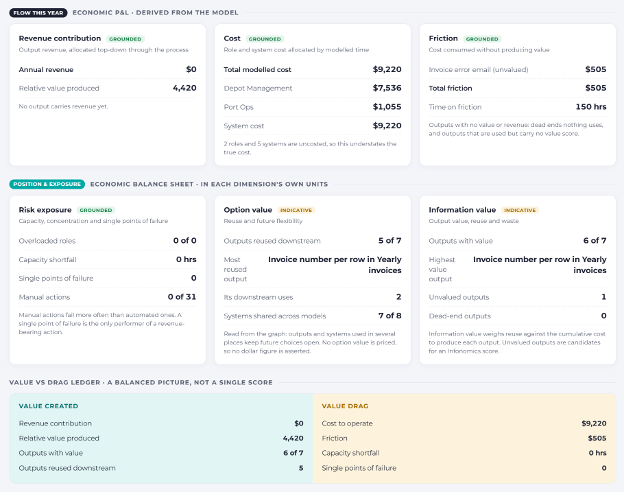
Sample economic process model ledger.
Douglas Laney
Enterprise, know thyself
The practical benefits of an enterprise digital twin featuring EPM are compound:
- It enables businesses to model the P&L consequences of a restructuring before headcount decisions are made.
- It surfaces the process components where AI investments could generate the highest return per dollar–rather than requiring that prioritization to be resolved through stakeholder negotiation and executive sponsorship, which is how it is currently resolved in most organizations.
- It makes visible the information assets being generated and destroyed by current process designs.
- And it shows where risk is concentrating in operational workflows before that concentration produces a regulatory finding or a customer failure.
These are not incremental improvements to existing planning processes; they represent a different quality of organizational self-knowledge.
What makes this achievable rather than speculative is that the required inputs exist in most large organizations already. Process mining tools extract actual workflow patterns from system logs, ERP and CRM systems hold the operational and customer data needed to attribute revenue and cost at component level, and risk systems hold the exposure data.
The missing element is the economic model that sits above the infrastructure, translates operational patterns into value attributions, and makes the enterprise legible as an economic system rather than a collection of functions.
Economic process modeling in action
CentrePort, is the port and logistics operator in Wellington, New Zealand. Its CentreConnect freight service generated a high volume of small inter-port charges, each reviewed and reconciled by hand by a small commercial team working from spreadsheets. Rather than automating first, the company modeled the invoicing workflow down to individual container movements, linked each activity to time and cost data, and tested standardization and automation scenarios before committing to change.
Processing time per invoice fell from 25 minutes to 23 seconds. But the more telling outcomes were those a throughput metric would miss: fewer financial discrepancies and less overpayment risk, stronger data governance than spreadsheets allowed, and groundwork for scaling volumes without adding staff. Those are risk, information and option value, not only cost.
CentrePort has since applied the approach to other commercial processes and now treats it as a precondition for change. “Before undertaking any projects, we now ensure that the current state is understood, along with the upstream and downstream impacts of change,” said Tanya Dednam, Head of Digital.
The evolution from physical to enterprise digital twins
As many businesses and the global economy continue to shift toward digital, AI-based and services-oriented offerings, economically modeling the enterprise can become more important than modeling physical things.
However, the analogy to physical digital twins carries an important limitation: Turbine physics are stable whereas organizational economics are contested, context-dependent and subject to strategic choice. An enterprise digital twin built on EPM does not produce a single authoritative answer about what a process component is worth. It produces a structured basis for the argument, with explicit assumptions that can be examined, challenged and revised as conditions change, which is precisely what distinguishes a useful analytical framework from the static planning artifacts it replaces.
The competitive advantage this capability confers is not in the model itself. Rather, it is in the organizational discipline of making economic attribution a continuous practice, of treating the enterprise as an asset to be actively managed rather than a structure to be periodically reorganized when the last reorganization stops working. And rather than an enterprise-wide focus, the practical aperture is a single process with high economic exposure–ideally one already under transformation or AI investment pressure, modeled well enough to inform a real decision or action.
Organizations that model, measure and analyze the EPM-enhanced digital twin of their processes will be able to adapt, optimize and transform with significantly greater agility than those navigating with onerous org charts and planning PowerPoints.
Read More from This Article: The next digital twin isn’t of a machine, it’s of your business
Source: News
