

These are early, fascinating days for the corporate title du jour — chief artificial intelligence officer (CAIO).
So when the CAIO of Australia’s largest bank, Commonwealth Bank (CBA), stands up to talk about his role and how times are changing, it’s worth a closer look.
I recently interviewed Ranil Boteju, CBA’s CAIO, on stage at Momentum Media’s FST Future of Financial Services, Data & AI conference, and one of his answers pointed to the story behind the story.
“I am the chief AI officer, but I’m one of many.” The real chief AI officer, he said, is “our CEO.”
Every organization is different, but it points to an early dilemma for CAIOs. Who, exactly, should be in charge of this AI transformation movement? CFOs, CMOs, CIOs and even CISOs have a stake, and the benefit is well-documented roles with clear areas of responsibility.
And of course, as Boteju notes, the CEO is key. If CEOs don’t ‘get it,’ the organization has bigger problems.
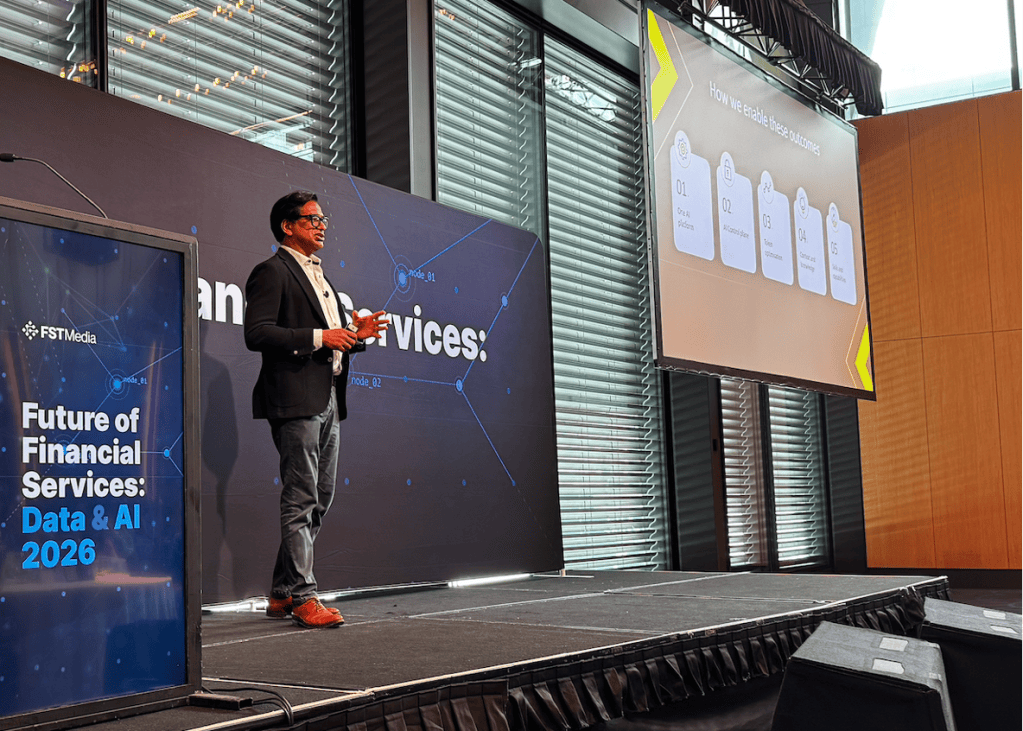
Ranil Boteju, Commonwealth Bank’s CAIO.
CAIOs finding their feet
Keep that tension in mind because Boteju’s experience offers plenty of lessons for companies forging an AI transformation path.
CAIOs occupy a rare space in the race to AI adoption: they’re highly influential and respected yet hold varying degrees of authority. Boteju does run a centre of excellence and builds the shared capabilities the business draws on, but if we step back, he still has a structural problem.
Like chief digital officers before him — a parallel he drew himself — Boteju holds a role that champions a technology which creates value only when it’s embedded across the entire business. “The chief digital officer was a digital team, and they were doing digital, and everyone was by definition not digital,” he said. The lesson he took from that era is noteworthy: “AI transformation can’t be constrained to one team.”
Clearly he’s not responsible for a vertical silo like his C-suite peers and, I’d add, necessarily so. Each business unit should “really lead their agenda”, he said, underpinned by “a common set of capabilities that I would build”.
CAIOs must master managing up to their CEO, collaborating sideways across the C-suite and providing the top-down inspiration that helps whole teams embrace and extend the vision for AI transformation.
So, what’s his story?
All this is vital because it shapes how leaders should understand his story. I picked up three lessons from his talk and our conversation.
1. Context is your moat
Before your buzzword filter goes off, this insight is worth a closer look. When everyone has relatively equal access to the same AI technologies, or at least the same large language models, it pays to understand how your competitive moat is changing.
“In a world where all of the banks are using the same models, what will differentiate us is the context, the organizational memory, all of the tacit knowledge that sits in people’s heads,” Boteju said. “This is effectively our moat.”
That’s the scarce, underused asset inside most companies: what your people know but have never written down. The patterns they’ve recognized over time, and their hard-earned wisdom. A standard operating process, he noted, “is pretty high-level. A lot of it sits in people’s heads.”
Of course, some of this knowledge can also be found scattered throughout vast collections of unstructured data in all organizations. But his point is that analysis isn’t the gap. Asked when data is good enough, he said that in most financial services organizations “there is no excuse to wait”.
So, here’s the better question: how much of what your organization knows has been written down, and how much of it could you hand to an agent tomorrow?
2. Simplify your strategy
Oh, how we love to overcomplicate enterprise IT strategies! And yet Boteju stood on stage with clean, simple slides that broke down his strategic thinking.
“The reason for doing AI needs to be really clear in your organization,” he said. “We’re not jumping on a bandwagon.”
CBA has chosen four strategic priorities: customer experience, fraud and scams, faster delivery and reimagining work. Each one makes sense, so that begs the next question: how can AI deliver against each of these easily understood priorities at scale?
The answer for CBA is five enablers, also presented on one slide: one AI platform, an AI control plane, token optimization, context and knowledge, and skills and capabilities.
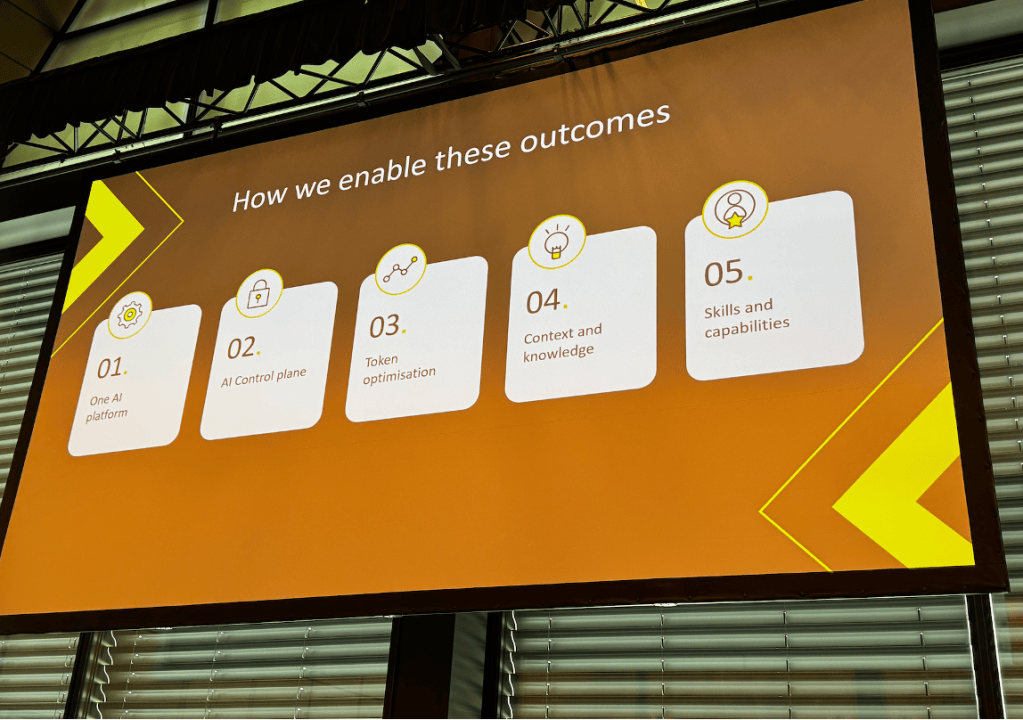
CBA’s “Five enablers”: One AI platform, an AI control plane, token optimization, context and knowledge, and skills and capabilities.
The alternative is a familiar story to anyone in this game. A few years ago, he said, it was “1,000 flowers blooming, lots of duplication, lots of POCs, nothing really scaled.” His advice now is to have “a really narrow set of … use cases to focus on”. Could you put your AI strategy on one page?
3. AI transformation is a control game
This point is a meta-insight I took from CBA’s big picture. Think about the dominant AI industry narrative pushed by the LLM leaders in particular: you can’t control AI — heck, even we can’t control agents and we built them!
Now contrast that with Boteju’s approach, which he describes as “machine layers of defence”. “We register every single asset,” he said. “Any given moment, I can point to all of the AI agents that are underway, live in production or being built.” Nothing goes live unless it passes pre-deployment testing. Then, in his words: “Has there been any drift? Is there anything that we need to be concerned about? We can monitor that in real time.” Outcomes are checked after the fact, and an independent team validates the lot.
Know what you can control and what you can’t — and have a plan for both.
And look back at the five enablers for a moment. Maintaining control is a strategy that runs through most of them: the AI platform and control plane, token spend (a single gateway, caps for engineers and smaller, cheaper models for less intensive tasks), and how context is protected. “To pick out the one thing at the bank that we need to really protect,” he said, “it’s our context and knowledge.” The final enabler is a handy $90m, which he said CBA is investing in upskilling teams.
In short, this is the behaviour of an organization that’s not lying down and letting the AI juggernaut run over it.
What’s your story?
It’s often said, “comparison is the thief of joy” — but in this case it should be an opportunity for inspiration and pointed reflection.
What comes to mind when you look at CBA’s approach and then hold up a mirror? You might have a CAIO who’s been given all the responsibility and none of the authority. Or perhaps your organization lacks the clarity of strategic thinking clearly evident at CBA?
As always, success is not contingent on one C-suite title, but on how your entire team understands and communicates the story of change that’s required in times like these. Times when new titles come and go, change feels faster than ever, and clarity can feel like a distant dream enjoyed by others.
In my mind, it starts with challenging the control narrative. Are you living inside your own story, or the AI industry’s adopted fear, uncertainty and doubt (FUD) narrative?
Read More from This Article: AI leadership: 3 success lessons from CBA’s chief AI officer
Source: News