

While you’re still debating whether to implement chatbots, the smart money is already building autonomous AI armies. Welcome to the agentic AI revolution, where your competitors aren’t just automating tasks, they’re orchestrating entire business ecosystems to run themselves.
Is automation dead? (Spoiler: it just levelled up)
Here’s the question every CTO should be asking: Is automation dead, or has it just evolved beyond recognition?
Let’s be brutally honest: traditional enterprise automation has been stuck in the Stone Age.
We’ve been celebrating “digital transformation” that amounts to glorified Excel macros with neural network stickers. Companies spent millions automating individual tasks while the real revolution was brewing.
Automation isn’t dead — it just reached its next form.
Think software 1.0 → software 2.0 → software 3.0.
Think web 1.0 → web 2.0 → web 3.0.
We’re witnessing automation 3.0: the evolution from task-based automation to autonomous business orchestration.
Agentic AI isn’t your typical enterprise upgrade. It’s the difference between programming a calculator and partnering with a strategic operations director who never sleeps, doesn’t need health insurance and can simultaneously orchestrate 1,000 interconnected business processes without breaking a digital sweat.
Here’s what the consultants won’t tell you: Your current automation strategy just became the new legacy system.
The numbers don’t lie (even when everyone else does)
Gartner predicts 70% of businesses will use AI integration platforms by 2028 — up from less than 5% in 2024. That’s not incremental growth; that’s a complete market restructuring disguised as a trend report.
But here’s the rebel insight everyone’s missing: This isn’t about technology adoption — it’s about survival.
The companies building agentic AI systems today aren’t just optimising operations; they’re creating moats that will be impossible for traditionalists to cross.
Why most companies will fail at this (and how to avoid being one of them)
The uncomfortable truth: Most enterprises are approaching agentic AI like it’s another IT project to be managed by committee, approved by procurement and implemented over 18 months.
Meanwhile, the disruptors are treating it like a competitive weapon.
The fatal mistakes everyone’s making:
- Thinking small: You’re not building a chatbot. You’re architecting the nervous system of your future enterprise. Start thinking like you’re designing an organism, not installing software.
- Committee-driven implementation: Innovation dies in committees. The companies winning at agentic AI have small, empowered teams moving fast and breaking things (intentionally).
- Waiting for “perfect” solutions: While you’re waiting for the perfect vendor and the ideal use case, your competitors are learning from 1,000 imperfect implementations.
The Accenture case study: What they’re not telling you
Yes, Accenture’s AATA platform achieved 93% efficiency gains and supports 800,000 employees. Impressive numbers.
But here’s what the press releases don’t mention:
They didn’t ask for permission. They didn’t wait for industry standards. They didn’t hire McKinsey to write a strategy document. They built it, deployed it and iterated based on real-world feedback.
The real lesson: Stop planning and start building.
The 4 pillars of agentic AI dominance
1. Operational anarchy (in the best way)
Traditional IT governance will kill your agentic AI initiative faster than a budget committee meeting. The winning approach? Controlled chaos with clear guardrails.
Let your AI agents break things. Let them find inefficiencies you didn’t know existed. Let them question why you do things the way you’ve always done them.
2. Data democracy
Your data architecture probably sucks. Most enterprise data is locked in silos, guarded by departments that treat information like medieval kingdoms protect gold.
Agentic AI demands data democracy. Break down the walls. Make everything accessible. Yes, it’s risky. Yes, it’s messy. Yes, it’s absolutely necessary.
3. Human-AI symbiosis (not replacement)
The “AI will replace humans” narrative is lazy thinking. The real opportunity is creating hybrid organizations where humans and AI agents complement each other’s strengths.
Your best employees shouldn’t fear AI – they should be designing it, directing it and leveraging it to do impossible things.
4. Exponential scaling
Linear thinking kills exponential opportunities. Don’t optimise existing processes – reimagine them entirely. Ask: “What becomes possible when intelligence is infinite and instantaneous?”
The implementation reality check
- Start subversive: Find the most frustrated department in your business. Usually HR or IT operations. Build them an agentic AI solution that solves their biggest pain point. Don’t ask for permission, ask for forgiveness.
- Fail fast, scale faster: Launch imperfect solutions and iterate rapidly. Your first agentic AI implementation will probably suck. Your tenth will probably transform your business.
- Think platform, not project: You’re not implementing a solution – you’re building the foundation for an AI-native organisation. Design for the future, not the present.
The contrarian’s guide to vendor selection
- Red flag: Any vendor promising “seamless integration” with your existing systems. Integration is never seamless, and seamless usually means constrained.
- Green flag: Vendors who admit their platform will require you to change how you work. The best agentic AI solutions are opinionated about better ways to operate.
- Reality check: The perfect vendor doesn’t exist. Pick one that aligns with your technical philosophy and can evolve with your needs.
What happens if you wait
While you’re reading white papers and attending vendor demos, your competitors are building operational capabilities that will be nearly impossible to replicate.
- The network effect: Early adopters don’t just get operational advantages, they get ecosystem advantages. The AI agents, data patterns and operational knowledge they develop create compounding returns over time.
- The talent magnet: The best technologists want to work with cutting-edge technology. Companies building agentic AI systems today will attract tomorrow’s top talent.
The bottom line for rebels
Agentic AI isn’t coming; it’s here. The question isn’t whether you should adopt it, but whether you’ll lead the transformation or become a casualty of it.
The rebel’s playbook:
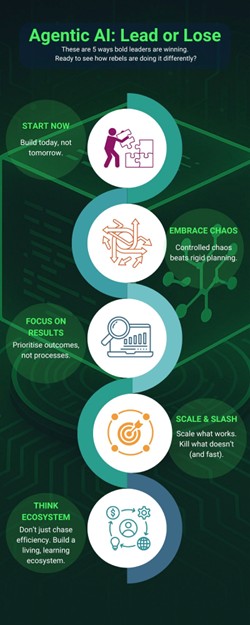
- Start building today, not tomorrow
- Embrace controlled chaos over rigid planning
- Focus on outcomes, not processes
- Scale successes, kill failures quickly
- Think ecosystem, not just efficiency
Brett St. Clair
The enterprise technology landscape is about to be completely restructured. You can either architect that future or get swept away by it.
Choose wisely. The revolution waits for no one.
This article is published as part of the Foundry Expert Contributor Network.
Want to join?
Read More from This Article: The agentic AI revolution: Why your business is about to get disrupted (whether you like it or not)
Source: News