

Salesforce’s announcement that it intends to acquire Informatica is more than a strategic M&A play. It’s a signal that enterprise applications are being fundamentally reshaped for the AI era—and that the battleground isn’t app features or UX polish. It’s data.
We’ve entered a new phase in enterprise technology—the era of the data-first architecture for systems of context. The next generation of value won’t come from dashboards or mobile-first interfaces. It will come from autonomous agents, co-pilots, and AI-powered workflows that act, learn, and reason in real time.
Siloed SaaS Applications are not the system of context for these operational, agentic orchestration flows. These Agentic systems are best run on a multi-application data context to deliver the benefit of the multi-modal cause-and-effect correlation that the AI models are designed for. This holistic context comes from data: unified, real-time, machine-understandable data that spans key data concepts such as customers, products, suppliers, transactions, and everything in between.
That’s what the Informatica acquisition is really about. Salesforce recognizes that to survive in the age of AI, it must move down the stack—owning more of the data, not just the application surface.
But that move raises some crucial questions for all of us.
Is Salesforce about customer agility or platform lock-in?
To be clear: investing in better data infrastructure is smart. The problem is when consolidation leads to more complexity, not less. Anyone who’s lived through a large-scale software integration knows how long and hard that journey can be.
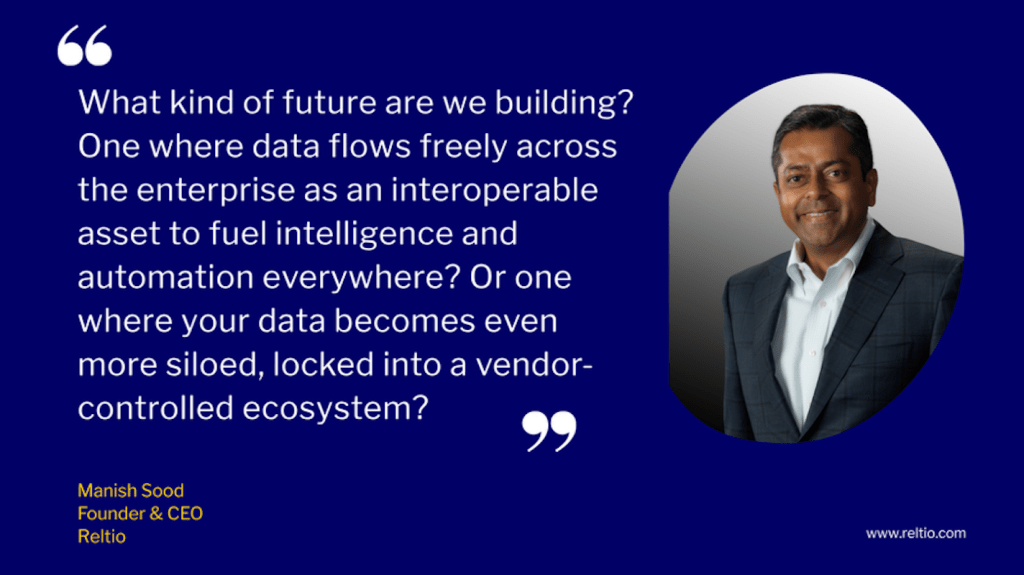
But beyond integration timelines, here’s the real issue: what kind of future are we building? One where data flows freely across the enterprise as an interoperable asset to fuel intelligence and automation everywhere? Or one where your data becomes even more siloed, locked into a vendor-controlled ecosystem?
Salesforce is already showing signs of the latter. Their recent changes to Slack’s API now prevent companies from using Slack data to train their own AI models. Bulk exports are blocked. You can only search Slack using Salesforce’s Real-Time Search API. This is your data, restricted inside someone else’s sandbox.
For enterprises racing to unify fragmented systems and accelerate AI across the business, this is a red flag.
Reltio
AI needs more than access. It needs understanding
Here’s the truth: AI can’t thrive on disjointed, app-specific, siloed data. AI is best at understanding the cause-and-effect correlation (i.e., if something negative happened in Support, then how does it impact a currently ongoing Sales cycle, or uncovering a fraud scenario that is based on a sequence of events across multiple engagements across lines of business and functions). AI needs a unified view of the data that provides this context. It requires a data foundation built for context, not just collection.
That’s why the data layer matters more than ever. Not just any data, but trusted, connected, and interoperable data that reflects how your business works.
In this new reality, enterprises can’t afford to hand over control of their data foundation to vendors who are optimizing for their own platforms. What we need is an application-independent system of context—a Switzerland for data—that cuts across lines of business, works across every function, supports all applications, and not just one vendor’s suite.
Your competitive edge is your data strategy
This shift changes the rules. Your company’s competitive edge will no longer come from choosing the right CRM or marketing automation tool. It will come from building the real-time data intelligence layer that feeds every business operation, every engagement, every agent, and every insight across your enterprise landscape.
That means moving beyond batch pipelines and brittle point-to-point integrations. It means real-time data quality, semantic context, and cloud-native scalability. And it means saying no to systems that lock your data behind APIs designed to favor the vendor, not the customer.
At Reltio, we’ve been building for this future from day one. We believe that AI will only be as powerful as the data you feed it—and that the foundation for that data must be trusted, open, and able to scale enterprise-wide.
The stakes have never been higher
This is a pivotal moment. The application stack is being reimagined faster than ever before. AI is no longer a bolt-on feature. It’s the core of the next-generation enterprise. And the foundation it runs on—your data—will either empower you or hold you back.
The question is: Who controls that foundation?
With every new announcement, it’s becoming clear that legacy vendors are repositioning to own your data layer. But ownership doesn’t guarantee openness. And control isn’t the same as enablement.
The companies that win the AI race won’t be the ones with the most tools. They’ll be the ones with the best data—and the freedom to use it across every system, team, and use case.
The future is being written in real time, and the rules are changing. Let’s make sure your data isn’t just a footnote, but the backbone.
Explore the new rules of intelligent data. See how industry leaders are unifying trusted data to stay ahead in the AI era.
Read More from This Article: Salesforce wants to own the data layer. Should you let them?
Source: News