

While many companies are busy switching from ECC to S/4HANA, an even more critical migration is looming: A large amount of SAP knowledge and experience will soon be lost to retirement.
Computerwoche spoke with Uwe Hartmann, founder of FITS-P GmbH, who was responsible for SAP systems as CIO at ABB for many years, about this pending knowledge drain as many SAP experts wind down their careers, as well as ways IT leaders can leverage process mining to help.
‘S/4HANA creates a solid foundation … but nothing more.’
Computerwoche: Many companies are facing a generational shift, as baby boomers, including numerous SAP experts, are retiring. How great is the risk of this vital enterprise knowledge being lost?
Uwe Hartmann: You have to look at the topic from different perspectives. The knowledge of experienced employees is not limited to technical operation, but above all includes an understanding of how a company’s processes function and how they are controlled in the SAP system.
Generating an order confirmation, for example, is relatively simple. But when this results in a delivery, special labels with barcodes are printed, financial accounting is integrated, and receivables or liquidity planning is initiated, then we are moving into a significantly more complex environment.
These connections aren’t understood overnight. It requires years of experience and in-depth knowledge of the company. The problem I currently see in many companies is that key personnel are retiring, and often there’s no successor yet.
Does the fact that many companies are in the midst of their S/4HANA transformation increase the pressure?
Absolutely. According to current figures, more than half of companies have not yet finished their migration to S/4HANA. If experienced employees leave, significant risks arise.
Studies by Gartner and McKinsey show that a large proportion of S/4HANA projects fail to meet their original cost or timeline targets. Every company faces a real challenge here.
What about after a successful S/4HANA migration? Will SAP experts leaving the workforce have less of an impact then?
No, not at all. The migration to S/4HANA alone won’t solve the problem. Many companies see it primarily as a prerequisite for continued maintenance and support from SAP. But this is similar to a smartphone update: You have the latest version and remain technically up-to-date, but the real added value doesn’t automatically materialize. This is precisely the question many companies are asking themselves: What does S/4HANA offer us beyond the mere maintenance requirement?
In my opinion, the real work begins here. Looking at the evolution of artificial intelligence, one can see how rapidly requirements are changing. Two years ago, AI was still an abstract topic for many. Today, it is increasingly being used productively in business processes. At the same time, SAP is also continuously developing its platform and has invested heavily in AI technologies in recent months.
But it is crucial to use these opportunities judiciously. AI only unfolds its full potential when it is meaningfully integrated into processes. Business processes in companies will very likely look completely different in three or four years than they do today. S/4HANA creates a solid foundation for this, but nothing more. Companies must build on this foundation. This will continue to require experienced employees who understand business processes and can effectively utilize new technologies with the necessary expertise.
‘The only solution then is process mining’
With time running out, what challenges do you see for organizations still postponing migration?
A successful S/4HANA migration begins long before the project starts. It requires intensive preparation. Companies must first clarify the scope of the migration. They need to determine what investments are necessary and what goals they want to achieve. Only once these foundations are in place should implementation begin.
To do that, companies must have a precise understanding of their existing SAP landscape. How complex is the company? In which countries is it active? Which processes deviate from the standard? How extensively has the system been customized? What in-house developments still exist? How good is the quality of the master data?
Individual customizations and in-house developments are often underestimated. Added to this are master data problems, which affect almost every company. Even seasoned SAP experts cannot know every intricacy of a system by heart.
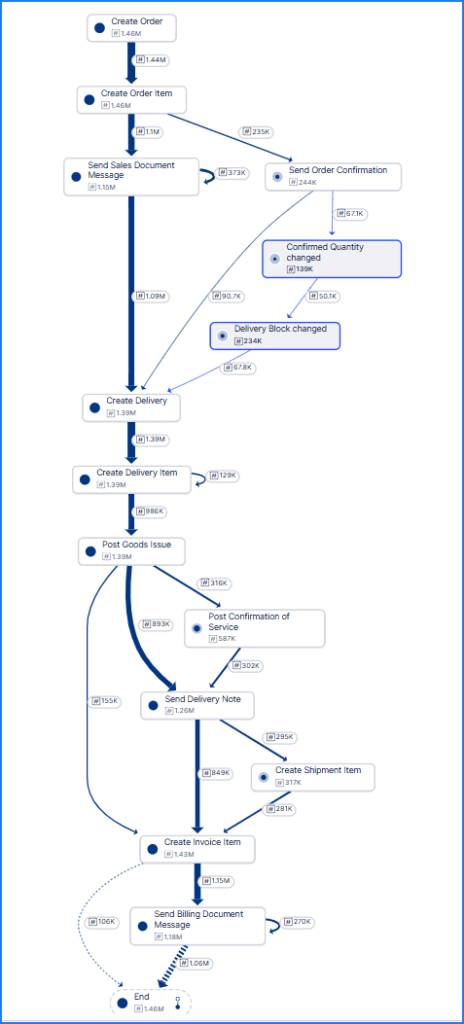
In such cases, process mining is the only solution. It’s like putting an X-ray machine on the ERP system, revealing hidden risks, dependencies, or special developments within the SAP system. This is crucial because during a migration, it’s the inconspicuous details that often become major problems. The goal is to uncover these blind spots early on, before they become a cost or time trap.
At Sapphire, SAP presented numerous AI agents designed to support S/4HANA migrations by analyzing and documenting processes. What’s your assessment of this development?
That’s definitely a useful addition. But we’re also seeing AI frequently portrayed as a panacea. People forget that this requires a solid data foundation to work.
AI can only deliver meaningful results if the underlying data models are well-structured. You can’t just give a chatbot access to an ERP system and expect it to automatically find optimization potential.
Only process mining platforms with a consistent data model create the conditions for AI to recognize patterns and identify potential improvements.
FITS-P GmbH
‘The emotional component cannot be replaced.’
Returning to retirement: What can companies do when experienced SAP experts leave the workforce? Is that knowledge irretrievably lost?
Part of it, yes. With every employee, not only is expertise lost, but also personal experience and a strong connection to the company. This emotional component cannot be replaced. Technical knowledge, on the other hand, can at least be partially preserved and made traceable.
With a data-driven approach, new employees can gain an overview. Process mining helps them see how processes run through the system, which customization settings have been made, and which in-house developments are in use. This enables them to form their own opinion and formulate targeted questions, instead of having the entire system explained to them step by step.
A personal handover is of course advisable if possible. But the major advantage is that it is no longer mandatory.
Is the loss of SAP know-how primarily a problem for medium-sized companies, or does it also affect large corporations?
This affects both equally — albeit for different reasons. In large companies, there is often a risk that the focus on details is lost as the company grows. Medium-sized companies, on the other hand, often struggle with more limited personnel resources and are more dependent on individual knowledge holders.
Regardless of company size, I see S/4HANA migration not just as an IT project, but as a strategic opportunity. Of course, the technical migration is the initial focus. But behind it lies a much larger task: Companies need to rethink their processes.
We are currently witnessing changes in processes across almost all areas of life. From digital tickets for public transport and apps for visiting swimming pools to AI-powered services — digital processes are becoming the norm. This trend will continue in businesses and public administration as well.
Therefore, the S/4HANA migration should be used to prepare the company for these changes. Making one’s own processes transparent often leads to a better understanding of the company than before and creates the foundation for adopting new technologies and ways of working more quickly.
At the same time, such a transformation project offers the opportunity to develop new talent. Companies that involve committed employees in the migration early often develop precisely the leaders who will drive the company forward in the next five or ten years. For me, that’s the true vision behind an S/4HANA migration: not just to introduce a new ERP system, but to future-proof the company.
‘What matters is not the number of consultants, but their quality’
What typical errors do you observe in knowledge management in SAP projects?
The true meaning of SAP know-how is often underestimated. I repeatedly encounter projects where employees are deployed who, while dedicated, lack the necessary technical and professional foundation. Anyone who can neither read ABAP code nor understand SAP customizing can hardly assess the numerous customer-specific extensions of a system.
Many believe that documenting processes graphically is sufficient. This is helpful, but it represents only a small part of reality. In practice, hundreds or even thousands of variations may exist for a single business process. These differences can be recognized only by understanding the processes themselves and the underlying system logic.
Equally important is professional project management. Every company should employ an experienced and certified project manager who works according to a clear phase and approval model. Before a project moves to the next phase, all prerequisites must be met.
I personally experienced a project that had to be stopped just two weeks before the planned go-live because the final test revealed that essential business processes had never been fully tested. This wasn’t a technical problem, but an organizational oversight.
That sounds more like a problem for medium-sized companies, correct?
Not necessarily. I see similar challenges in corporations as well. There, the greater risk is that projects will lose touch with operational reality.
My most important advice is: Rely on experienced project managers with sound project management training and bring the necessary SAP expertise on board early. The crucial factor is not the number of consultants, but their quality. Companies should not hesitate to seek external expertise in the early stages of a project. This is usually significantly cheaper than having to correct errors shortly before go-live.
One last question: Some companies are considering having their existing SAP systems maintained by third-party providers instead of migrating directly to S/4HANA. Is this a viable strategy?
I don’t personally know any clients who are taking this approach, but I can understand why companies are considering it. When studies by Gartner or McKinsey show that a large proportion of S/4HANA projects miss their deadlines or budgets, then their reluctance is understandable. After all, those who miss the deadline usually exceed their budget.
Furthermore, many consulting firms are operating at full capacity. Companies are therefore rightly asking themselves whether they can get the best resources for such a project right now, or whether a later date would be more sensible.
Those who still have sufficient support for their existing system and only need to make a few changes can consider using the remaining time strategically. However, it is crucial not to let this time go to waste.
In my view, there’s no way around S/4HANA in the long run. But speed alone isn’t a guarantee of success. Companies that have some leeway today can invest that time to prepare their organization: by training employees, strengthening IT staffing, building the necessary expertise, and refining their own strategy.
In recent years, many companies have paid a high price for their migration projects. By 2028, more tools will be available, and the experience gained from the first large-scale projects will benefit everyone. Therefore, careful preparation can be more sensible than a rushed start.
My advice would therefore be: Use the remaining time wisely. Build expertise, attract the right employees, and align your IT so that it can still successfully support the company in five or ten years. The S/4HANA migration should be part of a long-term future strategy — not just a project to meet a deadline.
See also:
Read More from This Article: S/4HANA’s hidden migration challenge: SAP expert retirement
Source: News