

Every morning, most entrepreneurs check their phones within 10 minutes of waking up. By noon, they’ve processed 2,000+ pieces of information. By evening, they can’t remember which three actually mattered. Meanwhile, the top 1% have AI systems that serve them only the decisions that will make or break their businesses (and nothing else).
Kevin O’Leary recently dropped a truth bomb about successful entrepreneurs: They can block out most of the noise of their personal lives to get the most important tasks of their day done. He said his former partner, Steve Jobs, found that an 80/20 ratio of signal to noise, with 80% signal and 20% noise, worked best for him. He added, “If you go back in history, you’re going to find out that the geniuses of their time were close to 100% signal.”
But what exactly is this signal-to-noise ratio that separates entrepreneurial legends from the rest?
Signal is information that directly impacts your business decisions, revenue or strategic direction. This includes customer behavior changes, market shifts, competitive threats, regulatory updates or operational bottlenecks that require your attention.
Noise is everything else. Social media notifications, industry gossip, vanity metrics, theoretical discussions and the 90% of information that feels urgent but changes nothing about what you should do next.
Most entrepreneurs operate at a 20% signal, 80% noise ratio — drowning in data while starving for insight.
But here’s what O’Leary didn’t tell you: In 2025, achieving that 100% signal ratio isn’t about superhuman focus. It’s about superhuman intelligence augmenting your every move.
The information apocalypse is here (and most entrepreneurs are losing)
The average entrepreneur processes 34GB of information daily, enough to crash a 1990s computer. Meanwhile, per O’Leary, “Elon Musk, he has no noise. He does not deal with noise. 60 seconds of every minute, 60 minutes of every hour, the 18 hours he’s awake, it’s all signal.”
The difference isn’t biological. It’s architectural.
While most entrepreneurs are still manually sorting through emails, social feeds, market reports and customer feedback like digital archaeologists, the signal masters have built something entirely different: An AI-powered cognitive infrastructure that transforms noise into insights before it reaches their consciousness.
The uncomfortable truth?
Your competition isn’t just other entrepreneurs. Not anymore. It’s entrepreneurs amplified by AI systems that never sleep, never get distracted and never mistake busy work for real work.
Proof? These incredible channels have entrepreneurs who are making bold strides using AI: Matt Wolfe, Liam Ottley and Greg Isenberg.
Your AI alter ego: The signal-amplifying machine you never knew you needed
Forget everything you think you know about AI assistants.
We’re not talking about ChatGPT writing your emails. We’re talking about building a digital alter ego, a better version of your decision-making output that operates at machine speed and scale.
Your AI alter ego isn’t just automation. It’s cognitive multiplication.
While you’re handling three priorities, your AI alter ego is:
- Processing 1,000 market signals simultaneously
- Identifying pattern breaks in real-time customer data
- Cross-referencing competitor moves against your strategic assumptions
- Flagging the 3% of information that actually demands your attention
The signal amplification framework is made up of four elements.
1. Information triage
Traditional entrepreneurs read everything. Signal masters let AI read everything and surface only what changes decisions. Deploy AI systems that monitor your industry, competitors and customers, then apply ruthless filtering based on your specific strategic priorities.
Implementation: Build custom AI monitors for patent filings in your space, customer sentiment shifts, regulatory changes and competitor hiring patterns. Set decision-relevance thresholds. If it doesn’t change a decision you need to make in the next 90 days, it’s noise.
2. Context preservation
O’Leary’s insight about Jobs hitting 80% signal wasn’t just about focus; it was about context. Every decision was built on previous decisions without losing the thread. Your AI alter ego maintains perfect context across all business domains simultaneously.
Implementation: Create AI systems that understand your business model, current priorities and decision frameworks. When new information arrives, it gets automatically contextualized against your existing strategy, not processed in isolation.
3. Pattern recognition
While you’re processing information linearly, your AI alter ego identifies patterns across thousands of data points simultaneously. It spots the weak signals that become tomorrow’s strategic imperatives.
Implementation: Deploy AI systems that correlate seemingly unrelated data streams. Customer support tickets, social media sentiment, hiring patterns and financial metrics become a unified intelligence picture.
4. Decision pre-processing
Your AI alter ego doesn’t just present information; it presents decisions. Complete with trade-offs, probable outcomes and recommended actions based on your established criteria and risk tolerance.
Implementation: Build decision trees into your AI systems. For every signal flagged as important, the system should present: What decision does this require? What are the options? What’s the recommendation based on your stated priorities?
The competitive moat nobody sees coming
Here’s the strategic insight most entrepreneurs miss: AI isn’t just making you more efficient. It’s creating a compound advantage that becomes nearly impossible to replicate.
The network effect of signal mastery means every decision made with better signal quality improves your market position. Better market position generates better information access. Better information access amplifies your AI’s signal detection. The feedback loop accelerates exponentially.
Your competitors stuck in manual information processing aren’t just slower, they’re operating with systematically worse data, making decisions based on incomplete pictures and falling further behind with every cycle.
As your AI alter ego processes more decisions, it learns your specific signal patterns. It becomes increasingly accurate at predicting what information will be decision-relevant before you even see it. Meanwhile, competitors are still trying to drink from the information firehose.
McKinsey reports that organizations modernizing with agentic AI report 2.5 times higher revenue growth compared to traditional companies. Early adopters achieve 132% to 353% ROI over three years.
But the real advantage isn’t the ROI, it’s the signal clarity that enables those returns.
Building your signal-amplifying infrastructure
Rebel Technologies
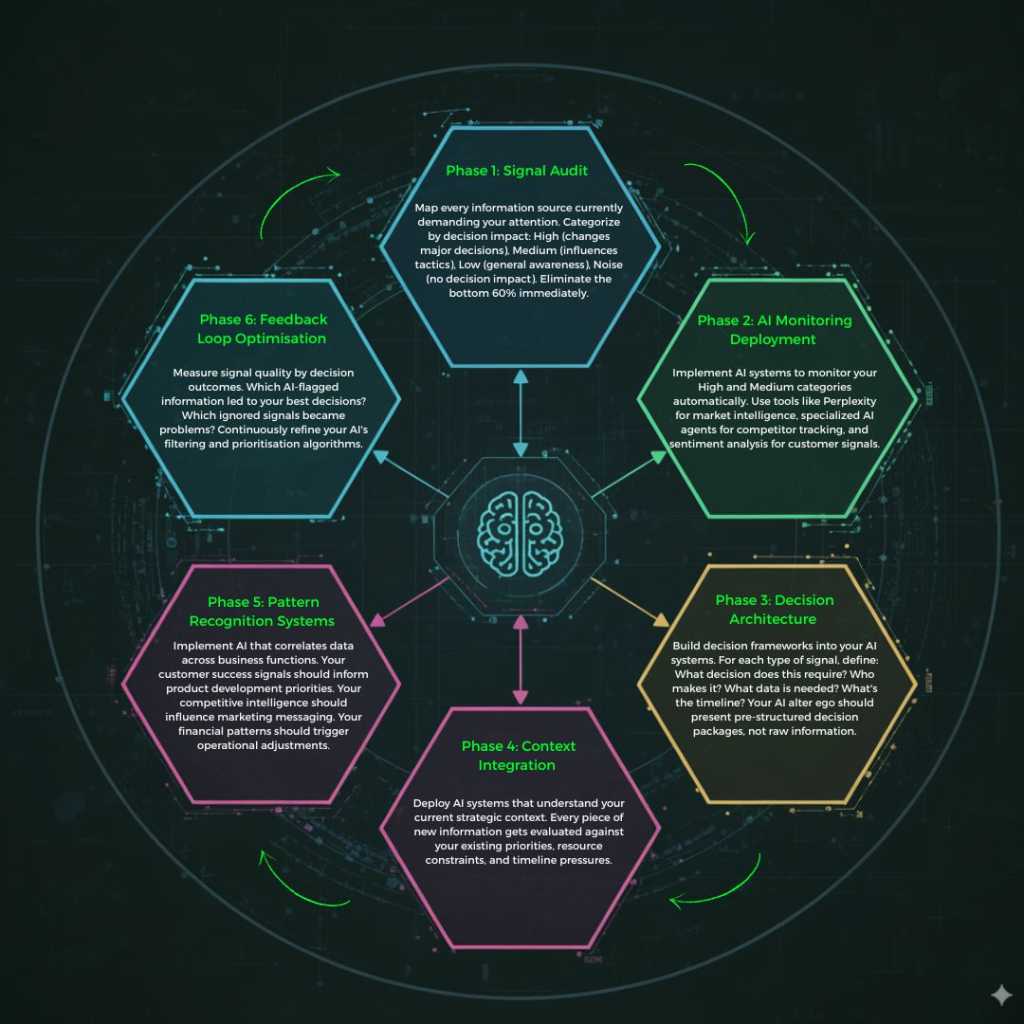
Phase 1: Signal audit
Map every information source currently demanding your attention. Categorize by decision impact: High (changes major decisions), Medium (influences tactics), Low (general awareness), Noise (no decision impact). Eliminate the bottom 60% immediately.
Phase 2: AI-monitoring deployment
Implement AI systems to monitor your High and Medium categories automatically. Use tools like Perplexity for market intelligence, specialized AI agents for competitor tracking and sentiment analysis for customer signals.
Phase 3: Decision architecture
Build decision frameworks into your AI systems. For each type of signal, define: What decision does this require? Who makes it? What data is needed? What’s the timeline? Your AI alter ego should present pre-structured decision packages, not raw information.
Phase 4: Context integration
Deploy AI systems that understand your current strategic context. Every piece of new information gets evaluated against your existing priorities, resource constraints and timeline pressures.
Phase 5: Pattern recognition systems
Implement AI that correlates data across business functions. Your customer success signals should inform product development priorities. Your competitive intelligence should influence marketing messaging. Your financial patterns should trigger operational adjustments.
Phase 6: Feedback loop optimization
Measure signal quality by decision outcomes. Which AI-flagged information led to your best decisions? Which ignored signals became problems? Continuously refine your AI’s filtering and prioritization algorithms.
The AI alter ego advantage: When AI becomes your strategic thinking partner
The entrepreneurs winning the signal-to-noise battle aren’t just using AI tools. They’re building AI alter egos that think strategically about their business.
Your AI alter ego operates with several key advantages:
Zero cognitive load: While you’re focusing on execution, your AI alter ego is constantly processing background information, identifying emerging patterns and flagging decision points before they become urgent.
Perfect memory: Every previous decision, every market signal, every customer interaction becomes part of a unified knowledge base that informs future recommendations.
Emotion-free analysis: Your AI alter ego evaluates information based purely on strategic relevance and decision impact, without the emotional baggage that clouds human judgment.
Scale without compromise: As your business grows, your AI alter ego scales its monitoring and analysis capabilities without requiring additional cognitive bandwidth from you.
The contrarian’s guide: What the productivity gurus won’t tell you
Rebel Technologies
The productivity industry has sold entrepreneurs a lie: that personal optimization is the path to competitive advantage. Morning routines, time-blocking and focus techniques are optimization at the margins.
The real opportunity is cognitive architecture.
While your competitors are trying to focus better, you’re building systems that eliminate the need for manual focus entirely. While they’re optimizing their personal workflows, you’re creating AI-powered intelligence infrastructures that operate 24/7.
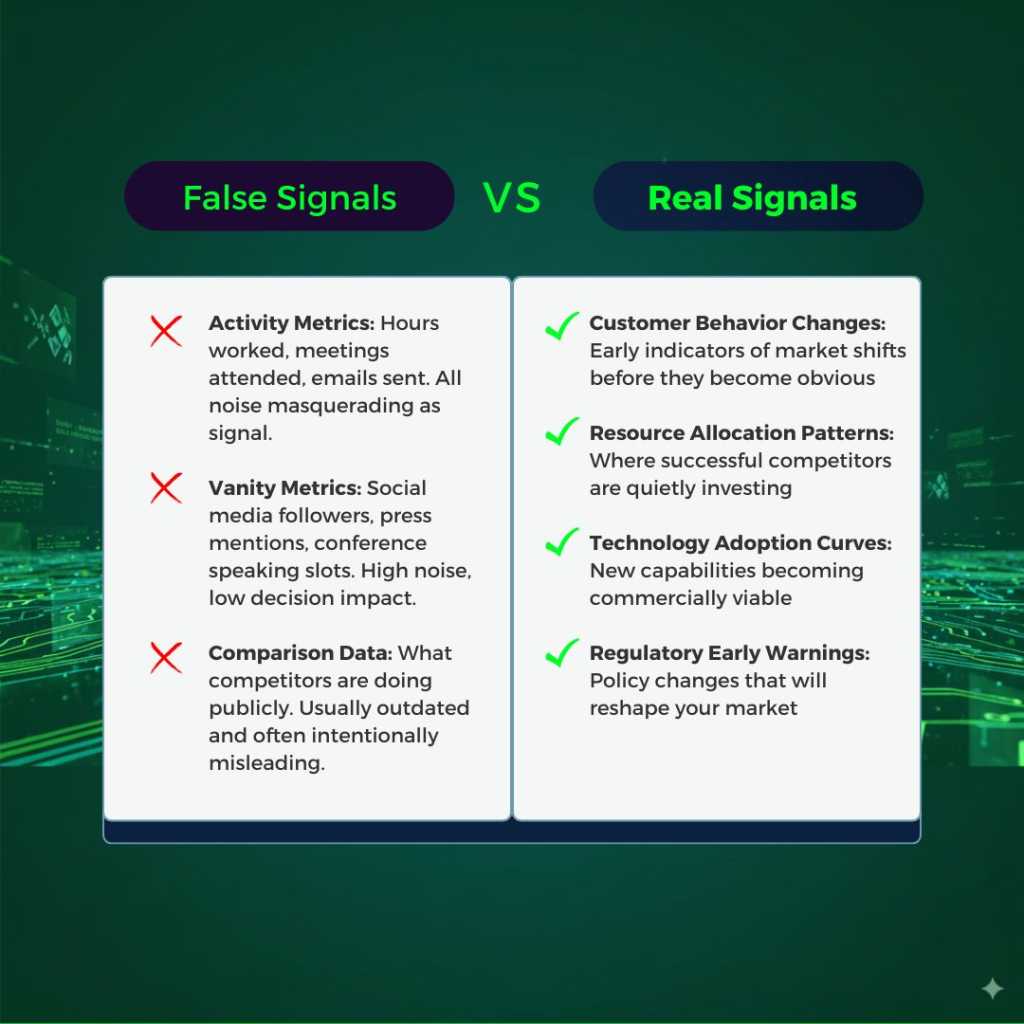
The false signals most entrepreneurs chase:
- Activity metrics: Hours worked, meetings attended, emails sent. All noise masquerading as signal.
- Vanity metrics: Social media followers, press mentions, conference speaking slots. High noise, low decision impact.
- Comparison data: What competitors are doing publicly. Usually outdated and often intentionally misleading.
The real signals your AI alter ego should track:
- Customer behavior changes: Early indicators of market shifts before they become obvious
- Resource allocation patterns: Where successful competitors are quietly investing
- Regulatory early warnings: Policy changes that will reshape your market
- Technology adoption curves: New capabilities becoming commercially viable
The network effect of signal mastery
As O’Leary notes, only a third of people can become successful entrepreneurs, but he’s missing the evolving definition of what that third looks like.
The entrepreneurs who achieve O’Leary’s definition of freedom aren’t just better at focus.
They’ve built cognitive infrastructures that scale intelligence beyond human limitations.
Your AI alter ego doesn’t just make you more productive, it makes you more intelligent. Not smarter in terms of raw IQ, but more intelligent in terms of decision quality under uncertainty with incomplete information.
The future belongs to signal masters
We’re entering an era where information abundance has become a competitive liability for most entrepreneurs and a decisive advantage for those who master the signal-to-noise ratio.
The entrepreneurs who build AI alter egos today will look back on this period as the moment they separated themselves permanently from the competition. Not through harder work or better focus, but through superior cognitive architecture.
Your AI alter ego isn’t just a productivity tool. It’s your upgrade path to You 2.0: a version of yourself that operates with perfect signal clarity, makes decisions with complete context and never wastes cognitive bandwidth on noise.
O’Leary’s insight into signal-to-noise ratios was correct. His timeline was conservative.
In the age of AI, 100% signal isn’t just possible, it’s the minimum viable cognitive architecture for serious entrepreneurs.
The question isn’t whether you can achieve Musk-level signal focus. The question is whether you’ll build the AI alter ego that makes it automatic.
The revolution is cognitive. The advantage is exponential. The window is closing.
Welcome to You 2.0. What’s your signal-to-noise ratio going to be?
This article is published as part of the Foundry Expert Contributor Network.
Want to join?
Read More from This Article: More signal, less noise: How AI alter egos help entrepreneurs succeed
Source: News