

As organizations embrace a cloud- and AI-native future, the pressure to control infrastructure spending while meeting sustainability goals intensifies. As a CTO, I want my investments to go into people—building strong, innovative development teams—rather than overspending on cloud resources that don’t deliver business value.
This is where Dynatrace plays a crucial role: helping organizations optimize cloud costs while advancing sustainability goals and enabling AI innovation. These priorities are no longer at odds; instead, they go hand in hand.
Key insights for executives
- AI innovation and sustainability goals can go hand in hand. As AI workloads surge—projected to exceed 50% of cloud compute by 2028—organizations must balance innovation with cost and environmental impact. Dynatrace enables both by optimizing cloud usage in real time.
- AI-powered observability empowers teams to cut waste, reduce emissions, and align spending with business value. By providing deep insights into idle resources, inefficient architecture, and energy-heavy workloads.
- Dynatrace improves efficiency and supports sustainability goals by dynamically scaling resources based on real-time data demand and business goals.
The true cost of cloud and AI
The rapid spread of AI—including LLMs, agentic AI systems, and coding assistants—and the shift to dynamic, multicloud environments have created yet more layers of complexity. AI workloads are compute-intensive. In fact, one of our customers in the banking sector shared that GenAI tasks cost five times more than traditional cloud workloads. Gartner® predicts that by 2028, more than 50% of cloud compute will be AI-related, up from just 10% in 2023.1
The International Energy Agency – Electricity 2024 report stated that when comparing the average electricity demand of a typical Google search (0.3 Wh of electricity) to OpenAI’s ChatGPT (2.9 Wh per request), and considering 9 billion searches daily, this would require almost 10 TWh of additional electricity in a year. That’s enough to power approximately 3 million households—or all private households in London—with energy for a year.
This growth brings significant environmental and financial implications. Yet, most organizations are beholden to opaque carbon footprint multipliers calculated by the cloud provider, which are often insufficient for actionable insights. Similarly, traditional cost reporting tools lack the depth and runtime visibility needed to drive meaningful optimization.
Dynatrace fills that gap, combining real-time observability, AI-powered insights, and topology-aware mapping to bring deep clarity into both cost and carbon impact.
Four steps to smarter cloud cost and energy management
1. Eliminate waste from idle or underutilized resources
Much of today’s cloud waste stems from overprovisioning and forgotten instances, especially in development and AI workloads. Dynatrace automatically detects underutilized or idle resources across the environments and surfaces insights that can drive decisions whether to shut down or re-size them, reducing both spend and carbon footprint.
Smartscape® automatic discovery and topology mapping adds unique value here, showing not just what’s idle, but whether it’s tied to business-critical processes or genuinely redundant.
2. Align cloud consumption to business value
Executives need more than cost data—they need to understand the why behind consumption. Dynatrace connects cloud utilization directly to applications, users, and business processes, enabling teams to assess whether resources are delivering real business value.
By linking costs to outcomes, organizations can prioritize what to keep, right-size what’s inefficient, and decommission what’s no longer serving a purpose.
3. Optimize architecture and energy efficiency
Most organizations are already taking basic steps like using contracted discount reserved instances or more flexible on-demand spot instances. The next level is architectural and source code optimization, such as green architecture and green coding. Dynatrace helps identify inefficient data flows, underperforming services, and high-cost cross-region transfers.
These insights enable teams to apply green coding techniques, reduce energy-hungry compute patterns, and bring data flows closer to where they’re needed, cutting both cost and carbon emissions.
4. Enable smart, automated orchestration
Finally, Dynatrace has a clear vision to make operations more autonomous. Its predictive, AI-driven orchestration of cloud resources enables teams to automatically scale resources up or down based on real-time demand, user behavior, and business impact.
However, autoscaling based on cloud metrics alone can’t ensure a great user experience or cost efficiency. Dynatrace links infrastructure and deep application observability to user-facing outcomes, allowing for smarter scaling that adapts dynamically to seasonal spikes, new product launches, or unexpected load while eliminating idle time and energy waste.
Accelerating sustainable innovation
Sustainability is now a strategic lever, not just a compliance checkbox. It resonates with environmentally conscious customers and a new generation of employees who want to work for conscientious companies.
By using Dynatrace Cost & Carbon Optimization and full-stack observability, organizations can:
- Gain real-time, fine-grained insights into the energy and carbon impact of workloads
- Make carbon reporting actionable and automatable instead of superficial
- Build a more efficient, resilient, and future-proof cloud environment
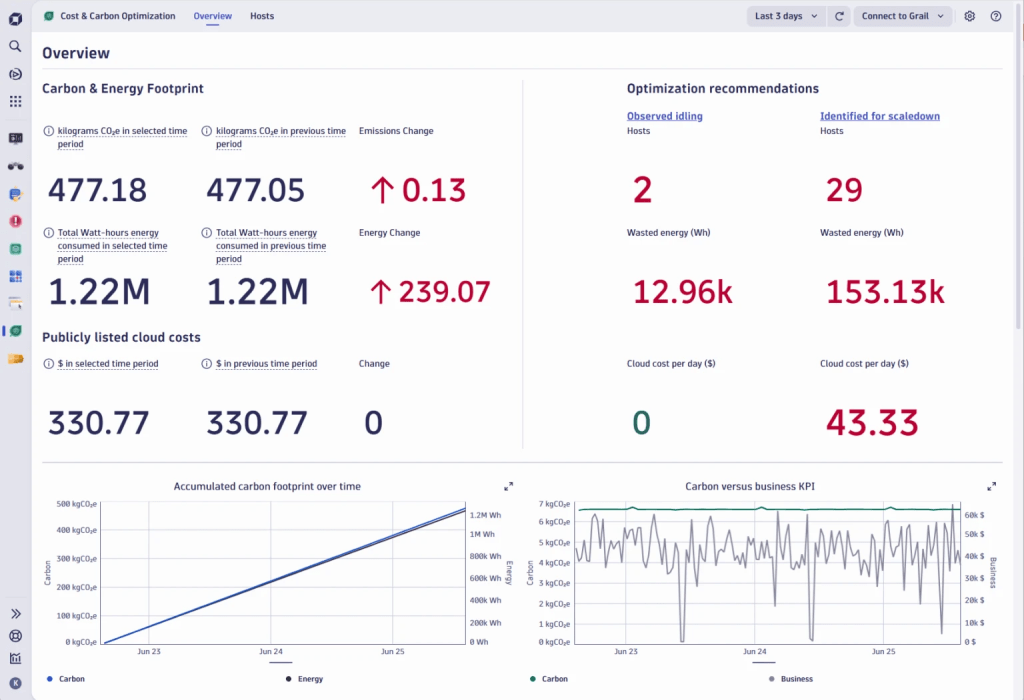
Figure1: Dynatrace Cost & Carbon Impact homepage
Dynatrace
Imagine your cloud-native teams rapidly scaling up environments to test the scalability of new AI features, leading to a 40% spike in compute usage. Without visibility, one wouldn’t notice that this test left over idle or oversized instances, quietly driving up both cloud costs and carbon emissions. Now imagine having real-time insights from Dynatrace that reveal 200 idle instances across non-critical environments, costing thousands monthly and consuming unnecessary energy. Dynatrace AI leverages Smartscape® real-time topology to know automatically which instances can be confidently decommissioned or right-sized—cutting waste, aligning spend to business value, and advancing your sustainability goals.
The bottom line: Intelligent clouds mean a more sustainable planet
Organizations today must move beyond basic FinOps or simple sustainability checklists. The future lies in intelligent, self-optimizing clouds that balance performance, cost, and sustainability in real time.
Dynatrace empowers executives to realize this vision—transforming cloud environments into engines of innovation that are efficient, responsible, and aligned with business and environmental goals.
Want to learn more about all 9 use cases? Visit us here.
Read More from This Article: Maximizing cloud efficiency: Driving cost optimization and sustainability with Dynatrace
Source: News