

A high school teacher had three girls sign up for her computer science class. Three for the whole year. Then a group of ConocoPhillips technologists came in to talk about their careers, and more than 20 students registered. The school had to add a half-day CS teacher to handle them.
That is Girls Talk Tech working exactly as designed. The program was formalized in 2018 by a group of women in the ConocoPhillips IT organization with a plain mission: educate, encourage and empower young women to embrace technology for the future. The gap it addresses is well documented. According to the National Center for Women & IT, women make up 57% of the U. professional workforce and hold only 26% of IT roles, and the disparity widens in engineering and computing.
“It’s really an outreach education program,” says Billy-Joe Lafortune, general manager of Lower 48 Digital Technologies and Global Strategy at ConocoPhillips. “It’s about reaching out to young women in middle school and high school, and it’s about inspiring them and preparing them to consider or pursue a career in technology and STEM.”
Lafortune has been a co-sponsor since 2019, when the team asked her to take the role alongside the CIO at the time. Her day job spans two responsibilities: she is the business unit technology leader for ConocoPhillips’ Lower 48 segment, the largest piece of the portfolio, and she leads global digital strategy, deciding where the investments go and then delivering them. She reached that seat over two decades at the company, through IT leadership roles in the Canadian business unit and corporate functions. In April, the HoustonCIO chapter named her the 2026 Super Global ORBIE recipient, the category reserved for leaders at organizations above $7.5 billion in revenue with multinational operations.
How the program runs
Girls Talk Tech works in three tiers of depth.
School panels are the primary channel and the highest volume. Volunteers visit local schools, share their own career journeys, walk through the STEM pathways a student might take, field questions about college, and bring food and swag.
For a more immersive experience, students are invited to short on-campus events that typically span one or two days and provide hands-on time with real technology, breakout sessions and conversations with practitioners from cybersecurity, software development and other disciplines.
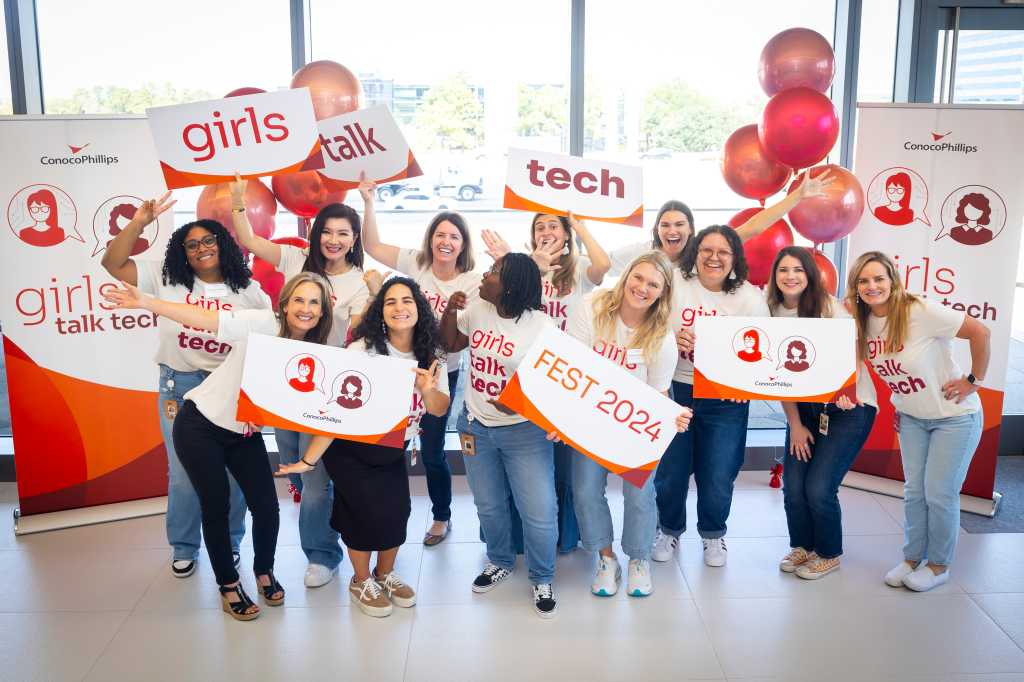
Girls Talk Tech 2024 staff and attendees meet for the first day on Tuesday, October 29, 2024, at Spirit Two at ConocoPhillips headquarters in Houston.
ConocoPhillips
Houston’s GTT Fest, a two-day event, draws close to 200 students. The deepest level of engagement comes through summer programs, where a small cohort of students spend about a week participating in mentorship, real-world projects and a capstone presentation back to the business. All programs are offered at no cost to participants.
Ninth year in, the numbers describe something that found demand rather than manufactured it. More than 7,000 girls reached. Three established affiliate programs in Houston, Bartlesville and Calgary. Pilots running in Midland and Equatorial Guinea. Twenty-plus global committee members and more than 150 volunteers.
“Schools want this, teachers want this, we’re seeing parents want this,” Lafortune says. “There’s this thing that’s drawing people in. And we’re not the only program like this out there. There are a lot of companies and nonprofits doing this, which I think is incredible, and the work has to continue. Clearly the gap still exists.”
She frames the case in pipeline terms rather than charitable ones. “It helps build the pipeline of talent needed for an AI-driven economy,” she says. “It’s making sure we have people equipped with the foundational skills, and that they participate rather than just consume.”
As AI plays an increasingly important role, it can help organizations improve productivity, decision quality and business performance. But the opportunity is not simply to use new tools. It is to help people develop the skills and judgment to apply them thoughtfully. “It’s more important than ever to bring young women on this journey so they can be part of building that future as we go along.”
The full loop
The story Lafortune returns to is Maddie’s. Maddie attended Girls Talk Tech events as a high school student, went on to earn a technology degree, and was hired into a ConocoPhillips rotation program. She is now a cybersecurity analyst at the company and sits on the Girls Talk Tech Houston committee. Her journey illustrates the human side of technology transformation: technical capabilities may continue to evolve, but expertise, mentorship and human judgment remain essential.
“She’s on the other side of the journey now,” Lafortune says. “She’s sharing her perspective, she’s mentoring students and she’s demonstrating what’s possible. For me that really hits home.”
Lafortune’s own role is sponsorship in the working sense of the word: air cover, prioritization and the executive weight that keeps a volunteer organization from drifting. That last piece is harder than it sounds. “It just keeps growing year over year, to the point where if we’re not careful this becomes a full-time job,” she says. “So, we really do have to prioritize how much we can do in a year and still have the impact we’re seeking. And everyone does it because they love it. They love to give back.”
Rationing volunteer capacity across three countries so a program stays effective while demand outruns supply is, functionally, portfolio management. It is the same work she does on the day job, in an arena where nobody has to do what she asks.
What leading something like this does for you
There is a secondary benefit here worth naming, because most technology executives underweight it.
Marketplace eminence is one of the dimensions we assess when we work with leaders on CIO readiness, and it is consistently the one they have thought about least. It is what puts you on a search firm’s short list before a role is posted, what makes a strong candidate return a recruiter’s call, and what earns you the benefit of the doubt in a board conversation.
Most of the ways leaders build it are good ways. Speaking on a panel puts your point of view in front of peers and gets it into circulation. Customer advisory boards, industry forums and analyst relationships all do real work, and the executives with the strongest reputations tend to do plenty of each.
Leading a community program complements those channels. It compounds, because you are there for years. It is genuine operating experience, since a program at this scale means governance, budget, volunteer labor and stakeholders across three countries who do not report to you. And it gives you something specific to say when the panel invitation comes, which is often the difference between an appearance people remember and one they do not.
Lafortune did not take this on as a career move. She took it on because she had seen what early access does. “It’s almost like you’re creating that spark to help people see what is actually possible,” she says. The standing came anyway, which is rather the point.
Call to action
If someone in your industry were asked tomorrow what you are known for beyond your own company, what would they say?
If the answer is thin, find the cause you would show up for even if nobody noticed and take a real leadership position in it. A STEM pipeline program. A workforce reentry initiative. A nonprofit that needs a technology strategy and cannot afford one. The cause matters less than the commitment, because the returns arrive slowly and they arrive as relationships, reputation and operating range you cannot buy or borrow.
Lafortune put it more plainly than I can. “The reality is that the future will be shaped by who shows up,” she says. “Programs like this help ensure who gets into the room, and whose voices are heard.”
That is true of the students. It is also true of the leaders who decide to show up for them.
Read More from This Article: Girls Talk Tech: 7,000 students and the next generation of women tech leaders
Source: News

