

Forward-deployed engineering (FDE), has moved from being a niche delivery model to becoming one of the most important operating patterns for enterprise artificial intelligence. In traditional software programs, organizations could usually separate product engineering, implementation consulting, operations and governance into different teams. Agentic AI changes that separation. An agent does not merely answer a question; it may plan, call tools, read enterprise data, update systems, create artifacts, trigger approvals and continue across several steps. Because of this, production success depends less on a model demo and more on the careful engineering of business context, workflow boundaries, controls, observability and human accountability.
FDE addresses this gap by embedding engineering capability close to the business problem. A forward-deployed engineer works with product teams, domain experts, security teams, platform owners and end users to convert an AI idea into a working, governed, measurable system. The role combines software engineering, data engineering, cloud architecture, model evaluation, security design, user research and operational ownership. In the Agentic AI world, this blend is not optional. It is the difference between a clever prototype and a dependable production workflow.
Why FDE is needed in agentic AI
Agentic AI deployment is rarely a simple matter of selecting a foundation model and connecting it to a user interface. Enterprise agents operate inside business processes that already contain policies, data quality issues, exception paths, audit requirements, identity controls and legacy systems. A sales operations agent, for example, may need to read CRM records, interpret account notes, generate a renewal recommendation, check discount eligibility, route an approval and update the opportunity. Each of those steps introduces risk. The agent must know what it is allowed to do, what it should never do, when it must ask a human and how its decisions can be traced later.
This is where FDE becomes valuable. FDE teams do not treat Agentic AI as a packaged tool to be installed. They treat it as a socio-technical system that must be shaped around a real business workflow. They discover the actual process, map data dependencies, identify integration points, define controls, implement the orchestration, create evaluation suites and help the client team learn how to operate the system after the initial deployment. The forward-deployed model is therefore especially suited to the last mile of AI adoption, where most enterprise AI initiatives struggle. This view is consistent with Gartner’s guidance that enterprise AI agent success depends on proportional governance aligned to autonomy level and scope of access.
The FDE operating model
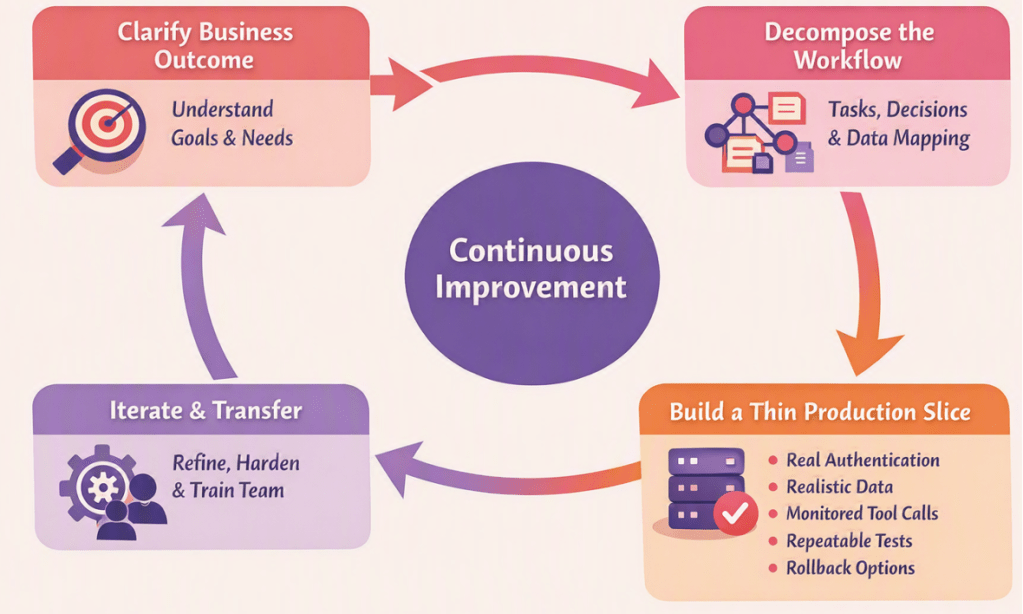
A mature FDE operating model normally follows a compressed but disciplined cycle. The team first clarifies the business outcome rather than accepting the initial solution request at face value. Next, it decomposes the workflow into tasks, decisions, systems, data sources and approval points. It then builds a thin production slice rather than a detached proof of concept. This slice includes real authentication, realistic data, monitored tool calls, repeatable tests and rollback options. Once the system is usable, the FDE team iterates with business users, tunes the agent behavior, improves the prompts or policies, hardens the integration layer and transfers operating knowledge to the internal team.
Magesh Kasthuri
The important distinction is that FDE is not conventional staff augmentation. It is also not advisory consulting that ends with a roadmap. FDE is outcome-oriented engineering in the field. The engineer is close enough to the customer environment to see real constraints, yet technical enough to change the system directly. In Agentic AI, that proximity matters because small details can decide whether a workflow is trusted: a missing approval step, an overly broad tool permission, an unlogged data access, a weak retry policy or an untested edge case can undermine the entire deployment. Forrester similarly positions agentic AI as a competitive frontier that requires leaders to redesign workflows, governance and engagement models rather than simply automate existing tasks.
Operationalizing multi-step agentic workflows
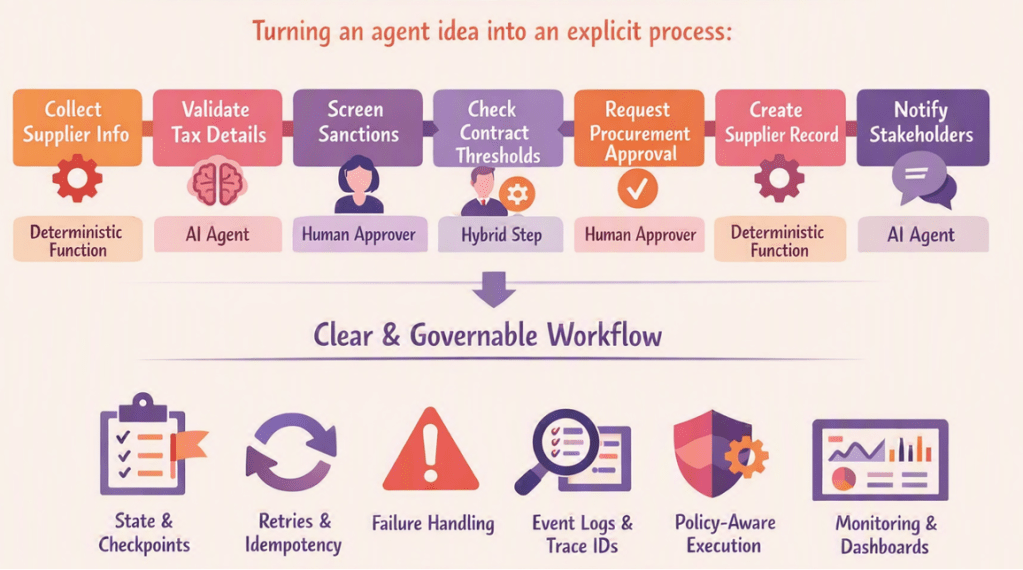
Operationalization begins by turning an agent idea into an explicit workflow. Instead of saying, “build an agent that handles vendor onboarding,” an FDE team defines the stages: collect supplier information, validate tax details, screen sanctions lists, check contract thresholds, request procurement approval, create a supplier record and notify stakeholders. Each stage is assigned to a deterministic function, an AI agent, a human approver or a hybrid step. This decomposition reduces ambiguity and makes it easier to govern the process.
Magesh Kasthuri
In production, an FDE must design for state, retries, failures, idempotency and observability. Agentic workflows may run for minutes, hours or days. They may wait for an external API, pause for approval, recover from a system outage or resume after a user changes input. A robust implementation therefore needs checkpoints, durable state, structured event logs, trace IDs, policy-aware tool execution and dashboards that show where the workflow is stuck. Without these engineering controls, an agent may appear intelligent in a demo but become fragile in live operations. IDC’s perspective on agent adoption also highlights that the scale of enterprise agents will create major demands around orchestration, token efficiency, governance and cost containment.
Governing agentic AI through FDE
Governance in Agentic AI cannot be added as a final compliance checklist. It must be embedded into the workflow design. FDE teams help by translating policy into executable controls. For example, they can define which tools an agent may call, which data classes it can access, what confidence thresholds require escalation, which outputs need review and how exceptions are recorded. They also help establish evaluation datasets that reflect real operating scenarios rather than sanitized prompts.
A practical governance model usually contains five layers. The first is intent governance, which verifies that the agent is solving an approved business problem. The second is data governance, which controls source quality, access, retention and lineage. The third is tool governance, which restricts actions such as writing to systems, sending emails, executing code or changing financial records. The fourth is decision governance, which determines where humans must approve or override agent recommendations. The fifth is runtime governance, which monitors drift, failure patterns, cost, latency and policy violations. Gartner’s 2026 guidance on AI agent governance reinforces this need for differentiated controls, warning that uniform governance across all agents can create both over-restriction and under-restriction risks.
Securing agentic AI workflows
Security for Agentic AI is broader than prompt safety. Agents can act and every action surface must be secured. FDE teams typically implement least-privilege access, scoped credentials, tool allowlists, secrets isolation, input validation, output filtering, data loss prevention checks and protected execution environments. They also design approval gates for high-impact operations. A procurement agent may be allowed to draft a purchase order, but it should not submit the order above a threshold without explicit authorization.
Another important responsibility is defending against indirect prompt injection and tool misuse. If an agent reads an email, document, ticket or web page, that content may contain instructions that attempt to override the system policy. FDE engineers reduce this risk by separating instructions from data, sanitizing retrieved content, validating tool arguments, limiting write permissions and logging every external action. In regulated environments, they also design audit trails that show not only the final answer but the path the agent took to reach it. Forrester’s AEGIS framework similarly argues that agentic AI security must move beyond traditional infrastructure-centric controls toward intent-aware guardrails, observability, accountability and least-agency principles.
FDE and vibe coding: Relationship and tension
Vibe coding refers to a style of AI-assisted software development where a person expresses intent in natural language and an AI system generates much of the code. It can be extremely useful for prototyping, exploration, internal tools and rapid experimentation. In the context of FDE, vibe coding can accelerate the early build cycle because forward deployed engineers can quickly sketch integrations, generate boilerplate, create test harnesses and explore workflow alternatives with AI coding assistants.
However, FDE also provides the discipline that vibe coding alone lacks. An enterprise agent cannot rely on generated code that nobody has reviewed, tested or secured. The FDE approach turns intent-driven development into responsible engineering. The engineer may use AI to generate code, but then verifies it through code review, unit tests, integration tests, security checks, policy validation and operational monitoring. In short, vibe coding helps move faster; FDE ensures that speed does not come at the cost of reliability, maintainability or accountability. This aligns with Forrester’s caution that agentic systems can become harmful when they are misaligned, poorly governed or deployed without adequate experimentation and control.
Example: LangGraph with FDE orchestration
LangGraph is well suited for FDE-led Agentic AI implementations because it models workflows as graphs with state, nodes, edges, persistence and human-in-the-loop control. An FDE team can use it to build long-running, auditable workflows where every step is explicit. Consider a customer support escalation workflow. The graph may begin with ticket intake, move to classification, retrieve policy documents, ask a diagnostic agent to propose a resolution, route uncertain cases to a human reviewer and finally update the ticketing system.
In this model, the FDE defines the state schema, selects which nodes use LLM reasoning, separates deterministic validation from agentic reasoning and adds checkpoints so the workflow can resume after interruption. Human review is not an afterthought; it becomes a graph transition. If the confidence score is low or a policy exception appears, the workflow pauses for approval. This is an example of FDE orchestration: the framework supplies the runtime primitives, while the forward-deployed engineer shapes those primitives into a secure business process.
A simplified LangGraph-style pattern may include nodes such as intake_agent, retrieval_node, policy_checker, resolution_agent, human_approval and ticket_update. The FDE ensures that ticket_update can only run after validation and that sensitive customer data is masked before being sent to the model. The result is not merely an autonomous assistant; it is a controlled workflow that can be inspected, resumed, tested and improved.
Example: Microsoft AutoGen and Microsoft Agent Framework with FDE orchestration
Microsoft AutoGen popularized the idea of multi-agent conversations where agents with different roles collaborate to solve a task. In newer enterprise settings, Microsoft Agent Framework provides production-oriented patterns for agents and workflows, including sequential, concurrent, handoff, group chat and manager-led orchestration. An FDE can use these patterns to design a governed multi-agent system rather than a free-form conversation among bots.
For example, imagine an enterprise architecture review assistant. One agent reads the solution brief, another checks cloud security requirements, a third evaluates cost and FinOps implications and a fourth prepares a decision summary. A manager or orchestrator coordinates the agents, decides when to ask for missing information and routes the final recommendation to an architect for approval. The FDE defines agent roles, tool permissions, routing logic, approval-required actions and telemetry. If the security agent recommends a design exception, the workflow can pause until an authorized reviewer approves it.
In this case, FDE orchestration prevents the system from becoming an uncontrolled debate among agents. It introduces structure: which agent speaks when, which tools each agent may use, which outputs must be machine-readable and what evidence is required before a recommendation is accepted. This is especially important in Microsoft-centric enterprises where identity, audit, data boundaries and cloud governance must align with existing platforms.
Example: CrewAI with FDE orchestration
CrewAI is useful when the solution naturally maps to a team of role-based agents. It supports crews, tasks, processes, tools, memory and flows. An FDE team can use CrewAI to model collaborative work where specialized agents perform defined responsibilities. Consider a market intelligence workflow for a product team. A research agent gathers public signals, a competitor analyst compares positioning, a financial analyst estimates market impact and an editor agent prepares the final brief.
The FDE’s role is to make this collaboration production-ready. The engineer defines task boundaries, expected outputs, data sources, tool limits, escalation rules and quality checks. If the market intelligence brief is used for executive decision-making, the FDE may require citations, confidence notes, evidence tables and human approval before publication. CrewAI Flows can then be used to orchestrate event-driven execution, manage shared state and resume longer workflows where human feedback or external triggers are involved.
A practical CrewAI FDE pattern is to separate creative agent work from controlled workflow steps. Agents may draft, analyze and summarize, but deterministic validators check schema, sensitive content, data completeness and approval status. This hybrid design gives the enterprise the benefit of agent collaboration without surrendering control of the process.
Reference architecture for FDE-led agentic AI
A typical FDE-led Agentic AI architecture includes six layers. The experience layer contains chat, workflow, API or embedded user interfaces. The orchestration layer manages graphs, crews, workflows, handoffs, retries, checkpoints and human approvals. The agent layer contains specialized agents with defined roles, instructions, memory and tool access. The tool and integration layer connects to enterprise systems such as CRM, ERP, ticketing, document repositories, email, messaging, databases and APIs. The governance and security layer enforces identity, policy, secrets, monitoring, evaluation, logging and audit controls. The operations layer provides deployment automation, dashboards, incident handling, cost tracking and continuous improvement. Everest Group’s 2025 AI and Generative AI Services PEAK Matrix also notes that enterprises are moving beyond pilots toward production-grade AI initiatives, with emphasis on scalable architectures, responsible AI, security, compliance and outcome-based partnerships.
The FDE connects these layers into one operating system for AI adoption. The value is not only in the code. It is in the ability to make the code work inside the customer’s real environment, with the customer’s data, controls, users and accountability model.
Best practices for FDE in agentic AI programs
- Start with a business workflow, not with a model capability.
- Define measurable outcomes such as cycle time reduction, error reduction, risk reduction or user productivity improvement.
- Use explicit orchestration for multi-step processes rather than relying on open-ended agent behavior.
- Separate deterministic logic from probabilistic reasoning wherever possible.
- Apply least-privilege access to every agent, tool, connector and data source.
- Build human-in-the-loop controls for high-risk, low-confidence or irreversible actions.
- Create evaluation suites using real examples, edge cases, policy scenarios and adversarial prompts.
- Instrument every workflow with traces, logs, metrics, cost visibility and audit records.
- Use AI-assisted coding to accelerate delivery, but review, test and secure generated code before release.
- Design for transfer of ownership so the client team can operate and extend the system after deployment.
Conclusion
Forward-deployed engineering is becoming central to the Agentic AI era because it solves the problem that models alone cannot solve: making AI work safely, reliably and measurably inside real organizations. Agentic systems introduce autonomy, but autonomy without orchestration becomes risk. They introduce speed, but speed without governance becomes fragility. They introduce new coding possibilities, but AI-generated code without engineering ownership becomes technical debt.
FDE provides the missing bridge. It brings engineering to the field, policy into the runtime, security into the workflow and operational discipline into agent design. Whether the implementation uses LangGraph, Microsoft AutoGen, Microsoft Agent Framework, CrewAI or another orchestration stack, the core principle remains the same: enterprise Agentic AI must be co-designed with the business, governed by architecture, secured by default and operated as a living system. That is the practical promise of forward-deployed engineering. Everest Group’s Innovation Watch on Agentic AI Products further reinforces this direction by describing agentic AI as the next stage of automation, where autonomy, adaptability and decision-making are embedded into systems to improve efficiency and responsiveness.
This article was made possible by our partnership with the IASA Chief Architect Forum. The CAF’s purpose is to test, challenge and support the art and science of Business Technology Architecture and its evolution over time as well as grow the influence and leadership of chief architects both inside and outside the profession. The CAF is a leadership community of the IASA, the leading non-profit professional association for business technology architects.
This article is published as part of the Foundry Expert Contributor Network.
Want to join?
Read More from This Article: Forward-deployed engineering in the age of agentic AI: From vibe coding to governed autonomy
Source: News