

Enterprises are moving to the cloud faster than they have in years. Nearly three-quarters (74%) of IT decision-makers say their organizations sped up cloud migration over the past 12 months, according to Foundry’s 2026 Cloud Computing Study.
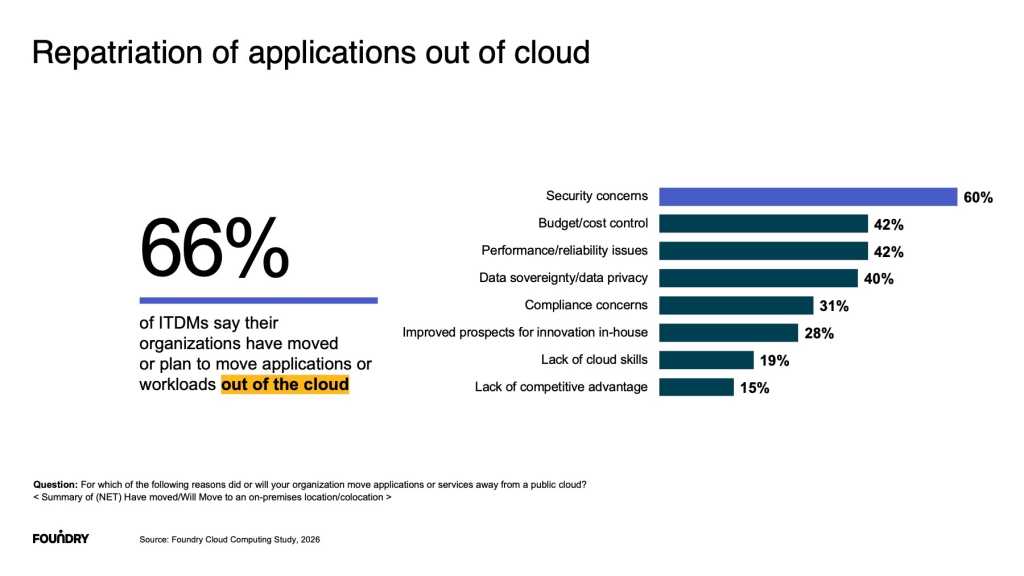
Yet a growing number are also bringing some workloads back in-house. About two-thirds (66%) say their organizations have moved or plan to move workloads out of public cloud.
“Repatriation is one part of a wider rethink of where workloads belong,” says Mukesh Ranjan, vice president at Everest Group, a research and advisory firm.
AI workloads are part of the calculus. They’re leaving public cloud nearly as often as storage and databases, and just 13% of IT decision-makers plan to run AI primarily there, according to Foundry’s research. For CIOs, that means deciding workload by workload where each one belongs, with AI adding new factors to weigh, from GPU costs to where models run and where prompts are processed.
Foundry
Selective moves
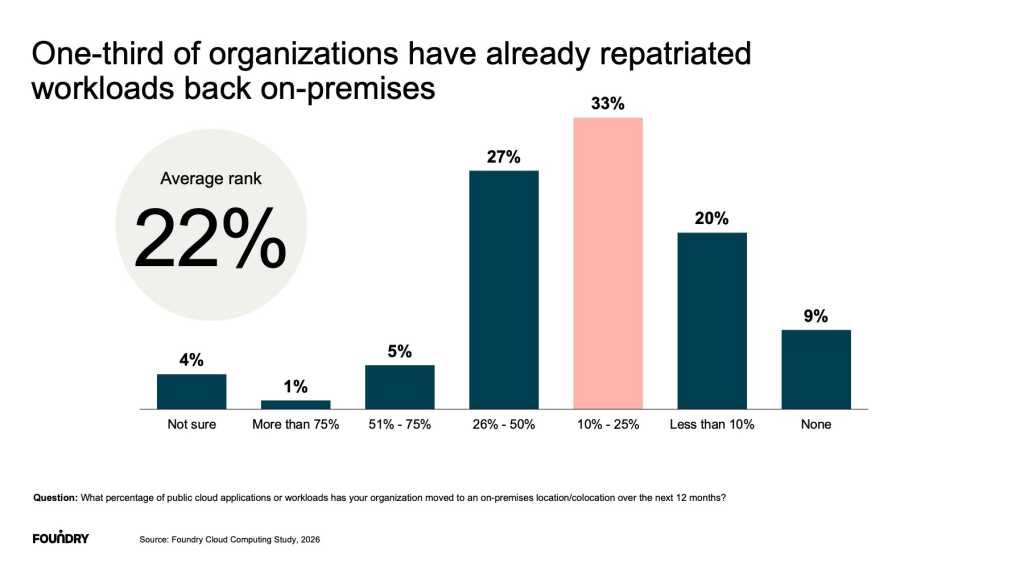
Foundry’s numbers don’t suggest a mass exodus, however. On average, organizations have moved 22% of their workloads back from public cloud and plan to move another 24% in the next 12 months. One-third of organizations have moved at least a quarter of their workloads back on-premises, down from 37% in 2024.
Many organizations moving workloads out of public cloud may be pulling back only two or three, Ranjan says. They’re certainly not rejecting the public cloud outright.
For global consulting firm Protiviti’s clients, “cloud first” remains the default, says Randy Armknecht, managing director there. “Repatriation is still the exception, driven by a thorough analysis of business value and technical capability,” he says.
Where AI fits in
Security concerns top the reasons organizations give for moving workloads out of public cloud (60%), followed by cost and performance (42% each) and sovereignty (40%), according to the Foundry survey. “Outside manufacturing, AI is a passenger on the repatriation trend driven by cost and security, not driving it directly,” says Armknecht of Protiviti. Ranjan of Everest Group sees AI driving some repatriation, but not most of it.
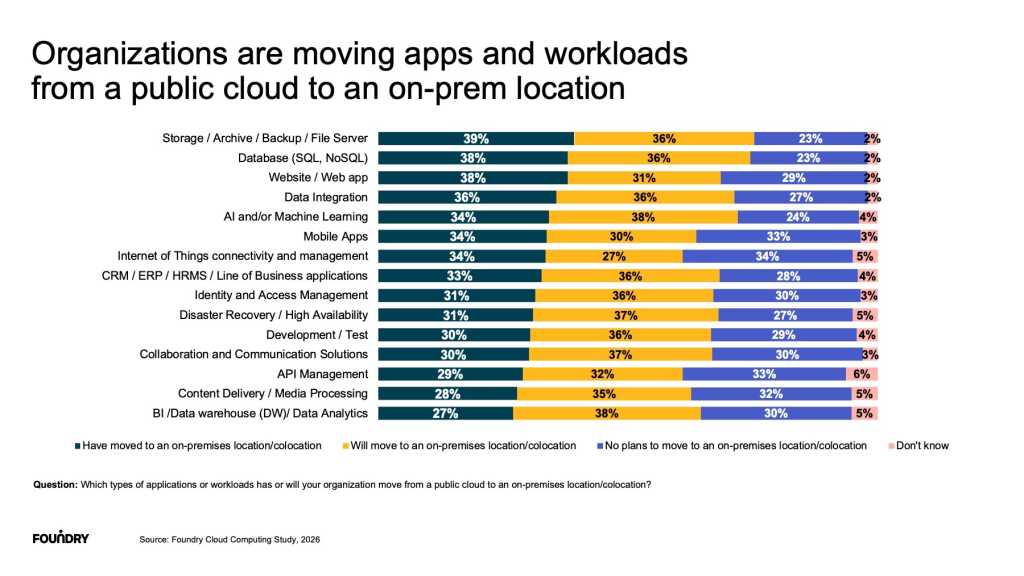
Even so, AI workloads are among those most often homeward bound. Foundry found that 34% of organizations have already moved AI or ML workloads out of public cloud and another 38% plan to.
Many of those workloads are business systems with AI built in. “Roughly half of what I’ve seen has ‘an AI component,’ and very few are pure ‘AI systems,’” Armknecht says.
Manufacturing is the exception. Many of Protiviti’s industrial clients have embraced AI at the edge to improve efficiency and reduce error rates, Armknecht says, and several tested their models in the cloud before moving them onto local hardware.
Sovereignty concerns have intensified over the past year, especially in Europe. “A year ago, sovereignty was still often discussed as data residency or a compliance checkbox. Today, particularly in Germany and the EU, customers are asking much broader questions: who operates the service, where the dependencies sit, which law applies, and whether critical processes can continue if a major service is unavailable,” says Uwe Geuss, CTO of Retarus, a German provider of enterprise communications services.
AI adds another layer to those questions. “AI makes the sovereignty question more important because it introduces another layer of dependency: not just where data is stored, but where models run, who operates the inference environment, where prompts and documents are processed, and whether sensitive data is being sent into an external AI platform,” Geuss says.
Data control comes first at Framestore, a visual effects and creative studio, followed closely by cost, says Lincoln Wallen, its CTO. The studio builds its own models and fine-tunes open-weight ones, running them on its own infrastructure or through infrastructure-as-a-service providers and tapping major cloud providers for extra capacity. That way, it can adopt new models without rebuilding its systems each time.
Foundry
Sizing up the costs
Whether owning infrastructure costs less than renting it depends largely on how steadily a workload runs. High-volume inference can favor private infrastructure when utilization is high, whereas intermittent demand can make public cloud the better deal, says Ranjan of Everest Group.
“Predictable usage is what makes local hardware pay off, and the need for predictability in spend is another driver for local versus cloud-based AI,” says Armknecht of Protiviti.
Mistakes can prove more expensive on-premises, too. “In the cloud, a sizing mistake costs you a month; on-prem, you live with it for the depreciation cycle,” he adds.
Paying an outside AI service for every interaction can also cost more than running models in-house, Framestore’s Wallen adds. But “public cloud still has an important role,” he says, “especially when businesses need additional capacity or access to specialized capabilities.”
Also at play: cloud savings that didn’t materialize. Idle resources, hard-to-calculate exit fees, and applications lifted and shifted without being adapted to cloud-native capabilities can all erode the expected savings, says Retarus’ Geuss.
“Selective correction of earlier cloud decisions” are among the drivers of repatriation, Ranjan of Everest Group says.
Foundry
Where the pull is strongest
Repatriation makes the most sense where sensitive data, predictable demand, and scale converge, Ranjan says, pointing to banking, healthcare, government, and some industrial workloads as likely candidates. Larger enterprises can more easily absorb the cost of dedicated infrastructure, he adds, though smaller organizations may reach similar outcomes through managed private cloud.
What pushes a company to move workloads varies by industry. Among Protiviti’s clients, defense contractors focus on keeping data on hardware they control, whereas manufacturers want fewer points of failure, which means cutting third-party connections, Armknecht says.
The model question
Many of the most capable AI models are available only as cloud services, because their makers don’t release them to run elsewhere. Open-weight models that are closing in on frontier models are what make AI repatriation practical, according to Armknecht. Framestore, for one, already fine-tunes open-weight models on its own infrastructure.
Fast-improving models can also undercut the case for owning the stack. Tricentis, a software testing company, runs its generative AI workloads on major cloud platforms and keeps only small classification models, such as vision models, on its own hardware.
“Maintaining this infrastructure in production only makes sense for small LLMs that you can assign specific tasks,” says David Colwell, vice president of AI and machine learning at Tricentis. GPUs are scarce and expensive, he says, and at the current pace of improvement, the next general-purpose model from an AI provider would quickly outperform any model Tricentis customized itself. The company keeps its datasets current so it can revisit that choice if base model progress levels off.
Trust is also a factor in which providers Tricentis buys AI from. The company goes through the large cloud providers instead of the AI labs directly, because the cloud providers have long track records protecting Tricentis’s data. “The frontier AI labs are still building that reputation,” Colwell says.
What comes next
Don’t expect a stampede off the public cloud. Protiviti’s Armknecht expects repatriation to continue “at a measured and business-value-driven pace, not a rush or hot trend.”
Workload placement decisions are likely to grow more deliberate across public, private, sovereign, and edge environments, according to Ranjan of Everest Group, with some AI workloads moving back and others starting outside public cloud altogether. “The challenge for CIOs will be maintaining consistent governance and economics across that estate,” he says.
“Many of today’s AI services are excellent at demonstrating what’s possible, but the cost of relying on them for every task could become difficult to sustain as adoption grows,” he says.
CIOs should plan for the day AI is part of nearly every business process, Framestore’s Wallen says, and weigh what it will cost to keep paying outside providers for it. “Many of today’s AI services are excellent at demonstrating what’s possible, but the cost of relying on them for every task could become difficult to sustain as adoption grows,” he says.
IT leaders considering repatriation should check out Networkworld’s deeper look at the challenges and choices: “You’ve decided to repatriate cloud workloads. Now what?”
Read More from This Article: Cloud repatriation is on the rise — but tricky questions remain
Source: News