

Artificial intelligence has been part of semiconductor design for years, helping engineers optimize chip architectures for performance, power efficiency, silicon area and faster development. More recently, the industry has begun integrating large language models and AI agents into established electronic design automation (EDA) workflows. Now Cadence Design Systems is taking that approach further with its Maestro AI Model Portfolio, a collection of domain-specialized models designed to work with the company’s engineering software and AI Super Agents.
Maestro combines specialized model training, reinforcement learning and established EDA tools to improve how AI agents execute engineering tasks and evaluate results. Cadence claims better design outcomes with greater token efficiency versus general-purpose foundation models. While initially focused on chip and electronic system design, I also see broader implications for enterprise AI economics, proprietary data protection and deployment across complex engineering and business applications.
AI builds on established engineering software
Modern semiconductor design is enormously complex. Engineers must balance performance, power consumption, silicon area, manufacturing constraints and costs across chips containing billions of transistors. Cadence and chief competitor Synopsys have spent decades developing software to optimize for these challenges, and both are now incorporating AI agents capable of executing increasingly complex engineering workflows using those tools.
Cadence Design Systems, Inc.
“Revolutionizing complex engineering tasks requires deep domain-specialized intelligence,” notes Cadence president and CEO Anirudh Devgan in the company’s announcement. In my discussions with Cadence executives, we explored how Maestro builds on that approach to improve engineering workflows and design outcomes.
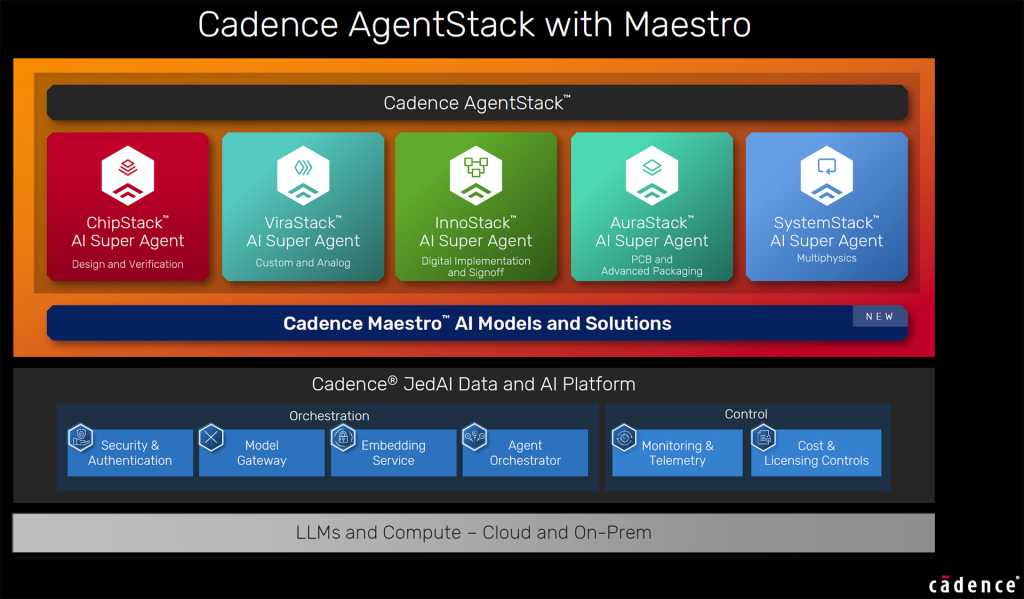
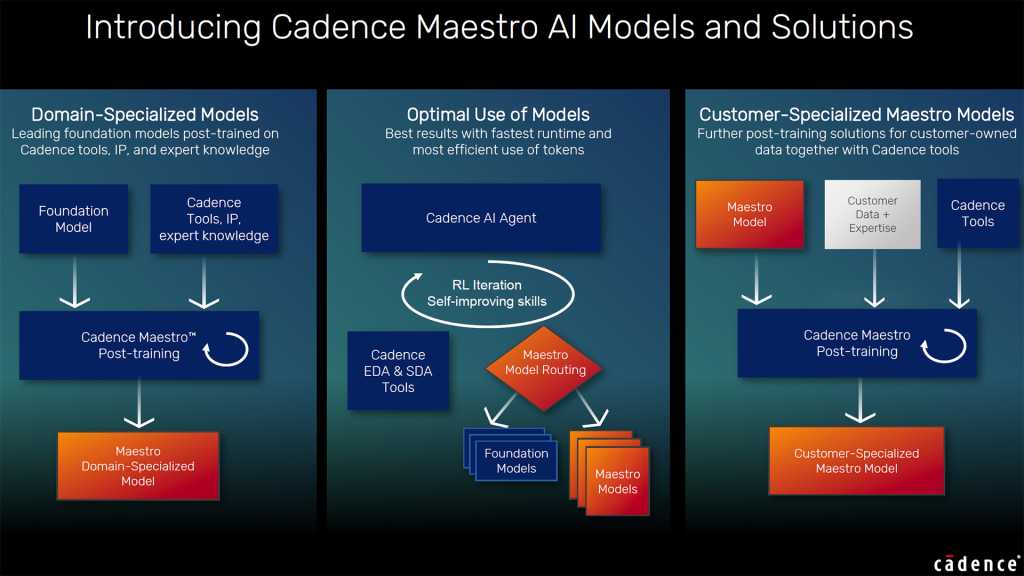
Cadence Maestro combines domain-specialized, post-trained language models, trained decision models and reusable agent skills with Cadence’s EDA and system design automation (SDA) tools. The portfolio supports ChipStack, InnoStack, ViraStack and AuraStack AI Super Agents, which interpret engineering objectives, break them into tasks and engage appropriate models and software tools. Rather than relying on a single model, agents can combine Maestro with commercial frontier and open-weight models according to workload requirements.
What I find particularly interesting is Cadence’s reinforcement learning architecture. EDA tools, evaluation frameworks and deterministic solvers assess AI-generated outputs against engineering constraints, including timing, power and physical design requirements. That feedback can improve subsequent model decisions and agent behavior. It’s a potentially important advantage over relying exclusively on general-purpose LLMs, since engineering results can be evaluated against measurable design constraints rather than language-based assessments alone.
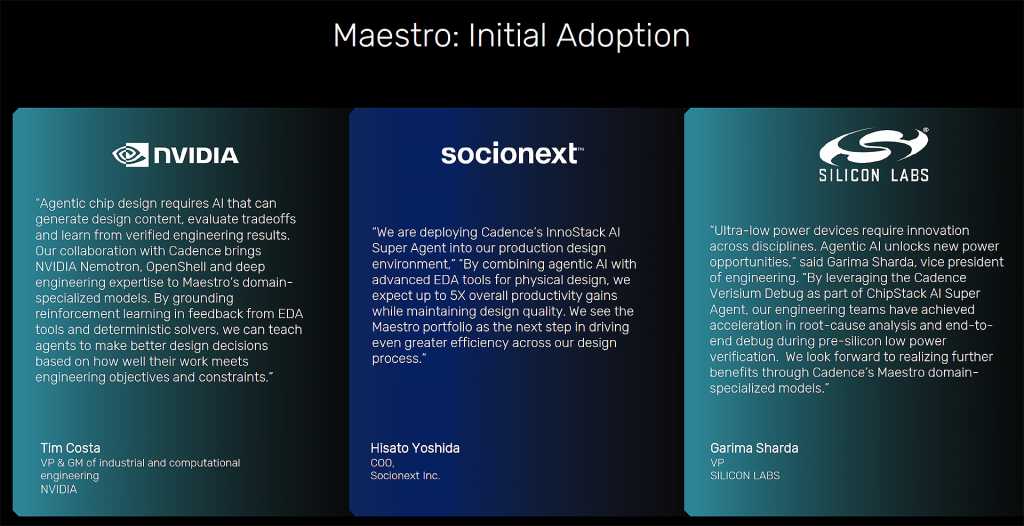
NVIDIA is contributing its Nemotron model technology and collaborating with Cadence on agent security through its OpenShell AI sandboxing architecture, with integration work by both companies underway.
The business case for domain-trained AI in engineering
Cadence Design Systems, Inc.
Cadence reports that initial Maestro evaluations delivered up to 30% better quality of results and five times greater token efficiency, compared to a general-purpose foundation model. These are early vendor-reported results, however, and Cadence hasn’t disclosed enough benchmark detail to establish how consistently those advantages translate across production workloads.
Greater token efficiency is always a goal of course, particularly for AI agents executing lengthy, iterative engineering tasks. But reducing token consumption doesn’t always translate into proportional cost reductions. Engineering software, simulation infrastructure, verification and available compute resources also contribute substantially to development costs.
To me, the larger opportunity is improving design quality and shortening development cycles. Chip development programs can require hundreds of engineers and substantial capital investment, so even modest productivity improvements or faster time to market can offer significant value.
Cadence Design Systems, Inc.
Cadence customer Socionext expects up to fivefold productivity gains from deploying the company’s InnoStack AI Super Agent in production, although that’s a projection rather than a demonstrated Maestro result. Silicon Labs has also reported faster root-cause analysis and debugging using Cadence’s ChipStack technology. These examples show progress with agent-based engineering, but Maestro’s performance claims still need production validation. I’ll be interested to see how those results develop.
Deployment flexibility and data control
Another noteworthy aspect of Maestro is deployment flexibility. Cadence says its agentic engineering environment supports deployment through its own secure cloud platform, supported public clouds or customer-controlled on-prem infrastructure. Customers can also further train supported models using proprietary engineering data.
For semiconductor companies, where intellectual property can represent billions of dollars in investment, maintaining control over sensitive design information is critical. Similar considerations apply in financial services, healthcare and aerospace, where proprietary data and regulatory requirements can complicate AI deployment.
The tradeoffs warrant examination, however. On-prem deployments can shift responsibility for GPU infrastructure, model updates, security controls and optimization to the customer. Those costs need to be weighed against cloud inference expenses, data residency requirements and the potential performance benefits of processing data close to engineering workloads. In my view, Cadence’s deployment flexibility is valuable because enterprises can evaluate these choices against their infrastructure, security policies and engineering economics.
Specialized AI continues to gain momentum in chip design
Cadence Maestro is part of a broader industry push toward AI-driven semiconductor engineering. Established EDA vendors are expanding their agentic capabilities, while AI-native startups are developing systems for RTL generation, verification, debugging and physical design optimization. Domain-trained models, engineering feedback loops and intelligent model routing are also gaining attention.
What’s interesting here is the potential for agents to coordinate multiple engineering tools and models while retaining the design context needed for complex tasks. The business opportunity extends beyond automating individual steps to reducing the effort required to reach verified design results. For enterprise technology execs, that puts greater emphasis on toolchain integration, measurable productivity improvements and the economics of AI-assisted engineering.
Proving the value of specialized AI in chip design
Cadence’s first Maestro models are entering select customer early access in the fourth quarter of 2026, so it’s too early to know whether the company’s performance claims will translate consistently into production.
General-purpose models will remain important for broad reasoning, language and multimodal applications. However, specialized engineering processes often demand deeper domain knowledge, validated results and tight integration with existing software.
From my perspective, Cadence’s approach offers a glimpse of where enterprise AI is heading. Selecting the right models, tools and deployment architecture for specific workloads will be critical as adoption expands. And the early results are promising, with specialized AI showing the potential to improve engineering outcomes, boost productivity and reduce development costs at scale.
Read More from This Article: Cadence Maestro puts domain-trained AI agents to work for chip design
Source: News

