

Speed-to-market dominates enterprise AI priorities in 2026. Beyond upfront resourcing costs of prioritizing speed, organizations face a more insidious risk: the compounding cost of ungoverned AI.
In November 2019, a tech entrepreneur signing up for the newly launched Apple Card publicly complained that he received a credit limit 20 times higher than his wife’s, despite joint tax filings and her higher credit score. Steve Wozniak had a similar experience: a limit 10 times higher than his wife’s. Retrospectively, these revelations were the canary in the coal mine.
In the years that followed, Apple and its credit partner, Goldman Sachs, drew legal and regulatory scrutiny over gender bias and consumer protection issues. The CFPB’s 2024 order documented that Apple had forced Goldman Sachs to accelerate deployment by attaching a $25 million penalty to every 90-day launch delay.
Prioritizing launch speed — ship first, address problems later — over building a functioning disputes process created years of cascading failures. Apple and Goldman Sachs were ordered to pay $89 million in penalties and consumer redress. Prohibited from launching another credit card until it could demonstrate a credible plan to comply with the law, Goldman Sachs lost money on Apple Card for years and ultimately sold its consumer credit line. The legal and compliance penalties were only a fraction of the total costs.
If a deterministic underwriting system can create liability at this scale, the risks posed by agentic AI are substantially greater: autonomous systems can multiply and scale errors, quietly and invisibly, at machine speed.
The accelerated cost of ungoverned speed
In software engineering, shortcuts taken to ship are called “technical debt.” When teams sacrifice robust architecture, processes or solutions to reach deadlines, interest accrues in the codebase as brittle integrations and expensive refactoring. When it comes to agentic AI, technical debt accrues faster. AI portfolio returns are estimated to drop by 18% to 29% when technical debt is ignored.
Similar to technical debt, AI governance debt accumulates when speed-to-market routinely takes precedence. Unlike technical debt, which can wait silently in a repository without immediate consequence, governance debt is neither patient nor pausable. Deployed without clear authorizations, boundaries, or constraints, AI systems scale defects across an enterprise at machine speed.
The agentic multiplier: Scaling decisions and outcomes
When a standard LLM produces an output, a person receives it and decides what to do with it. That pause is a crucial point of control: a “human gate” stands between the generative AI model and the consequence. AI agents operate in continuous, (semi-)autonomous loops, without any gate friction. With agents, a model error can cascade downstream unimpeded through enterprise systems. Multi-agent systems inadequately governed have error rates of nearly 20%. Generative AI scales outputs, and agentic AI scales outcomes. Put another way, agentic AI scales outcome-producing actions, and every autonomous action carries a decision that a human used to make.
AI governance is often mischaracterized as “putting the brakes on” speed-to-market. In practice, omitting it causes “velocity decay.” While 54% of leaders consider governance to be an obstacle to scaling, its absence or inadequacy creates sociotechnical bottlenecks that ultimately stall deployment and operations. To prevent both velocity decay and governance debt, governance must “shift left” to be architected throughout the AI system lifecycle.
Accountability reduces the debt
Technical accountability within an autonomous system cannot exist in a vacuum; it requires both structural and cultural accountability throughout an organization.
Structural accountability
Structural accountability assigns formal ownership over agent actions to specific human decision-makers. A July 2026 white paper, Safeguards for Agentic Finance at Runtime (SAFR), provides specific case studies from the financial services industry that include and advocate for structured human accountability.
- Individual ownership of agent decisions: Any decisions made by an agent that are highly consequential require a human owner. Think of a CFO signing her name to financial statements: if auditors or regulators take issue with those documents, she is named as responsible for the numbers. Her successor inherits the same accountability. Consequential decisions, such as a denied insurance claim, a moved financial asset or a rejected job applicant, require a human owner and a process to identify them (detailed below).
- Shared ownership of agent outcomes: When an autonomous workflow crosses traditional siloes, such as a logistics agent altering supply chain routes based on real-time marketing data, ownership becomes distributed. While externally, an organization remains a single liable entity, internally, it must assign accountability across organizational boundaries. Mechanisms like a Joint Accountability Agreement (JAA) can facilitate this by explicitly aligning cross-functional decision rights, escalation protocols and continuous monitoring metrics.
Cultural accountability
Cultural accountability means everyone has a role to play, and everyone owns both the final result and the process to get there. Think of a crew team rowing: everyone rows to win, and everyone is responsible for both individual performance (like erg times) and the team’s overall success (race speed and ranking). High-ownership cultures ensure that accountable behaviors are recognized and rewarded, and visible consequences exist when accountability is lacking. Just as accountability is instilled in a crew team through clear, shared goals and transparency on individual and team effort, metrics and results, employees can be incentivized to own individual and collective actions, outputs and outcomes. Importantly, these accountable behaviors enable accountable AI. If these employees are also empowered to challenge AI, they are equally empowered to own its results. Knowing they will be rewarded or recognized for interceding – not punished – is critical to reduce governance debt and prevent velocity decay.
Human accountability in the agent workflow
Product Advisory Council
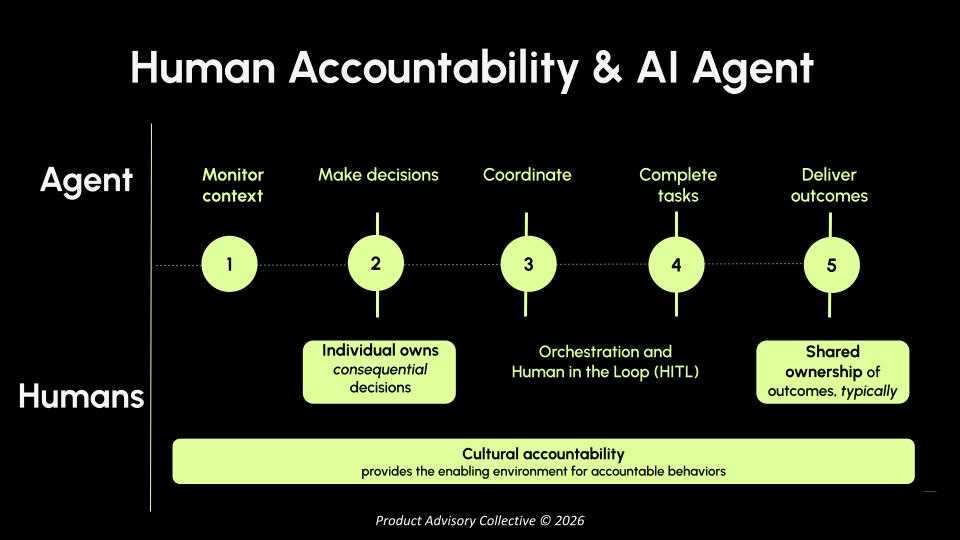
The diagram maps structural and cultural human accountability with an agent’s workflow: monitor context, make decisions, coordinate, complete tasks, and deliver an outcome. When decision-making is consequential, a single human owner must be accountable (Step 2), whereas shared ownership of agent outcomes, across all of the teams and individuals that contributed to the workflow or are impacted by its results (Step 5), is typically necessary. Underpinning all five steps is cultural accountability, which facilitates accountable human behaviors and enables human workers to detect and prevent unaccountable agent behaviors.
Importantly, whether an agent’s decisions (Step 2) require a single named owner depends on the severity of consequences for the enterprise and its key stakeholders. A named owner signs off on the risk criteria and thresholds, and answers for any consequences that occur if risk thresholds are surpassed. The SAFR white paper recommends evaluating five risk criteria: action reversibility, financial materiality, customer impact severity, regulatory sensitivity and novelty or anomaly. Risk thresholds are set pre-deployment, and proposed agent actions (Step 2) are evaluated continuously at runtime. While “above threshold” risks trigger a real-time human-in-the-loop (HITL) review, the executive owner remains ultimately responsible for any resulting repercussions or systemic issues.
Too often, model decision-making oversight is lacking. While agent orchestration and escalations to HITL reviewers are established practices, scrutiny over the risk or consequences of an SLM or LLM’s decisions is the exception, not the rule, even in high-risk industries. As recently as 2023, roughly 40% of hospital systems did not evaluate AI models for accuracy and 56% did not evaluate them for bias. This clear lack of oversight is governance debt with acute liability. Preventing and reducing the debt requires formal structural ownership and a culture that rewards accountability.
Strategic recommendations
A unique organizational impact of agentic AI is that it collapses traditional operational boundaries, converging performance metrics, systemic risks and multi-jurisdictional compliance requirements over time. To address this convergence of performance and governance issues, we recommend systemic interventions, including:
- Streamline governance efforts strategically to account for the collapsed operational boundaries and eliminate organizational friction and bottlenecks.
- Structure accountability into roles: assign names to consequential decisions and set up JAAs to manage shared accountability.
- Shift governance left by embedding oversight early and continuously across the system lifecycle.
- Design governance ex ante, not ex post: consider it a core architectural and infrastructural requirement, rather than post-launch remediation.
- Scale efficiently with policy-as-code: supplement or replace siloed and unnecessary manual oversight with automated computational controls.
Final takeaways
For CIOs, the ultimate mandate is to anchor AI governance directly in day-to-day infrastructure, roles and responsibilities. When autonomous agents scale risks instantly, traditional manual reviews and human-controlled workflows simply cannot keep pace. Oversight must “shift left” and be strategically built into system logic from the start.
Unchecked speed-to-market is an expensive illusion. As Apple Card’s costly errors and losses demonstrate, a rushed launch and a lack of oversight can result in financial penalties, remediation and loss of trust, reputation and business. To avoid the repercussions – including the velocity decay – that accompany governance debt, leaders must proactively architect accountability across the enterprise, the system lifecycle and critical decisions.
Eliminating systemic blind spots doesn’t require perfect foresight; it requires intentional architecture, well-designed collaborative ownership across silos and explicitly named human decision-makers. It’s possible to prevent the compounding liability that falls between AI decision-making and unstructured human accountability by answering two key questions early on: Who owns which decisions? And how do we clearly incentivize accountability?
Read More from This Article: AI agents are compounding a debt no one owns
Source: News

