
Skip to content
Tiatra, LLCTiatra, LLC
Tiatra, LLC
Information Technology Solutions for Washington, DC Government Agencies
  • Home
  • About Us
  • Services
    • IT Engineering and Support
    • Software Development
    • Information Assurance and Testing
    • Project and Program Management
  • Clients & Partners
  • Careers
  • News
  • Contact
 
  • Home
  • About Us
  • Services
    • IT Engineering and Support
    • Software Development
    • Information Assurance and Testing
    • Project and Program Management
  • Clients & Partners
  • Careers
  • News
  • Contact

AI built the report, but can your business trust it?

The old way of creating reports is almost cliché, but only because it remains so pervasive. 

It’s a familiar scene: A teammate pings you at 4:57 pm asking for a last-minute report. The data and business logic you need live across 10 spreadsheets, in five Microsoft Teams threads, and in an email from two months ago that you can’t seem to find. 

But that was the old way. What happens when you use AI for the same situation? 

Let’s find out. 

What working with AI often looks like 

Your stakeholder pings you, asking for a report based on a massive tax reconciliation spreadsheet. 

This spreadsheet is a beast, chock-full of tabs, formulas, and data that’s been copied and pasted from several enterprise data sources. 

“Sorry for the last-minute ask,” they say, “but can you just throw AI at this?” 

You go to your LLM prompt library, select a robust prompt, and input it into Claude, along with the spreadsheet. 

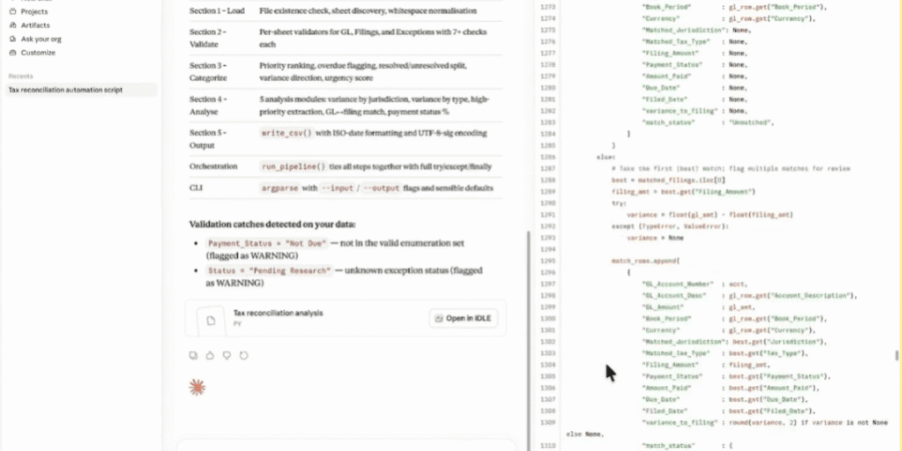
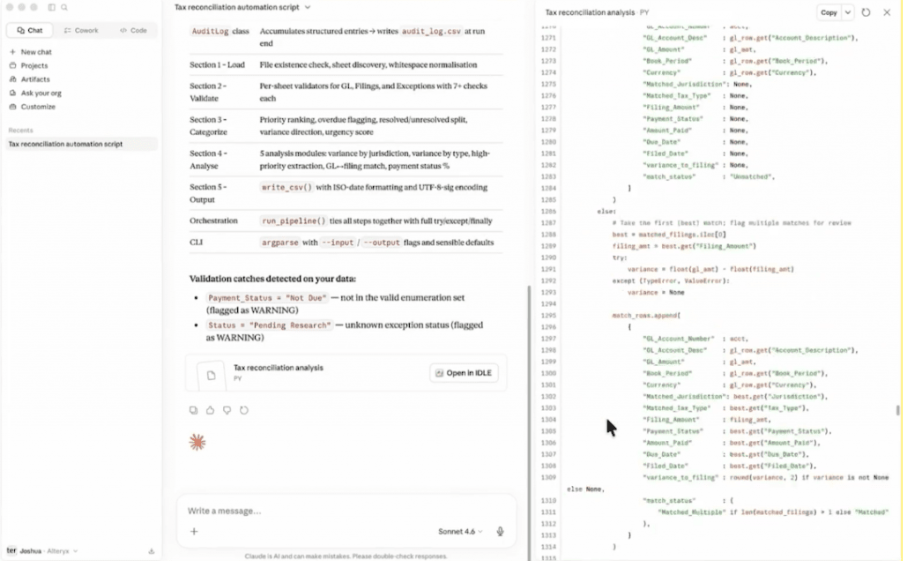
Four seconds later, you get over 1,700 lines of Python code. Somewhere inside, there appear to be all the data transformations, calculations, and visualizations you need to build your report. 
But there’s a hiccup. 

Your stakeholder remembers that your tax jurisdictions change four times a year and wants to ensure that you can make any necessary changes. 

Sure, you think, that shouldn’t be a problem. I can probably find that line of code somewhere … 

Also, there are three subsidiaries. Someone else handles those taxes, so you’ll need to filter those out. 

Finally, your stakeholder remembers that your CFO will want to sign off on this and that your auditor is coming tomorrow. They’ll both want to see the logic behind your report. 

Suddenly, parsing through and validating hundreds of lines of AI-generated code seems far more difficult and time-consuming than you’d hoped. 

VURA: The missing piece 

While AI can bring incredible levels of automation and speed, those are only force multipliers when directed strategically. 

“I can get an infinite number of PowerPoints out of the AI systems if I want that,” Ethan Mollick recently told me during our executive exchange. “It may even be good content, but if it doesn’t serve the purpose you need it to, the productivity gains become a trap.” 

Ethan’s point is that more isn’t always better; bringing four hundred PowerPoints to a sales call won’t help you close a deal. Likewise, instantly generating hundreds of lines of Python is unlikely to help your CFO feel confident in your AI’s vibe-coded report. 

For an AI workflow to be trusted, it has to be Visible, Understandable, Repeatable, and Auditable, or VURA. You need to know what’s happening at every step of the process: where the inputs came from, how business logic was applied, and whether the outputs were correct. 

So, how can you accomplish this? 

The transformation and business logic layer 

Let’s try a different AI-powered workflow. Same situation and model. Only this time, we’re going to add a visual transformation and business logic layer. 

First, we go into Claude and type up a prompt, but instead of Python, we ask for an Alteryx workflow. 
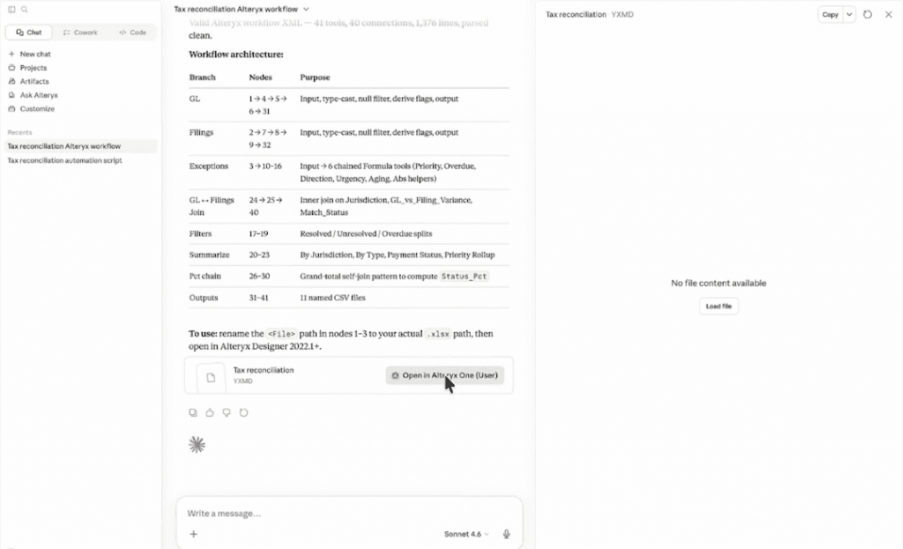
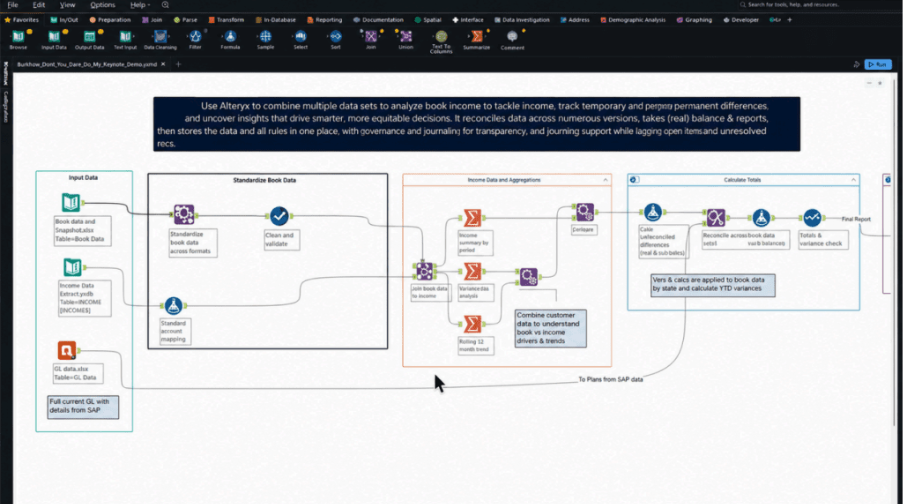
We open our workflow in Alteryx, and instead of hundreds of lines of AI-generated code, we see a visual canvas showing the entire tax reconciliation process. 

It’s still an AI-generated workflow, but now, anyone in the organization can inspect it. They can see what data was used. Your analysts and domain experts can validate the logic. And you can add governance and repeat the process. 

Suddenly, AI-generated workflows become far more trustworthy and scalable, giving you a foundation for enterprise intelligence. 
The future of enterprise AI workflows 

AI tools that can’t adapt when the business changes have short shelf lives, and rebuilding from scratch constantly drains tokens, time, and energy. Endless iterations create endless chances for inconsistencies and errors. 

With a visual business logic layer, the people who know your business best — your business analysts, sales professionals, finance team, and more — can apply their expertise to your AI workflows and validate its outputs. They can see what’s happening at every step of your AI workflows so that every process is Visible, Understandable, Repeatable, and Auditable. 

Speed and reliability are no longer mutually exclusive. Now, you can bring AI’s power and your business experts together to create something fast and reliable, the intelligent solution you need to create scalable business value. 

Learn more: See how Alteryx One can help you build AI workflows your business can trust. Or, watch a live workflow demo to see Alteryx in Action. 

 To learn more, visit us here. 


Read More from This Article: AI built the report, but can your business trust it?
Source: News

Category: NewsAugust 28, 2026
Tags: art

Post navigation

PreviousPrevious post:Scaling beyond spreadsheets: platforms built for large-scale data analysisNextNext post:Why finance teams need to modernize the logic behind spreadsheets

Related posts

How CIOs can overcome the AI trust gap
October 30, 2026
State of IT jobs: AI boosts salaries but also burnout and the gender gap
October 30, 2026
The next digital twin isn’t of a machine, it’s of your business
October 30, 2026
Scaling agentic AI with confidence
October 30, 2026
The AI trust deficit: Why explainability, not more automation, is the CIO’s next priority
October 30, 2026
Governing the agent workforce: New data on the next frontier of AI risk
October 29, 2026
Recent Posts
  • How CIOs can overcome the AI trust gap
  • State of IT jobs: AI boosts salaries but also burnout and the gender gap
  • The next digital twin isn’t of a machine, it’s of your business
  • Scaling agentic AI with confidence
  • The AI trust deficit: Why explainability, not more automation, is the CIO’s next priority
Recent Comments
    Archives
    • October 2026
    • September 2026
    • August 2026
    • July 2026
    • June 2026
    • May 2026
    • April 2026
    • March 2026
    • February 2026
    • January 2026
    • December 2025
    • November 2025
    • October 2025
    • September 2025
    • August 2025
    • July 2025
    • June 2025
    • May 2025
    • April 2025
    • March 2025
    • February 2025
    • January 2025
    • December 2024
    • November 2024
    • October 2024
    • September 2024
    • August 2024
    • July 2024
    • June 2024
    • May 2024
    • April 2024
    • March 2024
    • February 2024
    • January 2024
    • December 2023
    • November 2023
    • October 2023
    • September 2023
    • August 2023
    • July 2023
    • June 2023
    • May 2023
    • April 2023
    • March 2023
    • February 2023
    • January 2023
    • December 2022
    • November 2022
    • October 2022
    • September 2022
    • August 2022
    • July 2022
    • June 2022
    • May 2022
    • April 2022
    • March 2022
    • February 2022
    • January 2022
    • December 2021
    • November 2021
    • October 2021
    • September 2021
    • August 2021
    • July 2021
    • June 2021
    • May 2021
    • April 2021
    • March 2021
    • February 2021
    • January 2021
    • December 2020
    • November 2020
    • October 2020
    • September 2020
    • August 2020
    • July 2020
    • June 2020
    • May 2020
    • April 2020
    • January 2020
    • December 2019
    • November 2019
    • October 2019
    • September 2019
    • August 2019
    • July 2019
    • June 2019
    • May 2019
    • April 2019
    • March 2019
    • February 2019
    • January 2019
    • December 2018
    • November 2018
    • October 2018
    • September 2018
    • August 2018
    • July 2018
    • June 2018
    • May 2018
    • April 2018
    • March 2018
    • February 2018
    • January 2018
    • December 2017
    • November 2017
    • October 2017
    • September 2017
    • August 2017
    • July 2017
    • June 2017
    • May 2017
    • April 2017
    • March 2017
    • February 2017
    • January 2017
    Categories
    • News
    Meta
    • Log in
    • Entries feed
    • Comments feed
    • WordPress.org
    Tiatra LLC.

    Tiatra, LLC, based in the Washington, DC metropolitan area, proudly serves federal government agencies, organizations that work with the government and other commercial businesses and organizations. Tiatra specializes in a broad range of information technology (IT) development and management services incorporating solid engineering, attention to client needs, and meeting or exceeding any security parameters required. Our small yet innovative company is structured with a full complement of the necessary technical experts, working with hands-on management, to provide a high level of service and competitive pricing for your systems and engineering requirements.

    Find us on:

    FacebookTwitterLinkedin

    Submitclear

    Tiatra, LLC
    Copyright 2016. All rights reserved.
