

Since the advent of generative AI, the use of AI in business has shifted from something we should do to something we must do to survive. Many companies are now working to utilize AI with the aim of improving productivity and creating value.
Here, I would like to pose a question to you all once again: “What is the fundamental factor that determines AI performance?”
Is it the AI model? Is it the AI tool? Or is it the AI agent?
Of course, I believe all of these are important. However, if we look at the long-term perspective, the competition among multiple companies to improve AI model performance will eventually level off, and we will eventually reach a point where every AI model is amazing!
In that context, what I believe is the most important factor influencing AI performance is the data accumulated by companies that connects to their unique strengths.
For example, if asked, “What do plants need to grow?” I would say “good water and light.”
Similarly, if asked, “What do people need to thrive?” I would say, “Kind words.”
Finally, “What does AI need to thrive?” The answer is “good data.”
I believe that the extent to which companies can genuinely understand the importance of this extremely simple principle and implement it with unwavering dedication will determine their ability to establish a competitive advantage and achieve sustainable growth.
AI is a mirror of data
As I’m sure you’re all aware, AI is by no means a magic wand. It is an entity that learns based on the data it is given and makes inferences within that scope. In other words, AI’s output depends heavily on the quality of its input data; one could say that AI is a mirror of data.
- If you feed it inaccurate data, it will return inaccurate results (i.e., garbage in, garbage out)
- If you feed it biased data, it will make biased judgments
- Insufficient data yields only shallow insights and suggestions
In this way, AI is not smart but rather faithful to the data. Based on this premise, it becomes clear that the essence of AI utilization lies not in which tools to use, but in what kind of high-quality data to prepare and how to utilize it.
What is good data?
So, what exactly is good data?
It goes without saying that data is useless if it is merely abundant in quantity, but on the other hand, what specific qualities must good data possess?
Generally speaking, good data possesses at least the following elements.
- Accuracy: Data containing many errors or noise will skew conclusions, no matter how advanced the analysis. It is important to minimize sensor errors, input mistakes and duplicates.
- Completeness: Are any required fields missing, and are there too many missing values? For example, if customer data is missing information such as age, region or gender, it becomes difficult to perform meaningful analysis.
- Consistency: Is data with the same meaning mixed in different formats (e.g., date formats, units, variations in notation)? This is particularly important for system integration and long-term data.
- Timeliness: No matter how accurate it is, data that is too old may not be useful for decision-making. Whether real-time data is required or historical data is sufficient depends on the use case, but it is important that the data has the appropriate freshness for the purpose.
- Relevance: If there is a large amount of data unrelated to the analysis objective, it becomes noise and leads to incorrect judgments. It is necessary to clearly define what the data is used for and ensure the data is appropriate for that purpose.
- Reliability: The data’s source and collection method must be clear, ensuring reliability and reproducibility. Data with an unknown source or that is a black box cannot be verified later.
In summary, good data is data that is accurate, has few gaps, is consistent in meaning and notation, is collected at the appropriate time, is suitable for the purpose and comes from a reliable source.
Only when the quality of this good data is guaranteed can AI produce valuable outputs. Conversely, introducing AI with unorganized data will not yield the expected results. Many complaints, such as “We implemented AI but it’s unusable” or “The AI’s accuracy isn’t improving stem from data issues.”
Data does not organize itself naturally
The key point here is that good data does not arise naturally. On the contrary, if left unattended, data will inevitably deteriorate.
- Rules become inconsistent depending on who entered the data and when
- Multiple instances of data with the same meaning exist
- Outdated data is scattered and left unattended
- Data becomes siloed by department
These conditions are likely common in many companies.
Below is an overview of our company’s data management framework.
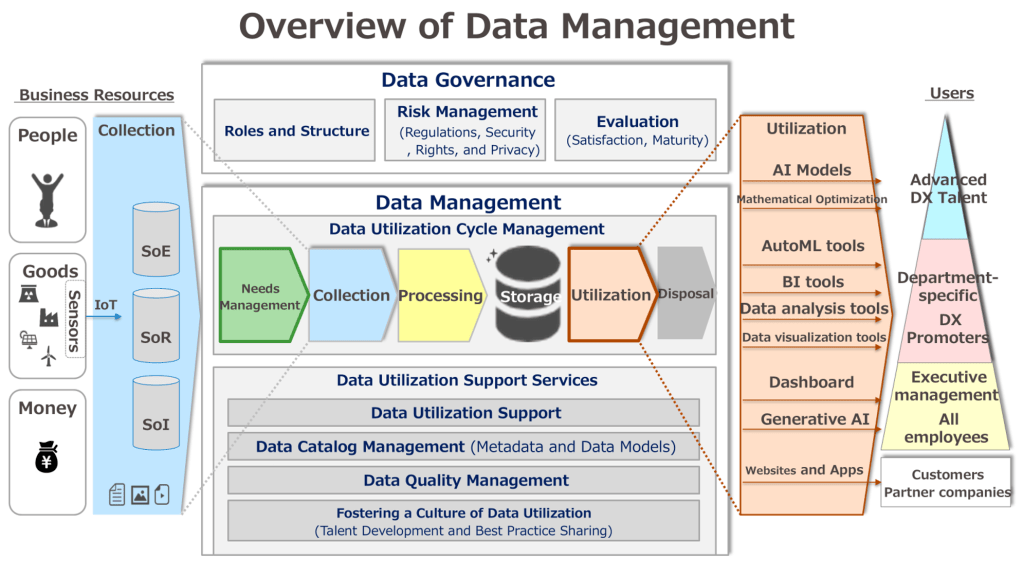
Akio Ueda
Broadly speaking, it consists of data governance — covering roles and structures, risk management and evaluation — and data management, which encompasses data utilization cycle management and data utilization support services. Within this framework, data utilization cycle management involves:
- Needs management: We clarify the purpose and needs by asking, “What is the data being used for?” and “For whom, and in what way, does this data create value?”
- Collection: We gather the necessary data based on the defined objectives. We design the process to determine what data is required (internal/external), the level of detail and frequency of collection, and how to ensure data quality.
- Processing: We enhance the quality and prepare the data for use. This includes cleansing (correcting errors and missing values), standardizing formats, deduplicating and integrating data, processing structured and unstructured data separately, and assigning business and operational meaning to the data.
- Storage: We ensure the data is available to the right people at the right time. This involves storing data in databases or data lakes, implementing security and access controls, and managing metadata (ensuring the data is clearly identifiable).
- Utilization: This is the most critical step. The purpose of data is not merely analysis but driving action. We generate value from the data through visualization (dashboards), analysis (statistical processing, BI, AutoML, AI) and integration into business operations (automation and decision support).
- Disposal: We properly dispose of data that is no longer needed. Simply holding data can itself pose risks, such as managing retention periods, complying with laws and governance requirements, and mitigating security risks. That is why the principle of not holding data that is not used is so important.
Data management is not a one-time effort; it is an ongoing initiative that requires continuous maintenance and improvement.
The CIO must embed data management as a system within the organization and continue to implement it until it becomes firmly established.
Data management is not just the IT department’s job
Another important point is that data management is not just the IT department’s job.
Data is fundamentally generated within day-to-day operations on the front lines. Therefore:
- Who determines the meaning and definition of data
- How should input rules be standardized?
- How do we ensure data quality?
are, in essence, operational issues, business issues and management issues.
The latest Digital Skills Standard ver. 2.0, published by the Ministry of Economy, Trade and Industry in April 2026, defines the following three roles within the data management category:
- Data steward: Based on business domain knowledge, this role is responsible for operations aimed at ensuring data quality, reliability and security, as well as for promoting the adoption and establishment of data management within business divisions and frontline organizations, and for fostering data utilization. In short, they are the data quality manager and data utilization promoter.
- Data engineer: This role involves understanding the current state of data and supporting the organization’s continuous data utilization through data preparation and preprocessing in processes such as collection, integration, processing and provision, as well as the design and implementation of data pipelines. In essence, they are the implementers and operators who drive data.
- Data architect: This role involves taking a bird’s-eye view of the data structure, flow and utilization methods across the entire organization and business. By designing and continuously reviewing data architecture that encompasses the entire data lifecycle in alignment with business strategy, they ensure the successful integration of company-wide data utilization and governance—essentially serving as the overall designer of data.
The CIO is not merely responsible for establishing data storage and analysis infrastructure; they are also tasked with appropriately assigning personnel to these three roles within the company and establishing cross-departmental, company-wide tools and rules to connect data with management, business operations and daily tasks.
Ultimately, the success of data utilization depends on organizational culture
On the other hand, no matter how much progress is made in staffing, infrastructure, tools and rulemaking, data will not be utilized unless there is an organizational culture that actively drives management, business and operations based on data.
- The purpose of data entry is not understood
- Data is optimized solely for the department’s own operations
- Decision-making based on data is not valued
In such a situation, no matter how well the systems are set up, they will become mere formalities.
In contrast, in organizations where data utilization is advanced:
- Discussions are based on data
- Formulate hypotheses and verify them with data
- And continuously improve based on data
These actions occur naturally.
In other words, the essence of data management ultimately lies in creating an organizational culture that assumes the effective use of data.
Data management cannot be achieved overnight. That is precisely why it is important to start small and build on your successes.
- Organize data for specific tasks and achieve results through the use of AI
- Rolling out successful practices
- Gradually Expand the Scope
By repeating this cycle, the importance of data will permeate the entire organization.
The role expected of a CIO in the AI era
In the AI era, the role expected of a CIO has changed significantly.
Traditionally:
- Ensuring the stable operation of systems
- And optimizing costs
However, moving forward:
- We will view data as an asset and maximize its value
- Developing the data infrastructure, tools and rules that underpin AI adoption, and advancing personnel allocation and development
- And fostering an organizational culture that embraces data utilization —roles that are more directly linked to business management
In other words, the CIO must evolve into the person responsible for creating value from data.
Data is the source of competitive advantage
In the coming era, the use of AI will be a given. What will set companies apart is not whether they use AI, but what data they possess.
Data is the accumulation of a company’s past strengths and the source of future value creation. And its quality is determined by daily operations and the nature of the organization.
- AI grows by being fed good data
- And companies grow through that AI
Taking this simple principle as our starting point, we must place data management at the core of our business strategy. Isn’t that the shortest route to sustainable growth in the AI era?
CIOs are called upon to lead the way in making this a reality.
This article is published as part of the Foundry Expert Contributor Network.
Want to join?
Read More from This Article: The essence of data management CIOs must embrace
Source: News