

For decades, the golden record was the goal of enterprise data management.
And for good reason. Large companies have stumbled on fragmented data. Customer information sits in CRM systems. Product data lives in ERP systems. Supplier records sit in procurement platforms. Interaction histories, transaction records, service tickets, consent data, contracts, and third-party data reside elsewhere entirely.
Master data management (MDM) helped bring order to that chaotic sprawl. It gave enterprises a way to identify and fix duplicate records, enforce standards, improve quality, and create a trusted view of core business entities such as customers, products, suppliers, locations, and accounts.
That work still matters. In fact, it matters more than ever.
The golden record was built for yesterday’s data problem
In the age of agentic AI, the golden record is no longer the destination. It is the starting point.
AI agents need more than clean records. They need context about the enterprise they operate in. They need to understand what a record is, how it relates to other entities, which rules apply, how it has changed over time, and which actions are appropriate in a specific business situation.
A golden record might tell an AI agent that a customer exists, where they live, and which account number belongs to them. But that alone is not enough for the agent to make a sound decision. The agent may also need to know whether that customer belongs to a household, which products they own, which contracts govern the relationship, whether they have open service issues, what consent permissions apply, whether they are eligible for a loyalty upgrade, or whether a regulatory restriction should limit the next best action.
The data exists. But without context, the AI cannot reason reliably over it.
From data retrieval to business reasoning
This is the shift enterprises now face. Traditional MDM was designed to unify and govern data. Agentic AI requires data that is not only unified and governed, but meaningful, connected, explainable, and available in real time.
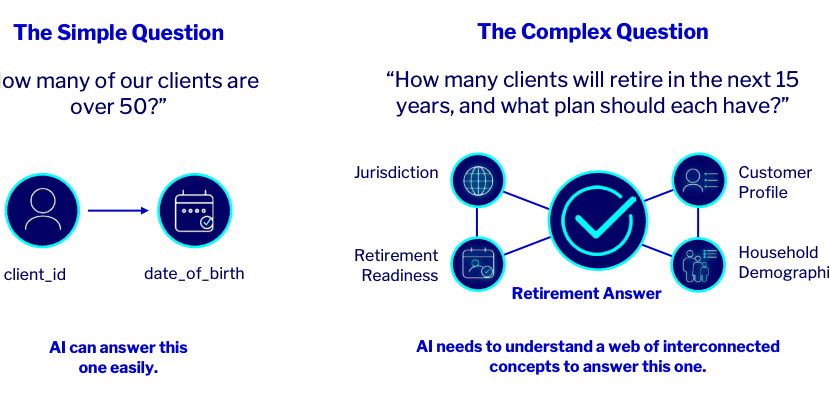
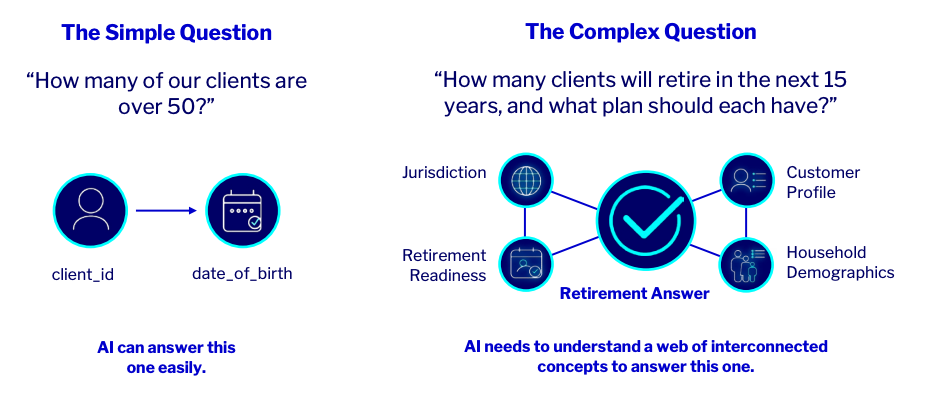
Consider a simple financial services example. Asking, “How many clients are over 50?” is a straightforward data question. It can be answered by filtering a date-of-birth field.
But asking, “How many clients will retire in the next 15 years, and what retirement plan should each have?” is a very different problem. Now the AI system must understand age, geography, household structure, employment status, tax rules, retirement policy, risk tolerance, account history, and product eligibility. It must reason across multiple domains, not simply retrieve a value from one table.
Figure 1: Agentic AI requires context to answer complex questions about your business
That is the difference between data and context.
It is also why enterprises are moving from golden records to trusted profiles, and from trusted profiles to Systems of Context.
Why business context looks like a graph
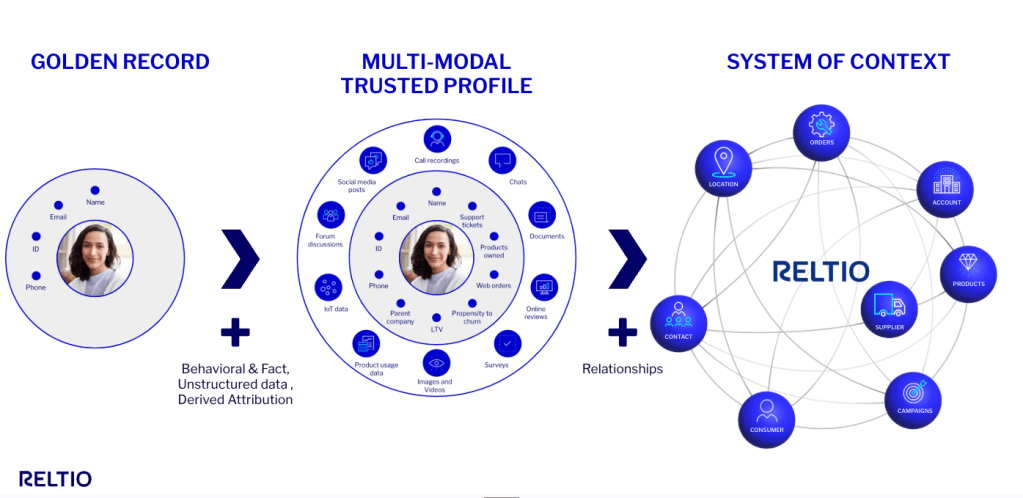
A golden record provides a clean, deduplicated view of an entity. A trusted profile enriches that entity with additional attributes, interactions, behaviors, relationships, and governance. A System of Context goes further by connecting entities across the business and making those connections machine-interpretable.
This matters because business reality is not flat. It is a network.
Customers are connected to households, accounts, transactions, products, service histories, consent records, locations, and employees. Suppliers are connected to contracts, materials, plants, shipments, risk scores, and compliance obligations. Products are connected to customers, campaigns, inventory, regions, and support issues.
Figure 2: A System of Context creates the enterprise foundation AI understands
AI agents need to traverse those relationships to make decisions. That requires a graph-native approach, where entities and relationships are represented in a way AI can reason over. It also requires semantics, metadata, lineage, business rules, and governance so that every answer can be explained and every action can be trusted.
This does not make MDM obsolete. Quite the opposite.
MDM is becoming the foundation for Context Intelligence
MDM provides the foundation for Context Intelligence. Entity resolution, data quality, governance, hierarchy management, and trusted profiles are still critical. But the purpose of that foundation is expanding. The goal is no longer simply to create a single version of truth for humans to inspect. The goal is to create a living, connected, real-time context layer that AI agents can use to reason and act.
That is a major evolution in enterprise data strategy.
The companies that win with agentic AI will not be the ones that simply connect large language models to more applications. They will be the ones that give those models and agents the richest understanding of the business.
In the last era, enterprises competed on who had the best data. In the agentic AI era, they will compete on who has the best context.
Read Reltio’s latest white paper to learn how Context Intelligence extends MDM into the foundation for trusted agentic AI.
Read More from This Article: Golden records are no longer enough in the age of AI agents
Source: News