

The strategic initiatives for Rajeev Khanna, CIO at insurance brokerage Trucordia, mirror those of most CIOs, with implementing AI throughout the organization at the top of the list.
But Khanna also includes cybersecurity, data and analytics projects, and innovation work as strategic priorities, saying they’re “all things we’re working on in parallel.”
While none of those initiatives stands out as unique, Khanna knows he can’t follow generic project templates or work toward vague objectives in any of those areas.
Rather, he’s using automation and AI to make his company’s workflows more efficient. He’s using technology to better serve Trucordia’s specific customer needs. And he’s enabling new products and services to differentiate the company in the market and fuel growth.
“Technology,” he adds, “is enabling business innovation and speed of delivery.”
Khanna’s strategic priorities — and the goals they’re meant to achieve — are representative of what CIO.com’s State of the CIO survey found to be the key strategic initiatives for IT today.
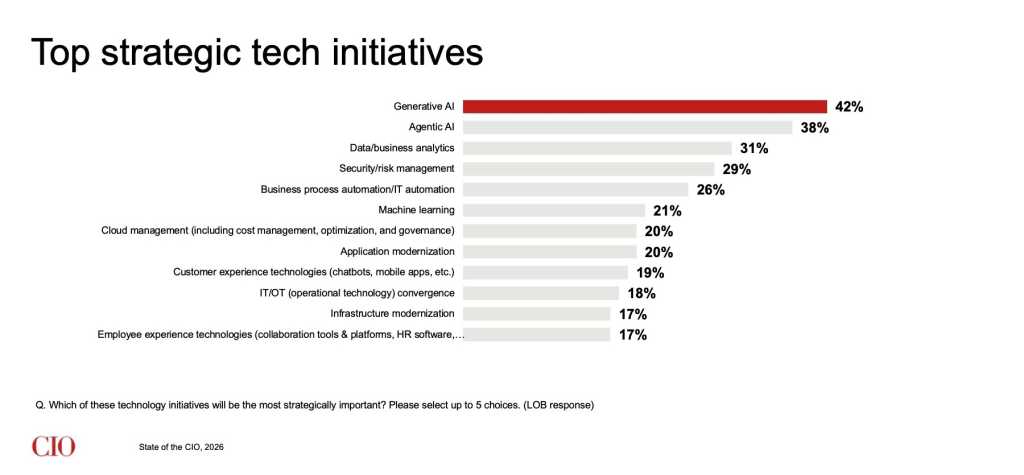
When asked to list their most strategically important technology initiatives, CIOs put generative AI at the top, followed by agentic AI and then data/business analytics.
Security/risk management and automation of IT and business processes round out the top five.
Farther down the list are the more conventional IT tasks, such as modernization efforts, cloud management, and developing applications for and migrating applications to the cloud.
CIOs, executive advisers, and IT analysts say IT’s list of strategic initiatives shows how tech execs are spending more energy shaping and enabling their organizations’ strategies and desired business outcomes — and focusing less on technology excellence as their primary objective.
“CIOs are spearheading the IT architecture, organizational structures, and process transformation necessary to drive adoption and business value at enterprise scale,” the State of the CIO survey found.
Such shifts underscore the ongoing evolution of the CIO role from operational order-taker to transformation leader, with CIOs actively engaged with business leaders to drive AI adoption and focus on high-value outcomes from all technology initiatives.
How CIOs are spending their time in 2026 reflects this, with the study finding that CIOs are devoting more time to working more closely with business leaders on potential AI initiatives, learning about emerging tech, and creating a framework and organizational structure to support AI initiatives. Compared to last year, they’ve cut back on negotiating with IT vendors, managing IT crises, controlling costs, and managing expenses.
CIO.com / Foundry
Tech enables new capabilities, products
Khanna’s focus reflects those findings. He’s prioritizing “new capabilities for the organization that are more differentiating and creating and launching new capabilities and products for clients in a more efficient way and at a faster pace,” he says — often through use of AI.
He’s also prioritizing projects that leverage data and analytics “to serve clients better and deliver products that fit market needs.” That includes, for example, incorporating large language models (LLMs) into analytics tools so that users can interrogate data using natural language.
And he’s doing all that with “cyber always top of mind” — a perennial task that requires constant attention.
“Given that cyber is a moving target, we need to work at staying current, modernizing, and staying ahead of the curve on what the bad actors are doing,” Khanna says. “That’s going to be a forever, ongoing focus.”
Scaling AI is the goal
Nick Nadgauda, global CIO at MetLife, similarly speaks about IT’s strategic initiatives as a business driver.
“As a CIO today, my most strategically important initiative is scaling artificial intelligence from pockets of experimentation into a core, trusted capability embedded in how the enterprise operates,” he says. “At MetLife, we view AI not as a standalone technology effort, but as a critical enabler of our strategy. It helps us sharpen decisions, simplify work, and ultimately deliver better outcomes for our customers and the business.”
To do all that, MetLife deployed MetIQ, an internal composite AI platform, that “allows teams to experiment, build, and deploy AI solutions in a secure, governed environment.” Nadgauda says the platform provides the company “the flexibility to adapt to rapidly evolving technologies while maintaining strong controls around data, privacy, and risk.”
Nadgauda’s IT team is also integrating AI into employee tools and processes, “so it becomes a thought partner that supports decisions earlier in the process, not just after the fact,” he explains.
IT is also “intentionally designing AI experiences, tools, and training that align to how people work in their roles,” Nadgauda says, noting that the organization gets “meaningful adoption” when employees see AI’s relevance to their day-to-day work.
All this, he adds, has made AI “a natural part of how work actually gets done across engineering, operations, and customer-facing teams.”
Like others, Nadgauda sees such work as evidence that the CIO’s role itself has become that strategic partner it has long aimed to be.
“It’s about shaping how the enterprise operates in a world where technology and business are fully intertwined. We need to always think about how we are making it easier for the business to move faster, make better decisions, and deliver stronger outcomes for customers,” he says.
Agentic AI becomes a priority
Likewise, Janardhan Santhanam, CIO of Tata Consultancy Services, considers transformation of the business as the strategic imperative for IT. Santhanam is using agentic AI to drive that. In the State of the CIO survey, 38% of respondents listed agentic AI as a strategically important tech initiative.
“Our most important initiative is redefining how our work gets done as an agentic enterprise,” he says, adding that the goal is to unlock “durable, nonlinear performance gains critical to our organization’s growth.”
As is the case with other CIOs, Santhanam has expanded his focus beyond IT infrastructure and even the IT realm to the whole organization to ensure success.
“In our view, this entails creating an AI-first culture amongst our workforce and resetting the operating model of internal functions and internal IT to one of ‘agents + apps + humans’ working together on intelligent decision‑making and autonomous execution,” he explains. “We have not just democratized AI infrastructure in the hands of all but also distributed agency to create 2x workers and teams.”
Furthermore, IT is reinventing processes across business departments to support desired business outcomes and add speed. Santhanam describes this work as creating “function-as-a-platform at scale.”
Reflecting another top strategic IT initiative identified in the State of the CIO survey, Santhanam stresses that IT has also prioritized security, privacy, and compliance as it advances its AI agenda.
Nearly all organizations have high hopes for agentic AI. An April 2026 study from HFS Research and Genpact found that 92% of surveyed executives believe agentic AI will fundamentally change how work is executed.
That has put pressure on CIOs to move forward with it, says Oz Vural, senior managing director of FTI Consulting.
“IT must move to agentic AI that can execute workflows and make real-time decisions within guardrails,” Vural says, noting that this is an opportunity for CIOs to contribute to increased revenue and EBITA “rather than just saving hours with automation.”
That is shifting a metric of CIO success to how quickly they deliver “time to intelligence,” he adds.
A holistic perspective on IT initiatives
CIOs, however, are hitting roadblocks on that quest.
Legacy tech, immature data programs, and skills gaps are stymying CIO ambitions around agentic AI and their other top initiatives, Vural says.
Such challenges reinforce the need for CIOs to continue prioritizing fundamental IT work, says Diane M. Carco, president and CEO of consulting firm Swingtide.
“In our time of rapidly developing technologies, I think the most strategically important initiative is clearing out the old to make way for the new,” Carco says. “Reducing technical debt by getting rid of shelfware and outdated, nonstandard systems is probably the most strategically sound and impactful thing a CIO can do to eliminate waste and improve customer satisfaction. Once that is done, plotting the right course of action for AI implementation is next.”
CIOs seem to agree on the importance of foundational IT work, as the State of the CIO Survey found that application modernization and cloud management were both cited as a strategic initiative by 20% of respondents, with infrastructure management cited by 17% and cloud infrastructure by 16%.
Given that such foundational technology initiatives are instrumental to those involving AI and leading-edge technologies, Ricki J Koinig, CIO of the Wisconsin Department of Natural Resources, says she doesn’t segregate some as strategic and others as not.
“I believe the most strategically important priorities for a CIO are often the ones that are not branded as standalone projects but instead underpin everything the organization does. In my view, three such initiatives are foundational to sustained success: innovation readiness, embedded cybersecurity, and organizational readiness,” she explains.
For Koinig, innovation readiness has become a defining capability. “Being ‘ready’ is no longer about keeping your asset management up-to-date or adopting a specific technology; it’s about continuously raising the bar of foundational work, including maintaining high-quality, governed data, ensuring collaboration, relevant input, and transparency in decision-making throughout key stakeholder layers, and sustaining operational discipline across systems and processes,” she says.
“Innovation readiness also requires a deliberate commitment to managing technical debt, routinely assessing the health of the technology landscape, and making conscious efforts to provide appropriate skills and capacity to move on actual mitigations,” she adds.
Meanwhile, cybersecurity “must evolve from a perceived constraint into an embedded capability within all functions — business as well as IT,” Koinig notes. It involves embedding best practices and requirements throughout the various units. “When done well, cybersecurity becomes organizational muscle memory that is intuitive, proactive, and inseparable from how work gets done, regardless of role.”
And then there’s organizational readiness — readiness for change, in particular.
“Innovation cannot take hold in environments that are culturally resistant or operationally unprepared to evolve,” Koinig says, noting that leaders must “intentionally cultivate a culture that embraces change as a constant, not a disruption, while aligning talent strategies to support that mindset.”
Read More from This Article: The 12 most strategically important IT initiatives today
Source: News