

Last quarter, I watched a client organization’s AI strategy presentation roll out to fanfare: executive buy-in, budget secured, timeline mapped. Three months later, actual usage sat at 4%. Meanwhile, in the basement (metaphorically speaking), their IT operations engineers were quietly using Claude and ChatGPT daily to debug stack traces and automate ticket responses.
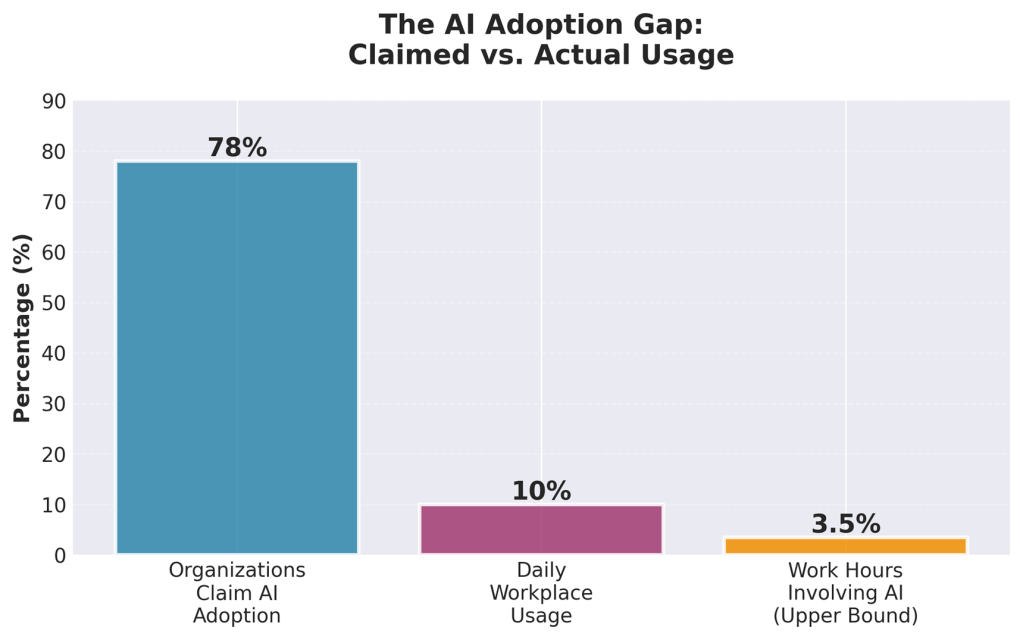
This gap between declared AI strategy and actual adoption isn’t unique to us. According to Stanford’s 2025 AI Index, 78% of organizations now use AI in at least one business function. Yet Gallup research reveals that daily use sits at just 10% of the American workforce, with the Federal Reserve estimating that only 0.5-3.5% of all work hours currently involve AI assistance. The disconnect isn’t about technology maturity or executive commitment. It’s about understanding how people actually adopt tools that require them to change how they think.
Here’s what I’ve learned: Your IT operations team isn’t just a good place to test AI — it’s the template for understanding how AI gets adopted across your entire enterprise.
Dotun Opasina
Why IT ops engineers are already doing what your strategy can’t mandate
When I started tracking where AI tools were actually being used in client organizations, IT operations lit up the dashboard. Not because of any mandate, but because these teams have something most departments don’t: forcing functions.
At 3 AM, when production is down and your phone is ringing, you’re not thinking about strategic AI initiatives. You’re thinking about solving the problem as fast as possible. If pasting a stack trace into ChatGPT gets you to resolution 10 minutes faster, you’ll do it. If Claude can help you write a monitoring script in half the time, you’ll use it. The forcing function—the urgent need to solve a concrete problem—creates the individual motivation that no strategic mandate can manufacture.
This matters because AI adoption follows a fundamentally different pattern than previous enterprise software rollouts. When we deployed Salesforce or Slack, the value was obvious and immediate: track customer interactions in one place, send messages faster than email. The friction was low and the use case was clear.
AI tools require something different: they ask people to change their cognitive workflows. Instead of searching the documentation, you’re prompting. Instead of writing code from scratch, you’re reviewing and iterating. This is why person-to-person adoption of tools that provide clear individual benefits is the only adoption pattern that actually works.
I saw this firsthand when I used Claude Code on a side project. My velocity increased 2-3x, not because the tool was magic, but because it removed the cognitive overhead of boilerplate work and let me focus on architecture and business logic. That personal experience—that compression moment where a tedious task became immediate—is what drives adoption. IT operations teams experience these moments daily.
The pattern that scales: individual benefits beat strategic mandates
The mistake most CIOs make is trying to replicate the forcing function through mandate. “Everyone will use our AI assistant for documentation,” or “All engineers will adopt GitHub Copilot by Q2.” These top-down approaches ignore what actually drives technology adoption in organizations.
Publicis Sapient’s research on AI adoption reveals a telling disconnect: the majority of executives claim their AI technology is scaled or enterprise-ready, yet most organizations remain in pilot mode. This confidence gap between C-suite declarations and operational reality mirrors what I’ve observed firsthand.
Look at how the internet spread through enterprises in the 1990s. Companies didn’t mandate email adoption through strategic initiatives. Engineers started using it to collaborate faster, then told their colleagues, who told their teams. The person-to-person transmission happened because the individual benefit was obvious and immediate. No training program or change management initiative could match the power of one engineer telling another, “Just try this, it’ll save you 30 minutes a day.”
AI faces a steeper climb because the individual use cases aren’t always obvious. Unlike email, where the value proposition was instant, AI requires experimentation to find your personal compression moments. This is exactly why IT operations teams are your blueprint. They’ve already found theirs:
- Incident response: “We’re using GPT-4 to analyze logs and suggest root causes, cutting our mean time to resolution by 40%.”
- Ticket deflection: “Our chatbot handles tier-1 questions, freeing engineers for complex issues.”
- Script generation: “Writing monitoring scripts used to take hours, now it takes minutes with AI pair programming.”
These aren’t strategic initiatives. They’re tactical solutions to concrete problems, discovered through use and shared peer-to-peer.
From IT ops to enterprise: what actually scales
Here’s what I recommend based on watching this pattern play out: stop trying to mandate AI adoption from the top down. Instead, identify the departments in your organization that have forcing functions similar to IT operations.
Customer support has them: angry customers and SLA clocks. Sales has them: quota pressure and pipeline gaps. Finance has them: month-end close and audit deadlines. These are the teams where individuals are already motivated to find faster ways to work.
Your job as CIO isn’t to create a comprehensive AI strategy. It’s to make experimentation easy and capture what works. Set up a simple system for teams to share their AI wins. When a sales rep discovers that Claude can help draft proposals in half the time, make sure that knowledge spreads. When a financial analyst figures out how to use AI for variance analysis, document it and share it.
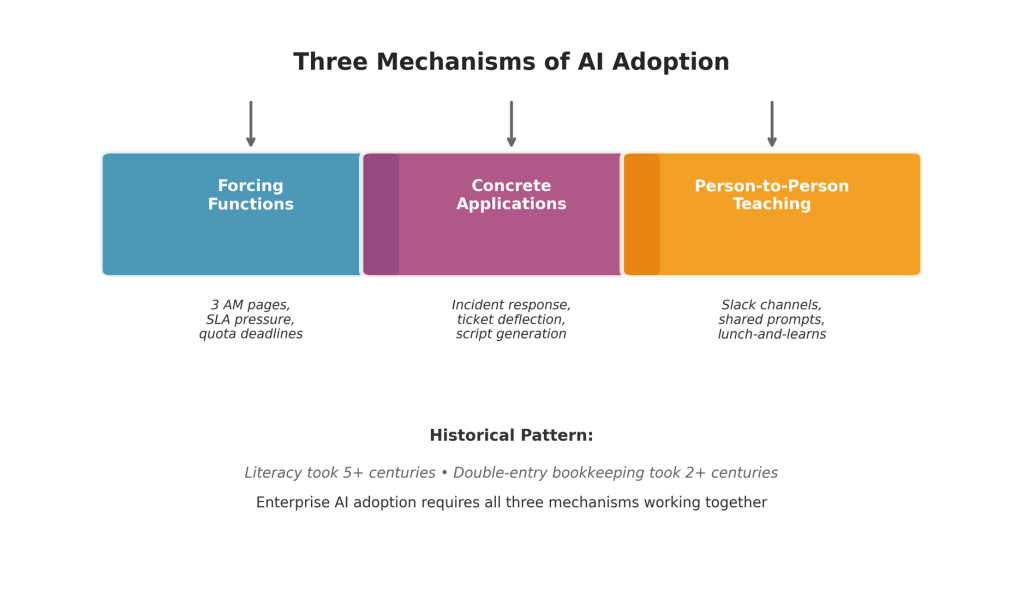
Historical patterns show that cognitive technologies — from the spread of literacy in medieval Europe to the adoption of double-entry bookkeeping in Renaissance commerce — took centuries to achieve mass adoption. They spread through three mechanisms: forcing functions that made adoption necessary, concrete applications that proved immediate value and person-to-person teaching. Your enterprise AI adoption needs all three.
Start with IT operations. They already have the forcing functions and they’re discovering concrete applications daily. Your role is to facilitate the person-to-person teaching. Create internal communities, Slack channels or lunch-and-learns where engineers share their prompts and workflows. Capture these discoveries and help other departments find their own compression moments.
Dotun Opasina
The metrics that matter
Traditional enterprise software adoption metrics don’t work for AI. Login rates and feature usage don’t tell you if people are actually changing their workflows or just clicking around. The metrics you need are compression metrics: time saved, quality improved, frustration eliminated.
I track three things:
- Voluntary adoption rate: How many people are using AI tools without being asked? This is your leading indicator of real value.
- Peer sharing frequency: How often do team members share AI tips unprompted? This measures if you’ve hit the person-to-person transmission phase.
- Concrete ROI examples: Can individuals articulate specific tasks that now take half the time? These become your proof points for expansion.
When IT operations tells you they’ve cut incident resolution time by 30 minutes on average, that’s a compression moment. When they start sharing their prompt libraries in Slack, that’s person-to-person transmission. When other engineering teams ask to learn their methods, that’s when you know you have something that scales.
What this means for your organization
The path to enterprise AI adoption doesn’t run through strategic planning decks. It runs through the lived experience of individuals who discover that a task they do every day just got dramatically easier. IT operations teams are finding these moments right now, not because of your strategy, but despite it.
Your job is to pay attention, capture what works and make it easy for others to experiment. The forcing functions are already there in your organization. The tools are already capable. What’s missing is the recognition that adoption happens person-to-person, not through mandates.
Stop trying to manage AI adoption from the top down. Start learning from the teams who are already doing it from the bottom up. Your IT operations engineers have been showing you the blueprint all along.
This article is published as part of the Foundry Expert Contributor Network.
Want to join?
Read More from This Article: Why your IT operations team is your AI adoption blueprint
Source: News