


The headlines read “Artificial Intelligence (AI) will completely transform your business.” But does the hype match the reality? We have been seeing these exclamations for two decades, but where are the examples? Where are the success stories? Is AI really a game changer, and does it actually apply to my business?
Every ten years it seems there is a new technology that is going to change the world, but all too often only leads to disappointment when adopting it becomes too challenging. For several decades this has been the story behind Artificial Intelligence and Machine Learning.
However, we have now reached a tipping point with AI where the compute capacity, ubiquitous connectivity, and wealth of data can match the moment and assist business leaders to create unique competitive advantages by better serving customers, improving processes, enhancing employee experience, or reducing costs. As Andy Jassy, CEO of Amazon, said, “Most applications, in the fullness of time, will be infused in some way with machine learning and artificial intelligence.”
As I advise in my presentation “Building a Smarter Organization Powered by Machine Learning” there are three key focus areas successful organizations master to get value from AI: Mindset, Skillset, Toolset. This creates a flywheel we call The Data Network Effect, where you acquire more data, which helps create better algorithms, which drives better engagement, ultimately leading to happier customers, which then generates more data, and so on, and so on. This process then repeats, improving and generating more value with each cycle.
While some companies are already benefiting from this transformative impact of AI, we see others struggling. There is often confusion at the management level about the applicability and impact of AI, leaving business leaders to struggle to find the right use cases to prioritize. Additionally, navigating existing AI resources reveals a great deal of highly technical information but little in the way of business impact examples and guidance. Until now, a comprehensive list of AI and ML use cases that serve as meaningful references for business leaders simply did not exist.
The bottom line: Most companies know they need AI but have not found the answer to “where do I start?” In this blog post, I will share five actions you can take to move beyond the buzzwords and make your AI-driven digital transformation a reality that will shape your organization’s future.
Be clear on the “why”
Do not just implement AI so you can check it off your list. AI should be used to support your business strategy not be your business strategy. Do not fall victim to the analogy of “a hammer in search of a nail, that only winds up pounding in screws everywhere.” Instead evaluate your business opportunities or problems and then determine if AI is the right tool for the job.
Get alignment from your stakeholders
I always told my team and customers that long-term success with AI solutions is driven by people, not technology. As you begin to work with various stakeholders on your initiative, ensure you are effectively and continuously collaborating with them. Structure your strategy discussions around the four key areas: business, finance, technology, and science, and encourage stakeholders in those areas to weigh in on your AI project decisions.
It is also important to develop an organizational culture that empowers people across business and technical roles to become involved with your AI. Our customers who have successfully rolled out these initiatives have one thing in common: they embraced the culture of continuous process evolution and had champions who brought teams across the organization together. Creating a culture that excels in change management, celebrates failure as learning, promotes new skills acquisition, and fosters collaboration is a great way to propel your organization in this direction.
Explore what is possible with AI and get started
To help you get started, AWS has just launched the AI Use Case Explorer, a complimentary, interactive guide for business leaders and AI practitioners to conceptualize and build their applications.
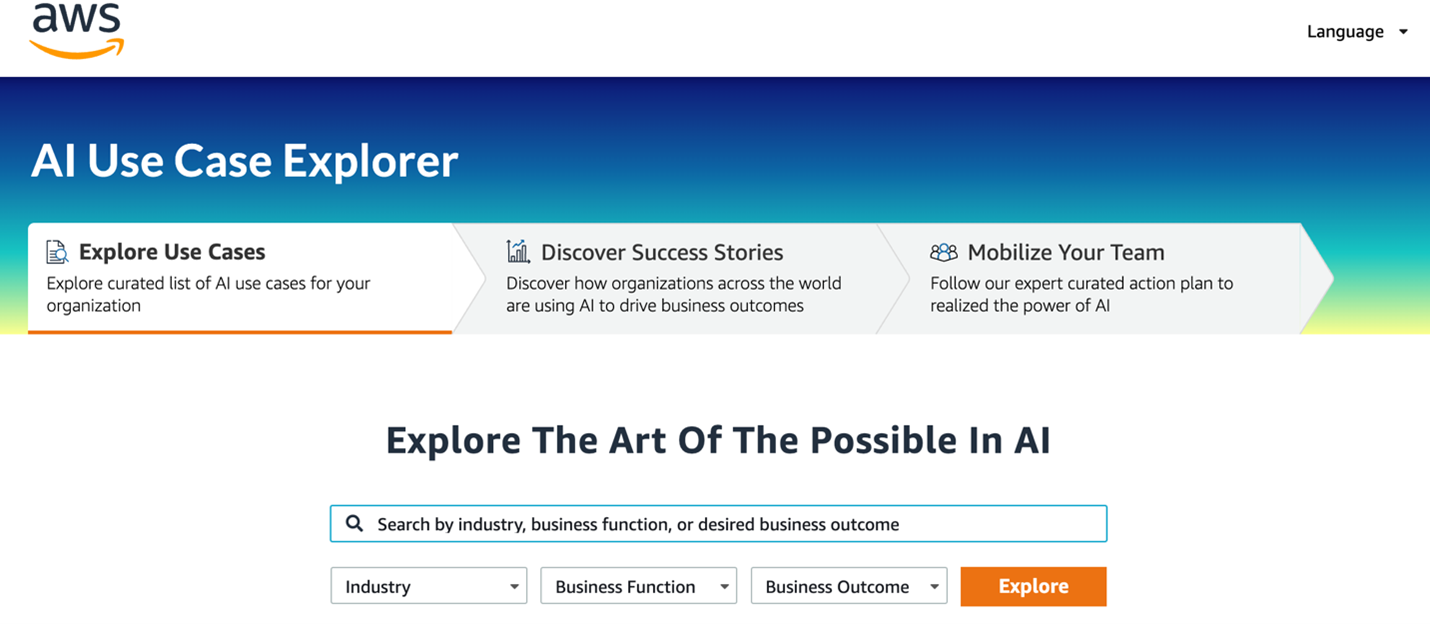 With over 100 use cases and sub use cases and 400 customer success stories, this tool can help you quickly identify the right use case to get started based on your industry, function, and desired business outcome. Once you have identified your use cases, you can read about success stories from around the world and kickstart your deployment, from proof-of-concept to full production, by following an expert-curated action plan provided for your specific use case.
Do not boil the ocean … we tried that … it did not work
As an industry, we have learned hard lessons from trying to deploy monolithic data warehouses, business intelligence implementations, and analytics solutions by gathering, cleaning, and preparing tremendous swaths of data from across the entire enterprise. This delayed value, increased cost, raised complexity, and ultimately failed to deliver. Instead, focus on gathering the data specific to the use case you are implementing, and drive quickly through proof-of-concept to production and value. Then move on to the next use case and do the same thing again, expanding your data assets as needed.
Technology is not the objective, it is the enabler
True value does not come from just using a new technology, but rather from using new technology to reimagine existing processes. As you look to implement your AI project go beyond just creating an AI-enabled twin of your existing process, and instead reimagine the process using the new capabilities of AI.
As AI transforms the way we live and work, from optimizing business processes to personalizing content for consumers, I am excited about all of the innovative and impactful AI applications that can assist businesses as well as individuals in the coming years. The possibilities are endless! I invite you to check out the AI Use Case Explorer site and explore your organization’s unique path to AI success.
ABOUT THE AUTHOR:
Tom Godden is an Enterprise Strategist and Evangelist at Amazon Web Services (AWS). Prior to AWS, Tom was the Chief Information Officer for Foundation Medicine where he helped build the world’s leading, FDA regulated, cancer genomics diagnostic, research, and patient outcomes platform to improve outcomes and inform next-generation precision medicine. Previously, Tom held multiple senior technology leadership roles at Wolters Kluwer in Alphen aan den Rijn Netherlands and has over 17 years in the healthcare and life sciences industry. Tom has a Bachelor’s degree from Arizona State University.
Artificial Intelligence
Read More from This Article: 5 steps to move AI beyond buzzwords to deliver true transformative impact
Source: News