
Skip to content
Tiatra, LLCTiatra, LLC
Tiatra, LLC
Information Technology Solutions for Washington, DC Government Agencies
  • Home
  • About Us
  • Services
    • IT Engineering and Support
    • Software Development
    • Information Assurance and Testing
    • Project and Program Management
  • Clients & Partners
  • Careers
  • News
  • Contact
 
  • Home
  • About Us
  • Services
    • IT Engineering and Support
    • Software Development
    • Information Assurance and Testing
    • Project and Program Management
  • Clients & Partners
  • Careers
  • News
  • Contact

Your first 100 days: A playbook for building credibility fast

You’ve landed the role. The board is excited. The press release is live. Expectations couldn’t be higher. Now comes the hard part: earning their trust.

Your first instinct, fueled by adrenaline and ambition, will be to draft a grand 18-month transformation plan. You want to prove they made the right choice. You want to start breaking things.

I’ve learned this the hard way: that’s a mistake. 

The most critical objective in your first quarter as a technology executive is not to launch a revolution. It is to build credibility. 

Credibility is the political capital you’ll draw on over the next three years. Earn enough of it early, and you’ll buy yourself room to transform. Fall short, and even the best strategy will stall. 

Instead of trying to boil the ocean, your focus should be narrow and intense. I rely on a simple framework, the 4A Playbook, to keep me focused when the spotlight burns hottest.
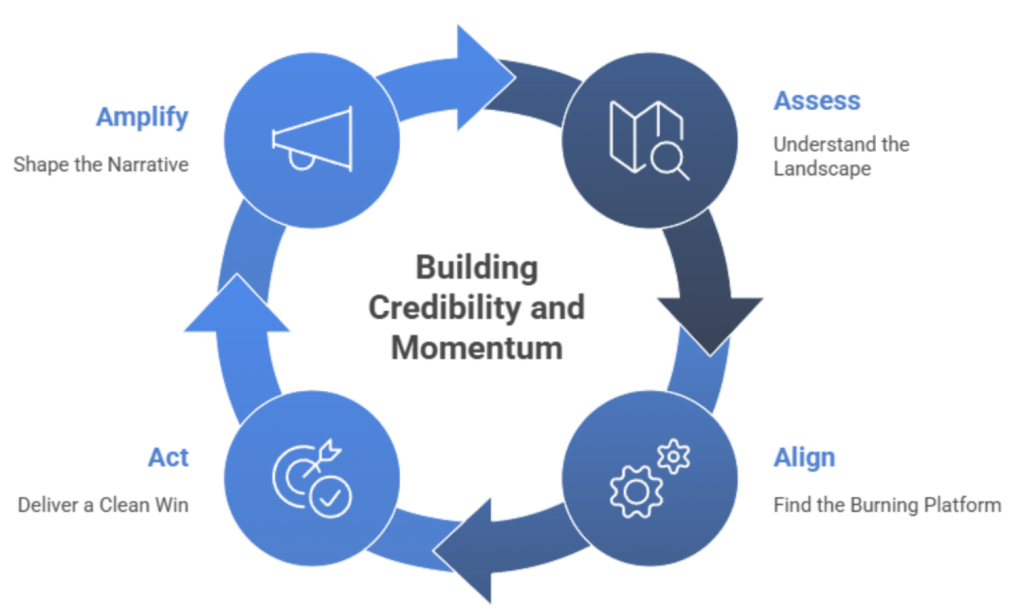
The 4A Playbook: Circular diagram showing Assess, Align, Act and Amplify

Jason Hood

1. Assess: Listen more than you speak 

Your first 30 days are for discovery. Your mission is to understand the landscape, not to change it. Schedule meetings not just with your peers, but with the senior engineers who hold institutional knowledge, the sales leaders who hear client complaints and the finance partners who understand the real budget pressures. 

I learned this lesson on a major lab transformation. The official documentation was a waterfall-style mess — pristine on paper but hopelessly outdated the moment it was approved. The real source of truth? It wasn’t in a binder. It lived in the heads of three people: a lead architect, a senior developer and a key operator from the business side. So I didn’t spend my first week huddled with VPs. I spent it at a whiteboard with that trio, teasing out what was really going on. And the breakthrough didn’t happen in isolation. It came when we brought IT and business perspectives together in the same room. Those sessions didn’t just give us a map — they built a bridge between two groups that had been working at arm’s length. That bridge saved us months of missteps down the road.

2. Align: Find the ‘burning platform’ 

After you assess, your next job is to find the one or two “quick wins” that solve a real, recognized pain point. Don’t invent a problem to solve. Find the “burning platform” that everyone already agrees is on fire. Is it the slow development environment? A buggy checkout process? A manual report that takes three days to run? By aligning your first actions with an existing, acknowledged problem, you aren’t asking for trust — you are earning it by being a practical problem-solver.

3. Act: Deliver a clean, public win 

Now, you execute. Your goal is a small, visible and unambiguous win within 60-90 days. When you automated that painful manual report, you didn’t just save a few hours; you showed the Head of Sales that you listen, and you deliver. When you sped up the development environment, you showed your engineering team that you understand their daily friction. These early wins aren’t about the technology; they are about building a reputation for competence and follow-through.

4. Amplify: Communicate the ‘what’ and the ‘why; 

This is the step most leaders forget. You must be the chief storyteller for your team’s success. It’s not enough to deliver the win; you have to amplify it. Send a concise, business-focused update to your peers: “This week, the technology team, in partnership with sales ops, automated the QBR report, cutting generation time from three days to two minutes. This means our sales leaders can now spend more time selling. Great work by the team.”

Sharing these wins does two things: it gives your team the recognition they deserve, and it helps your peers see technology not as a cost center but as a driver of business outcomes. 

Real credibility isn’t earned by rolling out a sweeping 18-month transformation plan. It’s forged in the first 100 days, one deliberate and well-communicated victory at a time. Stack enough of those wins, and you’ve earned the right to ask for the big investment. 

In my next article, as part of what I’m calling the CIO Masterclass, we’ll tackle a new challenge: How to move from approval to advocacy and secure board-level buy-in for your real vision.

This article is published as part of the Foundry Expert Contributor Network.
Want to join?


Read More from This Article: Your first 100 days: A playbook for building credibility fast
Source: News

Category: NewsAugust 5, 2025
Tags: art

Post navigation

PreviousPrevious post:AI’s last mile just got a supercomputer, courtesy of ASUS and NVIDIANextNext post:How safe is your AI conversation? What CIOs must know about privacy risks

Related posts

SAS makes AI governance the centerpiece of its agent strategy
April 29, 2026
The boardroom divide: Why cyber resilience is a cultural asset
April 28, 2026
Samsung Galaxy AI for business: Productivity meets security
April 28, 2026
Startup tackles knowledge graphs to improve AI accuracy
April 28, 2026
AI won’t fix your data problems. Data engineering will
April 28, 2026
The inference bill nobody budgeted for
April 28, 2026
Recent Posts
  • SAS makes AI governance the centerpiece of its agent strategy
  • The boardroom divide: Why cyber resilience is a cultural asset
  • Samsung Galaxy AI for business: Productivity meets security
  • Startup tackles knowledge graphs to improve AI accuracy
  • AI won’t fix your data problems. Data engineering will
Recent Comments
    Archives
    • April 2026
    • March 2026
    • February 2026
    • January 2026
    • December 2025
    • November 2025
    • October 2025
    • September 2025
    • August 2025
    • July 2025
    • June 2025
    • May 2025
    • April 2025
    • March 2025
    • February 2025
    • January 2025
    • December 2024
    • November 2024
    • October 2024
    • September 2024
    • August 2024
    • July 2024
    • June 2024
    • May 2024
    • April 2024
    • March 2024
    • February 2024
    • January 2024
    • December 2023
    • November 2023
    • October 2023
    • September 2023
    • August 2023
    • July 2023
    • June 2023
    • May 2023
    • April 2023
    • March 2023
    • February 2023
    • January 2023
    • December 2022
    • November 2022
    • October 2022
    • September 2022
    • August 2022
    • July 2022
    • June 2022
    • May 2022
    • April 2022
    • March 2022
    • February 2022
    • January 2022
    • December 2021
    • November 2021
    • October 2021
    • September 2021
    • August 2021
    • July 2021
    • June 2021
    • May 2021
    • April 2021
    • March 2021
    • February 2021
    • January 2021
    • December 2020
    • November 2020
    • October 2020
    • September 2020
    • August 2020
    • July 2020
    • June 2020
    • May 2020
    • April 2020
    • January 2020
    • December 2019
    • November 2019
    • October 2019
    • September 2019
    • August 2019
    • July 2019
    • June 2019
    • May 2019
    • April 2019
    • March 2019
    • February 2019
    • January 2019
    • December 2018
    • November 2018
    • October 2018
    • September 2018
    • August 2018
    • July 2018
    • June 2018
    • May 2018
    • April 2018
    • March 2018
    • February 2018
    • January 2018
    • December 2017
    • November 2017
    • October 2017
    • September 2017
    • August 2017
    • July 2017
    • June 2017
    • May 2017
    • April 2017
    • March 2017
    • February 2017
    • January 2017
    Categories
    • News
    Meta
    • Log in
    • Entries feed
    • Comments feed
    • WordPress.org
    Tiatra LLC.

    Tiatra, LLC, based in the Washington, DC metropolitan area, proudly serves federal government agencies, organizations that work with the government and other commercial businesses and organizations. Tiatra specializes in a broad range of information technology (IT) development and management services incorporating solid engineering, attention to client needs, and meeting or exceeding any security parameters required. Our small yet innovative company is structured with a full complement of the necessary technical experts, working with hands-on management, to provide a high level of service and competitive pricing for your systems and engineering requirements.

    Find us on:

    FacebookTwitterLinkedin

    Submitclear

    Tiatra, LLC
    Copyright 2016. All rights reserved.