

Bill Clinton’s successful 1992 presidential campaign told voters, “It’s the economy, stupid,” a phrase coined by his advisor and strategist James Carville. It was meant as a call to focus on what really matters. While Silicon Valley obsesses over artificial general intelligence (AGI), the real AI revolution is happening in corporate boardrooms worldwide.
As a three-time CIO100 winner transforming operations across global manufacturing, financial services and healthcare organizations, I have witnessed something extraordinary. While the tech world debates whether machines can think like humans, trailblazing organizations are already achieving what AGI promises to deliver someday.
The strategic insight that changes everything: Most of AGI’s promised benefits can be delivered years before AGI arrives through what I am calling enterprise general intelligence (EGI). EGI is the systematic orchestration of AI capabilities across all business operations to achieve autonomous, intelligent decision-making at scale.
EGI fundamentally transforms how enterprises operate — not through recycled pilots, but through systematic reinvention. It demands retiring legacy processes and roles while breaking down the silos that fragment critical workflows such as order-to-cash, procure-to-pay and design-to-release. The foundation requires creating unified enterprise taxonomies, building interconnected knowledge graphs and liberating decades of data trapped in PDFs, spreadsheets and disparate systems. This data — originally designed for yesterday’s rule-based world — must be re-engineered, labeled for AI consumption, teaching domain-specific LLMs your unique business context.
When EGI takes hold, your organization deploys an army of intelligent agents exhibiting goal-driven autonomy, self-learning capabilities and adaptive behavior in complex environments. These agents coordinate as specialists across domains, seamlessly transferring tasks and context, sharing knowledge and solving interconnected problems. This is the EGI flywheel in action: Intelligent, collaborative systems managing enterprise-scale complexity while continuously learning and improving.
Raman Mehta
According to McKinsey’s 2024 Global Survey on AI, 65% of organizations are already regularly using generative AI, nearly double from just ten months ago. The enterprise AI market tells the story: valued at $23.95 billion in 2024, it’s projected to reach $155.2 billion by 2030, growing at 37.6% CAGR.
This isn’t a prediction. It’s happening now. Manufacturing systems predict quality issues weeks ahead, adjust parameters in real-time and optimize supply chains 24/7. You’re not just building products more efficiently — you’re engineering the future itself.
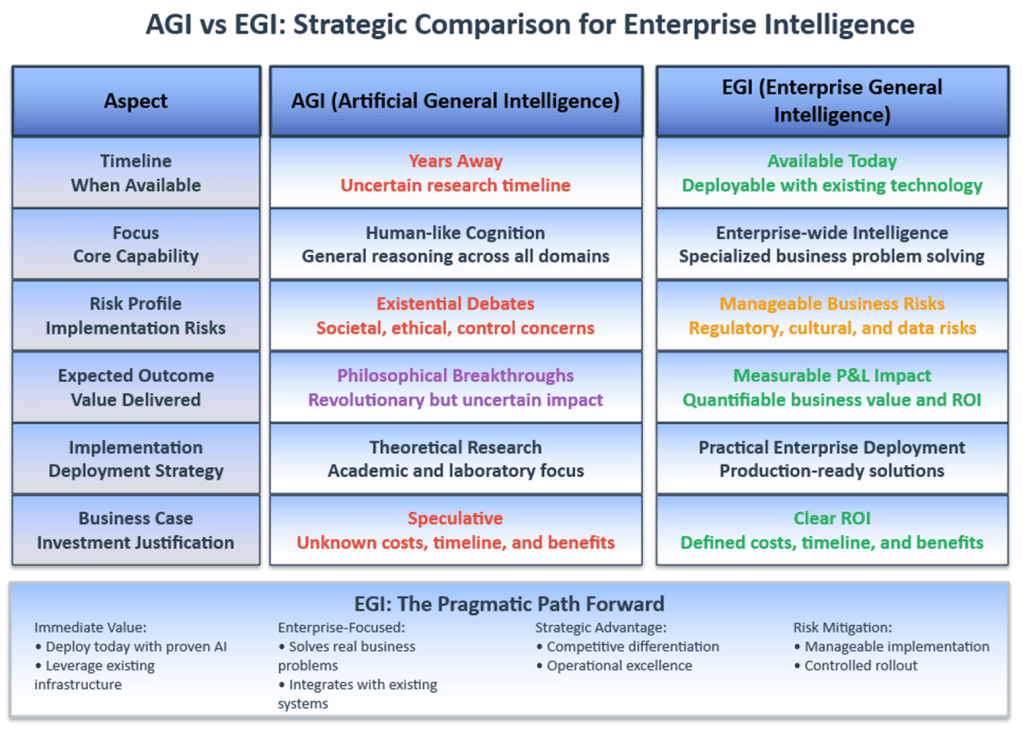
The AGI vs EGI reality
Here’s the disconnect: AGI chases human-like thinking, but businesses need practical solutions, not machine-like philosophers. We need smarter enterprises that cure diseases, deliver clean energy and make transportation safer.
Consider the breakthrough innovations that defined the last decade:
- mRNA vaccines that saved millions of lives
- Autonomous vehicles and battery chemistries are reshaping transportation
- Humanoids that mimic human motions with real-world few-shot learning
- Precision agriculture feeds growing populations while regenerating soil
None emerged from standalone AI systems pursuing general intelligence. They came from enterprises with deeply integrated data ecosystems, cross-functional intelligence capabilities and the operational capacity to execute at a global scale.
The untapped gold mine: enterprise data
Here’s what keeps me up at night and excited at the same time about the opportunities lying ahead: enterprises are sitting on decades of untapped intelligence. At Johnson Electric, where we manufacture a billion motion systems annually across 23 countries, we have:
- 40 years of engineering designs in disparate CAD systems and PDFs
- Millions of quality reports across handwritten logs, MES databases and Excel sheets
- Decades of supplier performance insights scattered through emails, ERP records and contracts
- Billions of sensor readings streaming from manufacturing equipment
The problem? This data was designed for rule-based systems of the past. Traditional approaches like retrieval-augmented generation (RAG) can retrieve documents, but they can’t understand relationships.
Let me give you a real example. RAG finds purchase agreements, orders, invoices and quality reports. But only knowledge graphs understand that when I discover a quality issue with Supplier A, it affects 15 products, impacts three customer deliveries, presents multiple 8D analyses to customers and requires specific contract remediation steps. That is the difference between information retrieval and intelligence.
The Moderna proof point
When Moderna developed COVID-19 vaccines in record time, it wasn’t because they achieved artificial general intelligence. They had something more powerful: enterprise-wide intelligence that connected genomic databases to manufacturing systems, linked supply chain optimization with regulatory compliance workflows and integrated quality management with global distribution networks.
That’s EGI in action — it literally saved millions of lives while traditional AI research remained focused on academic benchmarks.
In my experience, manufacturing enterprises reduce unplanned downtime by 60% or more. Supply chain operations that once struggled with 70% on-time delivery now consistently hit 99%+. Quality management systems achieve near-perfect accuracy through comprehensive AI-driven analysis.
The model context protocol: EGI’s secret weapon
The breakthrough in our own operations came when we implemented Anthropic’s open-source model context protocol (MCP) to connect our LLMs directly to enterprise systems.
MCP enables our AI agents to not just analyze but act — safely, within governance boundaries, with full audit trails. This is the bridge between intelligence and execution that AGI research hasn’t even begun to address.
The 8-pillar EGI transformation model
The EGI framework I’ve developed operates through eight interconnected pillars that create a self-reinforcing intelligence flywheel:
Raman Mehta
Foundation layer
- Harmonized enterprise data lakes: Incorporating semantic relationships rather than just storage efficiency
- API-first enterprise integration: Preserving context rather than stripping it away during data movement
Intelligence layer
- Enterprise language models (ELM): Purpose-built, fine-tuned LLMs that understand industry and enterprise-specific contexts
- Human-in-the-loop validation: Ensuring intelligence serves business objectives with accountability
Execution layer
- Intelligent automation: AI reasoning that adapts to changing conditions
- Real-time business intelligence: Actionable insights driving strategic decision-making
Innovation layer
- Innovation acceleration: AI-driven product and process development
- New service creation: Revenue diversification through AI capabilities
Each pillar reinforces the others, creating exponential intelligence growth rather than linear capability improvements.
Why some enterprises will win, and others will fail
The road to EGI requires hard work, new thinking and commitment to aligning enterprise workflows with the modern AI era. Through this series, I will lay out the core EGI components your enterprise needs to master:
- Unified data architecture: Breaking down silos
- Knowledge graphs: Contextual reasoning fabric
- Model context protocol: Enabling AI to act, not just advise
- Autonomous agents: The workforce that never sleeps
- Human-AI collaboration: Change management for the intelligence age
The EGI maturity model: Where is your organization?
Raman Mehta
Based on my observations of a multitude of enterprises, most enterprises today operate at Level 1 (Ad-hoc AI experiments) or Level 2 (Departmental pilots), treating AI as isolated projects rather than enterprise transformation. Level 3 organizations achieve integrated intelligence across business units, while Level 4 represents true EGI — autonomous systems making complex decisions at scale. The jump from Level 2 to Level 3 is where most organizations fail, unable to break down data silos and governance barriers. Understanding where you stand on this maturity curve determines whether you’ll lead or follow in the intelligence revolution.
The transformative societal impact
When I see manufacturing EGI systems orchestrating thousands of suppliers, predicting disruptions weeks in advance and automatically rerouting production across global facilities, I realize we are witnessing an industrial transformation that redefines what’s possible. This is not theoretical — we’re deploying these systems today through integrated enterprise data, knowledge graphs and autonomous agents working in concert.
Real-world EGI impact today
Based on my observations across the industry:
- Manufacturing: Global supply chains are self-optimizing to reduce waste by 30-40% while cutting carbon footprints
- Agriculture: Precision farming is increasing yields by 20-30% while regenerating soil health
- Energy: Smart grids seamlessly integrating renewable energy at scale
- Financial services: Real-time fraud detection, preventing billions in losses
What excites me most about EGI is its immediate, tangible impact on humanity’s greatest challenges. While the technology world debates future possibilities, we’re quietly revolutionizing how enterprises build, grow and power our civilization.
The call to action
The next decade’s winners will not be those waiting for AGI. They will be enterprises that build EGI systematically, starting with:
- Executive alignment on EGI as a strategic priority, not an IT initiative
- Data architecture modernization to support AI reasoning, not just human analytics
- Pilot programs demonstrating agent-driven value creation in core processes
- Governance frameworks ensuring trusted and explainable decisions
- Change management programs prepare organizations for intelligent operations
By 2026, organizations that operationalize AI transparency, trust and security will see their AI models achieve 50% improvement in adoption, business goals and user acceptance.
The bottom line
AGI might arrive someday. EGI is delivering results today. Which will your competitors choose?
While the world debates whether machines can think like humans, enterprises implementing EGI are transforming industries through intelligent systems that optimize energy grids, revolutionize manufacturing and ensure food security. The question isn’t whether AGI will eventually arrive — it’s whether your enterprise will build EGI before your competitors do.
The EGI revolution isn’t coming. It is here. And the enterprises that recognize this will own the future.
This article is published as part of the Foundry Expert Contributor Network.
Want to join?
Read More from This Article: Why EGI will deliver the AI revolution that matters
Source: News