

An explosion of chatbots brought on by rapid advancements in generative AI over the last few years has led to mass adoption of the tools both by enterprises and consumers for a variety of use cases.
While the tools are lauded for their speed, comprehension of natural language and efficiency, in some instances, the digital tools have been blamed for dangerous suggestions leading to real harm.
Still, there’s no sign of these technologies or their adoption slowing down. Market research company Mordor Intelligence estimates the global chatbot market to grow from a market size of $9.3 billion today to $29.07 billion by 2030.
Weekly users for one of the most popular tools (and arguably the one that brought AI to mainstream headlines), OpenAI’s ChatGPT, recently topped 700 million as of August 2025. This single chatbot platform alone reportedly received 2.5 billion daily prompts in July 2025. OpenAI, the tech giant behind the generative AI tool, also just surpassed a $500 billion valuation.
ChatGPT is just one of many AI-powered chatbots and use cases for these tools only continue to grow.
AI chatbots are gaining traction for everything from simple answer engines to code writing agents to writing assistants, creative design tools and even mental health support. For all the positive elements AI chatbots deliver, they’re known to hallucinate answers and share false information.
Regardless, these powerful tools are here to stay, which means understanding their benefits and drawbacks is increasingly critical for executives in any industry.
Chatbot origins and definition
Chatbots originated as menus of options for users, decision trees, or keyword-driven tools that looked for particular phrases (or utterances), such as “cancel my account.” Current iterations use AI and machine learning to create a more human-like experience.
AI-powered chatbots of today are highly advanced at using large language models (LLMs) to analyze natural language processing (NPL) and even detect sentiments behind user requests.
The advanced AI models of today owe their capabilities to their ancestor ELIZA, the first basic chatbot developed in the 1960s by Joseph Weizenbaum, a computer scientist at the Massachusetts Institute of Technology (MIT). ELIZA was hosted on an early mainframe computer and simulated conversation with pattern-matching rules and pre-programmed phrases. ELIZA was rudimentary in comparison to today’s standards and did not actually have the capability to analyze and comprehend a conversation with a user.
Still, this early iteration mimicked human conversation with a psychiatrist in such a way that if a user typed “I am sad,” it might reply “Why are you feeling sad?” much like the tools of today do as well. This gave way to what was dubbed the “ELIZA effect” – a phenomenon referencing the human tendency to project human traits onto technology and become attached to the program.
Since the boom of AI chatbots in recent years, there have been multiple accounts of individuals growing attached to AI chatbots, forming deep relationships and friendships with the tools of today that can process, remember and comprehend sentiment. There have also been at least 17 cases of AI-induced bouts of psychosis in which these chatbots have reinforced delusions and led individuals to troubling mental health states and behaviors.
Preprint research released in September 2025 concluded that “across 1,536 simulated conversation turns, all LLMs demonstrated psychogenic potential, showing a strong tendency to perpetuate rather than challenge delusions.”
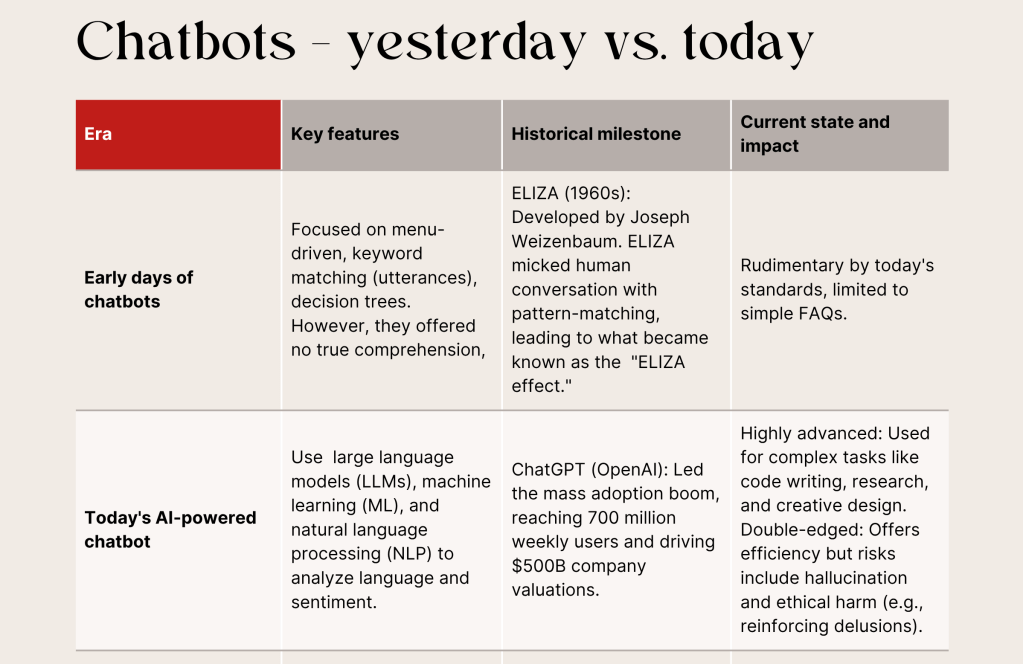
Chatbots aren’t necessarily new technology. However, the arrival of generative AI has greatly expanded their capabilities.
Foundry
OpenAI is being sued by the family of a 16-year-old after what started as using ChatGPT for homework help grew into the child asking for suggestions and the most effective ways to commit suicide. The bot guided him through recommendations step-by-step, according to court documents filed in August 2025, rather than referring him to mental health resources. The boy ultimately died by suicide shortly after.
The company has since worked to put more mental health guardrails and parental controls in place, but the incident is a glimpse of just how deeply chatbots have infiltrated daily life and relationships.
Chatbots of today can be defined as simply computer programs designed to simulate human conversations, but their use cases and depth of capabilities continue to multiply.
“This isn’t about massive, generalized models that skim the surface; it’s about small, focused agents that collaborate behind the scenes to solve real problems,” Mark Sundt, the chief technology officer at Stax Payments, a business-to-business payment platform, said.
Chatbot examples
Advancements in generative AI over the last few years made way for the creation of an amalgamation of chatbots with similar capabilities but different strengths.
The most popular bots are Open AI’s ChatGPT followed by Google’s Gemini, Meta AI, Amazon’s Alexa, Apple’s Siri, Anthropic’s Claude, Deepseek, Grok, Microsoft’s Copilot and Perplexity, according to research from Menlo Ventures.
As one of the first to dominate the market in this sector, ChatGPT continues to top the list with the most users, but its analysis, conversational, content generation, writing and research capabilities are similar to other bots.
Claude has been praised for its power with creative tasks, while Perplexity has been regarded for research and up-to-date data.
Google’s Gemini and Microsoft’s Copilot are baked into each company’s suite of business tools and workspaces for enhanced user experiences. Grok is integrated into the social media platform X (formerly Twitter) for similar user enhancement purposes.
Each tool can roughly do the same thing, but with different programming, training models and guardrails they’ll handle and respond to similar requests in a slightly different fashion.
Chatbot use cases
The most common use of chatbots within an enterprise setting is still for customer service.
Responding instantly on-site to customer inquiries, answering FAQs, guiding through order and check-out processes and helping with shopping assistance are just a few use cases.
Internally, chatbots can also be integrated into platforms like Salesforce and HR or IT tools to help with lead generation, payroll and benefits questions and basic technology issues, saving human employees time on larger, more demanding tasks.
“Chatbots have been part of the hiring process for more than a decade. …” Kathleen Preddy, a senior data scientist at HireVu, a recruitment platform, said. “ Today’s AI-powered chat experiences are far more capable. Built on LLMs, they understand context, interpret intent, and engage in dynamic, human-like dialogue that keeps candidates informed and connected rather than frustrated.”
Creative use cases also continue to grow. Chatbots can develop images and rough logos in under a minute from a single prompt, help with brainstorming, manage to-do lists, take a jab at problem-solving and even generate video.
“As AI takes on more repetitive, structured tasks, team members are freed up to handle strategic and emotional moments: calming an angry customer, solving a case, or managing high-stakes escalations,” Sundt said. “That shift requires new skills. Tech professionals need to get fluent in working alongside AI, whether that’s through interpreting its recommendations, overseeing its knowledge base, or intervening when necessary. We’re training teams to become more like AI coaches and risk escalators, rather than just support representatives.”
Chatbot software
The major cloud vendors all have chatbot APIs for companies to hook into when they write their own tools. There are also open source packages available, as well as chatbots that are built into major CRM and customer service platforms.
Standalone chatbots are also available from a number of companies and can be customized based on enterprises’ specific needs.
OpenAI’s ChatGPT also has an open-source large language model dubbed “GPT-OSS” which is released under the Apache 2.0 license and allows developers to build on top of freely, customize and deploy without restrictions.
Chatbots, AI and the future
Chatbots originally started out by offering users simple menus of choices, and then evolved. This is where AI comes in. Natural language processing is a subset of machine learning that enables a system to understand the meaning of written or even spoken language, even where there is a lot of variation in the phrasing.
To succeed, a chatbot that relies on AI or machine learning needs first to be trained using a data set. In general, the bigger the training data set, and the narrower the domain, the more accurate and helpful a chatbot will be.
As AI technology continues to evolve, so too will chatbot use cases. Research projects that the future of chatbots will become more autonomous, hyper-personalized, increasingly agentic and voice-activated.
However, these tools continue to evolve, one thing is clear, chatbots of today are no longer merely answering questions or looking up insights, they are advanced, learning agents capable of driving business impact.
“The real shift we’re seeing is that organizations are connecting conversational interfaces directly to governed, interoperable data environments,” Scott Gnau, head of data platforms at InterSystems, a provider of data management solutions, said. “That means responses aren’t just fast; they’re grounded in accurate, contextual information. When these systems are built on open standards and smart data fabrics, they stop being novelty tools and start becoming integral parts of enterprise decision-making.”
As functionality continues to become enhanced, so will the need for robust privacy policies, compliance and regulation.
More on natural language processing:
Read More from This Article: What is a chatbot? The rise, risks, and impact of generative AI
Source: News