

AI is now a standard topic in boardrooms, signaling a clear shift from experimental capability to declared strategic priority. When we examine earnings call transcripts across sectors, we see AI mentions spiking sharply beginning in 2022, coinciding with the maturation of large language models and the broad availability of generative tools.
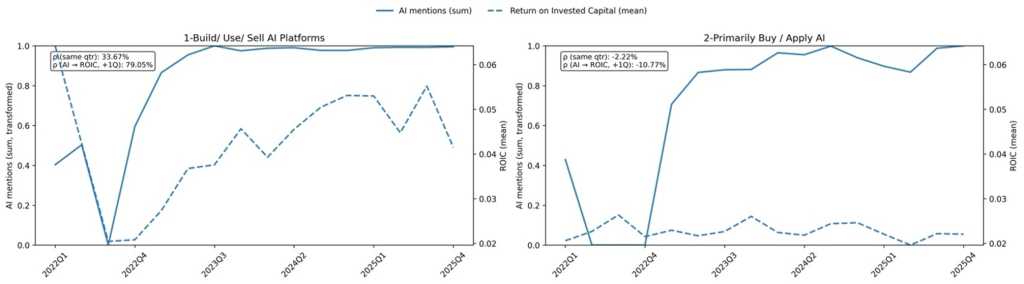
To understand whether that narrative translates into measurable business outcomes, we analyzed the Fortune AIQ Top 50, a representative set of companies with material exposure to the AI ecosystem. We separated them into two groups to distinguish between organizations where AI is central to the portfolio, i.e., companies that enable AI through infrastructure, hardware, software, revenue model and those where AI functions primarily as a strategic input rather than the product itself, i.e., companies that consume AI to deliver value to customers, employees and shareholders. We then compared the intensity of AI mentions in earnings transcripts with Return on Invested Capital, a core indicator of long-term value creation.
Surendar Narasimhan
The analysis reveals two complementary patterns. Companies for which AI is core to the business show a strong and accelerating relationship between AI emphasis and ROIC, reflecting the direct monetization of AI capabilities. Companies that primarily consume AI exhibit more stable ROIC trends that largely track historical and macroeconomic cycles, suggesting AI is not delivering material value. When AI is embedded at the core, value creation appears relatively quickly. When AI is adopted as an enabler, the realization curve is longer and more uneven. In this article, we examine the root causes of that lag and outline what it truly means for an organization to be AI-ready.
For companies where AI is not a core offering, accelerating ROIC has less to do with access to tools or the sheer scale of investment and far more to do with organizational structure. AI compounds value in enterprises that are internally coherent, well-aligned and self-aware in how decisions are made and executed. In fragmented organizations, however, AI often amplifies existing inefficiencies and inconsistencies, accelerating dysfunction rather than delivering sustained financial impact.
This is the defining leadership challenge of the AI era: building the self-aware enterprise, moving away from considering AI as a technology and more as a field, a field that encompasses far more than the technology itself.
Previous technology waves primarily optimized execution. AI changes the role of technology from execution to interpretation. Traditional systems understand content. AI understands context. That shift exposes a hard truth we see repeatedly: context cannot be inferred reliably from disconnected workflows, fragmented systems and siloed data.
When we walk through the evolution and growth of organizations, what we see resembles less an integrated system and more a collection of powerful parts assembled without a unified nervous system. We refer to this condition as the Frankenstein enterprise.
The Frankenstein enterprise
Most large organizations were not designed as integrated systems. They were assembled through acquisitions, regional expansions, product overlays, functional silos and decades of tactical IT decisions. The result is an enterprise composed of strong and capable parts that can move and operate but lack shared awareness.
In Mary Shelley’s story, the monster is not weak. It is powerful and resilient. Its tragedy is not capability but consciousness. Sensation, memory, interpretation and action are not integrated into a single learning loop. Pain is recognized only after damage spreads. Responses occur without understanding how one part affects another.
This is precisely the failure mode AI exposes in the modern enterprise.
For CIOs, this reframes accountability. AI readiness is not an IT maturity issue or a tooling gap. It is a systems problem. Until sensing, interpretation, memory and action are aligned into a single learning organism, AI will accelerate motion without creating understanding. The result is an enterprise that can transact, reconcile and report but cannot learn coherently. Signals arrive late. Decisions conflict. AI trained on fragmented inputs magnifies latency and contradiction rather than producing intelligence.
The 6 myths that keep the monster alive
When we speak with executive teams, the same myths surface repeatedly. They are what keep fragmented enterprises functioning without becoming self-aware.
- Scale equals invincibility. Past survival is mistaken for future safety, and AI trained on lagging indicators reinforces delayed awareness rather than early warning.
- The monster should remain intact. Legacy approval paths and operating models are preserved because they once worked, even when they no longer align with how value is created.
- Stronger parts fix weak coordination. New platforms, tools and consultants (with the best of capabilities) are added without redesigning how decisions connect across the enterprise.
- External polish reflects internal health. Dashboards, reports and transformation narratives mask structural fractures and growing employee friction.
- Point integration creates unity. Systems are connected at the interface level while semantics, workflows and ownership remain misaligned.
- More models mean more intelligence. Specialized AI proliferates without a shared decision architecture, multiplying contradictions instead of clarifying choices.
The charts show where executive attention is going. The Frankenstein analogy explains why results often lag. These myths create the illusion of coherence while structural damage accumulates beneath the surface. AI does not fix this condition. It exposes it.
What makes an enterprise self-aware
A self-aware enterprise resembles a living organism rather than an assembled machine. It shares a common understanding of how work flows, how customers experience value and how decisions propagate across the system. In organizations like this, people across functions describe value creation in remarkably similar terms.
This state emerges through six reinforcing imperatives.
- Workflow congruence inside and out. Internally, processes flow end to end across functions rather than stopping at organizational boundaries. Externally, workflows align with how customers operate rather than how the company assumes they do. When organizations map day-in-the-life experiences for employees and customers, they uncover friction invisible to dashboards, including duplicate data entry, circular approvals, confusing handoffs and rework cycles. These exercises consistently reveal where AI can remove friction or augment decisions long before KPIs surface the issue.
- Governance of data and process. Garbage in is garbage out. For any model to function effectively, organizations need a single, trusted foundation of high-quality data that is well connected across the enterprise. Governing data quality and lineage is, therefore, a critical step in becoming AI-ready. When organizations recognize that a parsimonious set of clean, connected data delivers far more value than vast volumes of incomplete and disconnected information, the journey to AI readiness truly begins.
- Engineering excellence beyond code. AI readiness depends as much on process and experience engineering as on technology. Process engineering maps how work flows and where it breaks. Experience engineering ensures people adopt systems without workarounds. Technology engineering shifts architecture from application-centric silos to unified data-centric platforms. Without these disciplines, AI strategies become elegant narratives that cannot be implemented in the real anatomy of the organization.
- Mastery of time. AI initiatives fail when leaders either chase isolated quick wins or over-rotate toward distant end states. Effective roadmaps balance immediate value with foundational capability building, one use case at a time. The most successful first-year programs focus on visibility, governance and a unified data backbone, allowing AI to learn safely and compound over time.
- Structure for change. Self-awareness cannot be delegated to IT. It requires governance that evaluates initiatives through financial value, architectural coherence and human experience simultaneously. Unified demand management, shared metrics and enterprise-level value dashboards replace siloed decision-making with collective intelligence.
- Sustaining the change. Once coherence is established, sustaining it becomes essential. Like a living system, the enterprise requires nourishment to maintain long-term value generation.
A structured demand framework unifies incoming requests, reveals common needs across the organization and enables scalable solutions. Standardization of digital solutions reduces complexity, lowers cost and concentrates expertise where it has the most leverage. Unified value generation and monitoring ties digital and AI initiatives directly to profit and loss outcomes, shifting focus from feature delivery to margin impact.
From fragmentation to compounding advantage
When sensing, interpretation, memory and action are aligned, AI becomes transformative. Across sectors and industries, the growth pattern becomes consistent. AI delivers step-change value only when the enterprise itself becomes coherent. Revenue accelerates. Margins expand. Innovation compounds.
The CIO’s mandate
For CIOs, the message is clear. AI strategy is enterprise strategy. Tools, vendors and models are secondary to the anatomical work of understanding how the organization senses, interprets, remembers and acts. The question is no longer whether your company uses AI. It is whether your organization understands itself well enough for AI to understand it too. The future belongs to enterprises that move beyond stitched-together systems and develop true organizational self-awareness.
What’s not in this article
The human aspect of this shift. Context has been the domain of humans; it has driven culture, hierarchy and identity. AI will impact context and, hence, impact certain core aspects of identity. The empathy needed to adapt successfully is above all aspects discussed. But that’s for another article/paper/book in itself!
This article is published as part of the Foundry Expert Contributor Network.
Want to join?
Read More from This Article: The self-aware enterprise: Why AI only transforms companies that know themselves
Source: News