

Why do so many data initiatives struggle?
Organizations have been investing heavily in data, analytics and AI for decades. The promise is clear and ambitious: Better reporting, more automation, sharper decisions and new insights that promise breakthrough innovations. Since the arrival of generative AI, value generation with data has climbed even higher on the agendas of executives.
Yet despite billions poured into technology, talent and consulting, most data initiatives fall short of expectations. Reports remain unused, dashboards collect dust and AI pilots rarely scale. Why is this so?
The problem is not technology. Infrastructure and tools are readily available and concepts for data management, business intelligence, data science and AI are mature. The real bottleneck lies elsewhere: How organizations work with data in everyday decisions. In addition to strategic clarity on how data creates competitive advantages, executives increasingly cite data culture as the missing ingredient to becoming truly data-driven.
But here lie some critical questions: What exactly is data culture and how does it relate to corporate culture in general? What role does it play in corporate transformations when organizations aim to become data-driven? And how can executives avoid the often-quoted low success rates of changing organizational culture?
To answer these questions, we first need to look at organizational culture before turning to data culture in particular.
Organizational culture
Executives have long recognized culture as a critical driver of corporate success. Yet large-scale cultural change seems to remain stubbornly difficult. Reports often cite failure rates as high as 70%. Even though scholars debate the figure, most leaders know from experience: Shifting culture is among the hardest management challenges. Why is this the case?
Modern organizational systems theory, rooted in the work of Niklas Luhmann, offers an explanation. From this perspective, culture resists direct control; it can only be influenced indirectly, through the way work is organized and how decisions are made. In other words, culture is not the cause of performance problems or successes, but an effect of how the organization continuously handles them.
As a consequence, culture cannot be treated as something leaders can actively engineer through new values statements, training programs or rebranding exercises. It emerges from repeated interactions and shared experiences. A further implication of the systems-theoretic view is that leaders should resist the common temptation to ‘fix’ people or their supposed mindsets. Behavior always makes sense within the organizational context that produces it. Thus, changing context, not people, is the bigger lever for achieving cultural shift. When that organizational context — such as decision routines, incentives and communication patterns — is adjusted, new behaviors naturally emerge.
For executives, this shift in thinking is crucial. Instead of trying to design a desired target culture, they should focus on value generation and start identifying very specific cultural barriers that block it. Once cultural root causes are uncovered and understood, they can design targeted interventions that reshape how employees make decisions, solve problems and collaborate. Done well, these interventions overcome the barriers to value creation — and, in turn, culture follows as a side effect.
So what does this perspective mean for the quest to build a data-driven organization?
Data culture
To make the concept of data culture tangible, we start with a definition. Data culture can be understood as the recurring patterns by which an organization uses data, analytics and AI to create or protect business value. These patterns show, for example, how much weight managers give to evidence in decision-making, whether data is shared proactively or hoarded for political advantage and whether teams feel safe to challenge intuition with facts—and, just as importantly, to know when to follow intuition rather than relying on facts.
When executives talk about becoming data-driven, they often highlight the need for a strong data culture. It is frequently described as the missing ingredient that explains why so many investments in data and AI fail to deliver business impact. But from a systems-theoretic view, data culture, which is a specific perspective on organizational culture, is not something leaders can design and impose. Like culture more broadly, it emerges from how organizations actually use data, analytics and AI in daily decisions.
This has two important implications: First, treating data culture as a prerequisite for success is misleading: Culture does not come first. It is the result of people’s concrete experiences when solving problems in value creation with data and AI. Second, attempts to engineer data culture are like trying to pull on plants to make them grow faster instead of ensuring the right growth conditions. What matters is that leaders identify and address the root causes that hinder data from becoming a corporate asset. This requires the crucial skill of seeing the invisible: Why does a manager refuse to share data with other departments? Why is it rational for that manager to behave this way?
When data culture is seen this way, it nicely complements data governance. The latter is often understood as designing and enforcing rules, processes and roles to assure data quality and compliance, thus being a foundation for leveraging data as an asset.
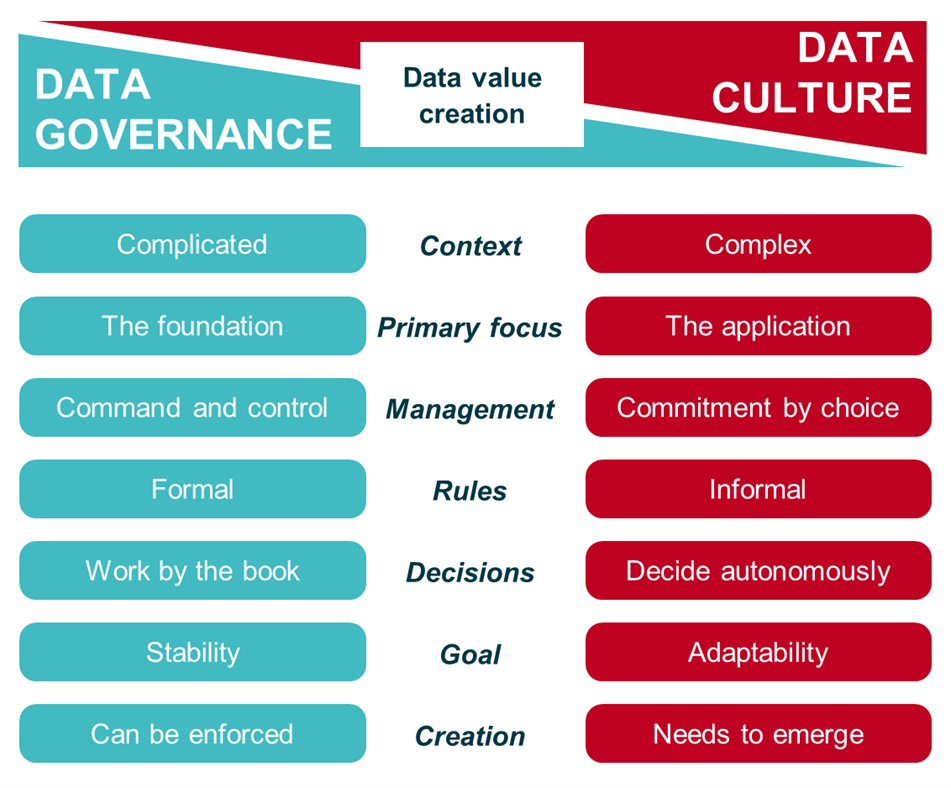
Data governance and data culture are two essential and complementary modes of data value creation. They are the two sides of the coin that determine how an organization translates data into tangible value. While data governance focuses on creating a reliable foundation — the data asset itself — data culture determines how that foundation is used to improve business outcomes. The following framework contrasts these two modes across seven key dimensions.
Jens Linden, Leonie Petry
Data culture becomes decisive at the moment of application — especially when teams must make autonomous decisions under uncertainty rather than ‘work by the book.’ Another crucial distinction is that data governance can be mandated, whereas data culture cannot — it only emerges naturally.
Making data culture practical: A tool and an example
If culture eludes design, what tools can leaders use to work with culture as a sensor? The Culture Board is such a tool helping to link business needs with cultural barriers and to create effective interventions. The following five-step process is based on its structure and adapted to focus on data culture:
- Business need: Frame the guiding organizational challenge clearly.
- Identify: Uncover cultural patterns in light of the business need.
- Sense: Distill and prioritize the barriers that matter most.
- Creating: Design interventions that connect to daily practice.
- Implement: Anchor interventions and observe their impact over time.
To see how the Culture Board works in practice, consider a hospital that sets out to improve patient safety by learning from medical errors. Although a reporting system was in place, almost no incidents were logged in useful detail, making it impossible to generate insights and learn from past incidents. The business need was clear: The reduction of error rates was not only a regulatory requirement, but also a strategic demand to stay competitive.
In the identify phase, leaders dug deeper and a telling pattern emerged. Staff avoided reporting. Doctors and nurses feared reputational damage or disciplinary action. On top of that, efficiency targets left no time for careful documentation. Thus, the Culture Board helped frame these issues not as a lack of human commitment, but as contextual barriers that had to be addressed.
In the sense phase, leaders agreed: Unless incident reporting became safe and worthwhile, no real progress was possible.
Two interventions followed these insights. The incident reporting process was redesigned to guarantee anonymity. At the same time, incentive structures were adjusted: Efficiency KPIs that solely focused on treatment efficiency, but punished detailed logging of incidents, were removed.
The results were striking. Both the number and the quality of reports rose sharply. A small innovation team could now analyze the richer data, develop better insights and measures that reduce error rates in specific procedures. As these improvements became visible, staff began to trust the system and a new culture began to emerge.
This outcome also reveals a powerful dynamic of data value generation: The feedback loop. The primary path is clear: A formal change in data governance can impact data culture. But crucially, this new culture can, in turn, improve the data asset itself, as the example of staff providing richer reports illustrates. The interplay of data governance and data culture creates a virtuous cycle, where an emergent culture actively strengthens the very formal system that enables it. This cycle is the true engine of sustainable, data-driven transformation.
Identifying and outwitting barriers
Executives often treat data culture as something broken that must be fixed before their organizations can become data-driven. But modern organizational theory suggests this is an error in reasoning. Attempts to engineer a desired data culture have low success rates by design. In contrast to data governance, data culture is the result, not the prerequisite, of becoming data-driven.
Instead, leaders should focus on identifying and outwitting the barriers that block value creation with data, analytics and AI. When these barriers are addressed, business success with data improves — and a suitable data culture emerges as a side effect, creating a virtuous cycle that actively strengthens overall data value generation.
Adopting this perspective enables organizations to shift focus and investments away from broad cultural initiatives and standard recipes with inherently low chances of success. Instead, resources can be directed towards the real challenge: Identifying data cultural patterns hindering value generation. Once the underlying contextual barriers are uncovered, this allows us to design interventions that enhance value creation and, in turn, finally improve the return on data investments.
This article is published as part of the Foundry Expert Contributor Network.
Want to join?
Read More from This Article: Stop trying to engineer data culture
Source: News