

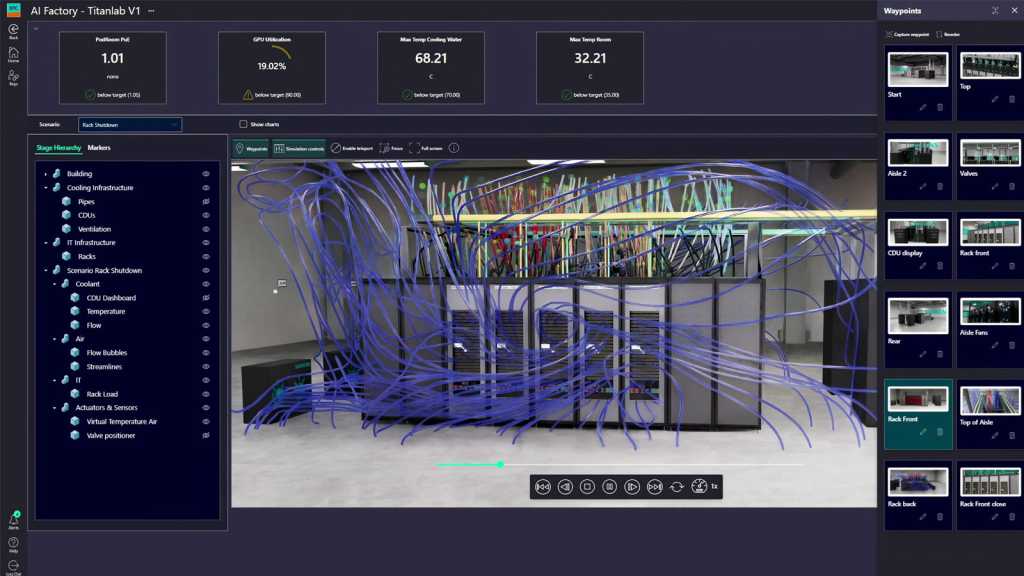
Siemens’ Digital Twin Composer enables companies to use industrial AI, simulations, and real-time physical data to make decisions virtually.
Siemens
Siemens’ joint keynote with Nvidia at CES should make it clear that, with AI, the manufacturing industry is poised for its next major transformation.
Siemens CEO Roland Busch and Nvidia CEO Jensen Huang presented a vision in Las Vegas that would make AI the operating system for the industrial sector — one that would revolutionize the industrial value chain, from initial design through production to complex supply chains.
“Just as electricity once revolutionized the world, industry is now undergoing a profound transformation,” Roland Busch explained during his keynote address. It’s no longer just about individual functions, but about “integrated intelligence” that enables companies to anticipate problems before they arise.
Digital Twin Composer as a bridge to the metaverse
The centerpiece of this technological vision is Digital Twin Composer, which is expected to be available in mid-2026 the Siemens Xcelerator Marketplace. The new offering aims to make the industrial metaverse feasible on a large scale.
The technology combines Siemens’ digital twins with photorealistic Nvidia Omniverse libraries and real-time engineering data. With Digital Twin Composer, users can rewind and fast-forward time in a virtual 3D environment, allowing them to simulate the effects of weather changes or technical adjustments to systems. In other words, the user gains a kind of crystal ball for factory planning, making it possible to correct errors in the virtual world before “even a single atom is brought into the real world,” according to Rev Lebaredian, vice president of Omniverse and simulation technology at Nvidia.
PepsiCo demonstrates what’s possible
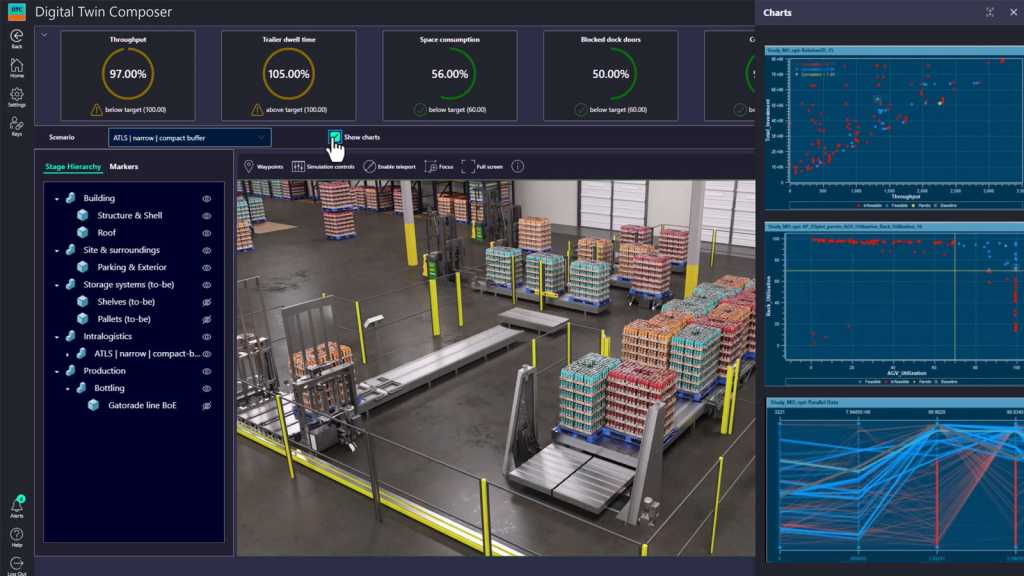
PepsiCo is digitizing selected production facilities and warehouses in the US using the Digital Twin Composer.
PepsiCo
That this isn’t a distant dream was demonstrated by beverage and food giant PepsiCo. The company is already using Digital Twin Composer in its US plants to digitally map production and storage locations. According to PepsiCo, the results speak for themselves:
• 90% of potential problems are identified before physical changes are made.
• Throughput was increased by 20% in the first implementation.
• Capital expenditures decreased by 10% to 15%.
AI copilots for the factory of the future
But Siemens is going even further, offering nine new industrial copilots designed to make work in manufacturing smarter. They will help optimize navigation through product data and shorten time to market. And the technology is intended to become wearable. In cooperation with Meta and Ray-Ban, AI glasses are being developed that will deliver real-time audio guidance and safety information directly into the field of vision of factory workers.
Siemens intends to provide proof this year that this is more than just PowerPoint presentations. To this end, the Siemens device plant in Erlangen will be transformed into the world’s first fully AI-controlled, adaptive manufacturing facility. This will serve as a blueprint for the next generation of “AI factories.”
But industrial AI’s influence extends beyond the factory floor. In the life sciences sector, the integration of research data enables life-changing therapies to reach patients up to 50% faster. At the same time, Commonwealth Fusion Systems is working with Siemens to pave the way for commercial nuclear fusion.
Read More from This Article: Siemens and Nvidia outline a radical realignment of manufacturing at CES
Source: News