

Why AI in M&A, and why now?
The technology landscape is expanding rapidly, leading to increasingly complex tech stacks that contribute to heightened risks and intricacies in mergers and acquisitions (M&A). Traditional methods such as spreadsheets and manual analyses are proving inadequate, often consuming excessive time and being prone to errors. These approaches also demand specialized skill sets and extensive human input to validate outputs, undermining the efficiency that modern technology aims to achieve.
As M&A strategies evolve, there is a pressing need for swift and precise decision-making. Over the past five decades, approximately 992,000 M&A deals have been executed globally, with a total known value exceeding $57 trillion. This wealth of information underscores the necessity of leveraging AI to navigate the complexities of contemporary M&A activities. (IMA&A).
The M&A pain points AI can solve
1. Data overload during due diligence
Due diligence has become a data problem. IT leaders now face terabytes of structured and unstructured information from ERP and CRM records to contracts, emails and market intelligence. Manual review slows down decisions, introduces errors and increases the risk of missing critical signals. AI shifts this dynamic by automating data extraction, analysis and anomaly detection. Platforms equipped with machine learning can surface risks, highlight synergies and predict integration challenges in minutes (IMA&A).
2. IT integration risks and redundancies
Post-merger integration remains one of the most failure-prone phases of M&A. Overlapping ERP, CRM, cloud and cybersecurity systems create redundancies, inflate costs and cause delays. Traditional integration built on spreadsheets and manual mapping — only adds complexity. AI-driven integration tools can map IT environments, identify duplicate systems and recommend optimal consolidation strategies. Predictive analytics further flags bottlenecks before they derail timelines (Statista).
3. Cultural and workforce misalignment
People-related issues often undermine otherwise strong deals. Cultural friction, communication gaps and talent flight can stall synergy realization. Traditional methods like surveys and workshops aren’t enough at scale. AI tools now analyze communication patterns, sentiment and engagement across collaboration platforms to give leaders real-time insight into morale and alignment. Predictive models identify flight risks and resistance points, enabling targeted interventions that accelerate adoption.
4. Cybersecurity blind spots
Blending two IT ecosystems introduces new vulnerabilities — unpatched systems, unsecured data stores and outdated software. Manual audits rarely catch everything. AI-based cybersecurity tools continuously scan environments, detect anomalies and rank vulnerabilities based on potential impact. These systems help move from reactive security to proactive protection, allowing integration efforts to continue without exposing the business to unnecessary risk. For examples of cybersecurity failures linked to M&A (CISA).
5. Regulatory and compliance hurdles
M&A deals face a growing web of compliance requirements across privacy, antitrust, labor and industry regulations. Manual reviews are slow, expensive and error-prone. AI can automate contract analysis, track regulatory changes and generate real-time compliance insights to accelerate approvals and reduce legal exposure. With global regulations evolving rapidly, automated compliance has become a necessity (Govt. Info).
Real-world impact: How AI has already shaped M&A success
AI has moved from concept to reality in M&A, enabling companies to accelerate deals, uncover hidden risks and unlock greater post-merger value.
Example 1: AI accelerating due diligence (speed + accuracy)
Traditional due diligence can take months, requiring manual review of financial statements, contracts and operational data. AI platforms significantly reduce this time while improving accuracy. Advanced document analysis and financial modeling tools can process thousands of records in hours, identifying inconsistencies, anomalies or hidden liabilities that might otherwise be overlooked. The result is faster deal execution and more informed decision-making.
Example 2: AI driving post-merger IT integration efficiencies
Post-merger IT integration is one of the most resource-intensive phases of M&A. AI tools help map IT systems, detect redundancies and automate consolidation tasks, dramatically improving efficiency. Machine learning algorithms can simulate integration scenarios, predict bottlenecks and recommend optimized workflows, allowing teams to accelerate synergy realization while minimizing operational disruption.
The essential AI toolbox for M&A leaders
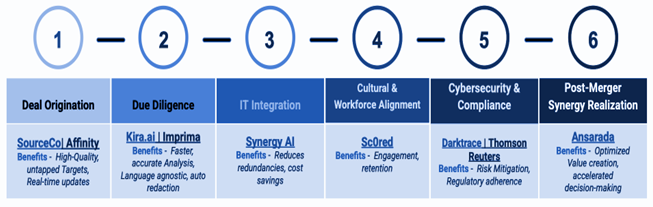
AI is transforming M&A by streamlining every stage of the deal lifecycle from automating due diligence and analyzing financials, contracts and market sentiment to mapping IT systems, identifying redundancies and monitoring workforce engagement. By applying machine learning, natural language processing and predictive analytics, AI helps leaders uncover hidden risks, highlight synergies and accelerate integration planning, making complex processes faster, more accurate and insight-driven.
In addition, AI strengthens cybersecurity and compliance by continuously monitoring IT environments, detecting anomalies and ensuring regulatory adherence across multiple jurisdictions. This enables deal teams to make confident, data-driven decisions, improve employee adoption, mitigate operational risks and ultimately capture post-merger value more effectively, turning traditionally labor-intensive and high-risk activities into strategic advantages
Kashif Syed
Your M&A AI roadmap: How to get started
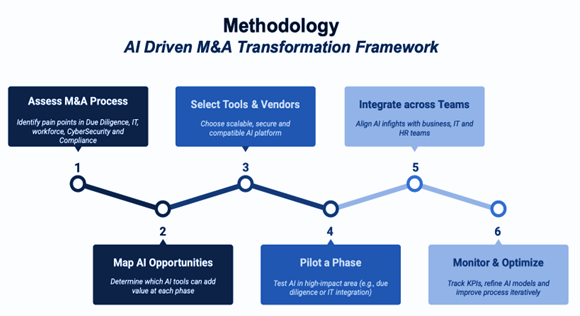
Implementing AI in M&A is not just about adopting technology, it requires a strategic, step-by-step approach to maximize value and minimize risks. IT leaders can follow a structured roadmap to embed AI successfully across the M&A lifecycle
- Assess Current M&A Processes: Identify pain points in due diligence, IT integration, workforce alignment, cybersecurity and compliance where AI can add value.
- Select the Right Tools and Vendors: Choose scalable, user-friendly AI solutions that fit your technology ecosystem and provide actionable insights.
- Pilot in One Phase Before Scaling: Start with a high-impact area to test AI capabilities, measure results and refine processes before full deployment.
- Align with Business and Integration Teams: Ensure collaboration across business, IT and integration teams so AI insights translate into actionable decisions and drive adoption.
- Measure Synergy Realization: Track outcomes like speed, risk reduction, integration efficiency and cost savings to optimize AI’s impact and capture post-merger value.
Kashif Syed
The future of AI in M&A
AI is rapidly becoming a strategic driver in mergers and acquisitions, transforming every phase of the deal lifecycle. Beyond efficiency, AI predicts deal outcomes, simulates integration scenarios and guides execution with minimal manual effort.
Predictive tools can score deal potential, helping executives prioritize targets, allocate resources and make faster, data-driven decisions. Digital twins allow leaders to model IT systems, business processes and workforce dynamics, anticipating challenges and optimizing strategies before committing resources.
Looking ahead, AI is expected to autonomously plan and execute integration tasks, continuously adapting workflows and identifying bottlenecks. Ultimately, AI will become a standard part of the toolkit, embedded across due diligence, IT integration, risk management, cultural analysis, cybersecurity and compliance, turning complexity into clarity and maximizing post-merger value.
Conclusion: From chaos to clarity
M&A deals are complex, but AI provides a clear path to manage that complexity. From accelerating due diligence to optimizing IT integration, workforce alignment and compliance, AI empowers leaders to make faster, smarter decisions.
Leaders who embrace AI strategically can capture post-merger synergies, unlock value and gain a competitive edge. By starting with pilots, scaling across phases and measuring outcomes, organizations can move from operational chaos to strategic clarity.
This article is published as part of the Foundry Expert Contributor Network.
Want to join?
Read More from This Article: How AI can shape M&A success
Source: News