

It’s the slow change no one notices: AI models evolve and people adapt to that. Systems learn and then they forget. Behavioral drift is quietly rewriting how enterprises operate, often without anyone noticing until it is too late.
In my own work leading AI-driven transformations, I have learned that change rarely happens through grand rewrites. It happens quietly, through hundreds of micro-adjustments and no dashboard flags. The model that once detected fraud with 95% accuracy slowly starts to slip. Employees sometimes clone automation scripts to meet deadlines. Chatbots begin answering differently than they were trained. Customers discover new ways to use your product that were never accommodated as part of the design.
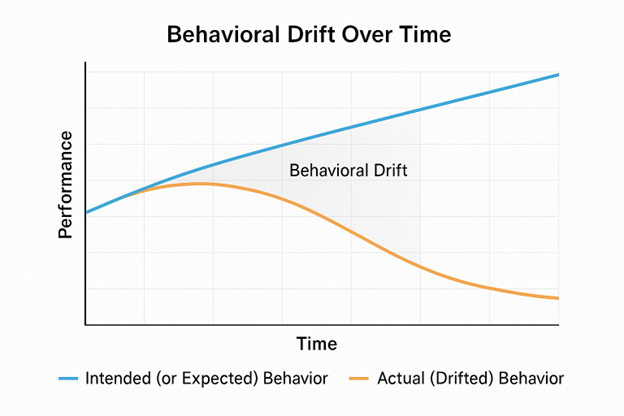
This slow, cumulative divergence between intended and actual behavior is called behavioral drift: A phenomenon that happens when systems, models and humans evolve out of sync with their original design. It sounds subtle, but its impact is enormous: the line between reliable performance and systemic risk.
For CIOs running AI-native enterprises, understanding drift isn’t optional anymore. It’s the foundation of reliability, accountability and innovation.
Why behavioral drift matters for CIOs
1. It impacts governance
Under frameworks like the EU Artificial Intelligence Act (2024) and the NIST AI Risk Management Framework (2023), enterprises must continuously monitor AI systems for changes in accuracy, bias and behavior. Drift monitoring isn’t just a “nice to have” anymore; instead it’s a compliance requirement.
2. It erodes value quietly
Unlike outages, drift doesn’t announce itself. Systems keep running, dashboards stay green, but results slowly degrade. The ROI that once justified an initiative evaporates. CIOs need to treat behavioral integrity the same way they treat uptime: to be measured and managed continuously.
3. It’s also a signal for innovation
Not all drift can be considered bad. When employees adapt workflows or customers use tools in unexpected ways, that leads to a productive drift. The best CIOs read these signals as early indicators of emerging value rather than deviations to correct.
What causes behavioral drift?
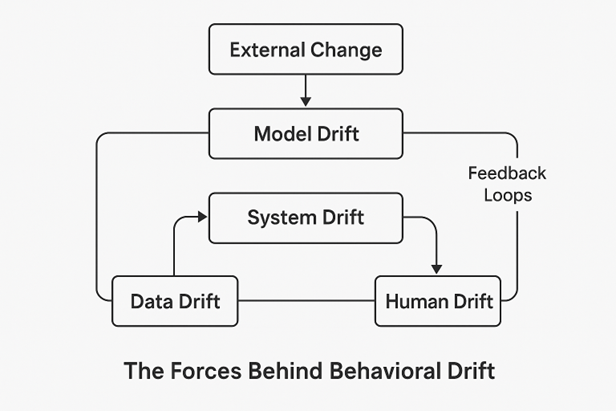
Drift doesn’t come from one source; it emerges from overlapping feedback loops among data, models, systems and people. It often starts with data drift, as new inputs enter the system. That leads to model drift, where relationships between inputs and outcomes change. Then system drift creeps in as code and configurations evolve. Finally, human drift completes the loop where people adapt their behavior to the changing systems, often inventing workarounds.
These forces reinforce one another, creating a self-sustaining cycle. Unless CIOs monitor the feedback loop, they’ll notice it only when something breaks.
Ankush Dhar and Rohit Dhawan
The human side of drift
Behavioral drift doesn’t just happen in code; it happens in culture as well. When delivery pressures rise, employees often create shadow automations: unofficial scripts or AI shortcuts that bypass governance. Teams adapt dashboards, override AI recommendations or alter workflows to meet goals. These micro-innovations may start as survival tactics but gradually reshape institutional behavior.
This is where policy drift also emerges: procedures written for static systems fail to reflect how AI-driven environments evolve. CIOs must therefore establish behavioral observability — not just technical observability — encouraging teams to report workarounds and exceptions as data points, not violations.
Some organizations run drift retrospectives, which are cross-functional sessions modeled on Agile reviews to discuss where behaviors or automations have diverged from their original intent. This human-centered feedback loop complements technical drift detection and helps identify when adaptive behavior signals opportunity instead of non-compliance.
Detecting and managing drift
Forward-thinking CIOs now treat behavioral drift as an operational metric, not a research curiosity.
- Detection. Define what normal looks like for your critical systems and instrument your dashboards accordingly. At Uber, engineers built automated drift-detection pipelines that compared live data distributions with training data, flagging early deviations before performance collapses.
- Diagnosis. Once drift is detected, it is critical to determine its cause. Is it harmful — risking compliance or customer trust — or productive, signaling innovation? Cross-functional analysis across IT, risk, data science and operations helps identify and separate what to fix from what to amplify.
- Response. For a harmful drift, you can retrain it, adjust its settings or update your rules. For productive drift: document and formalize it into best practices.
- Institutionalize. Make drift management part of your quarterly reviews. Align it with NIST’s AI RMF 1.0 “Measure and Manage” functions. Behavioral drift shouldn’t live in the shadows; it belongs on your risk dashboard.
Frameworks and metrics for drift management
Once CIOs recognize how drift unfolds, the next challenge is operationalizing its detection and control. CIOs can anchor their drift monitoring efforts using established standards such as the NIST AI Risk Management Framework or the ISO/IEC 23894:2023 standard for AI risk governance. Both emphasize continuous validation loops and quantitative thresholds for behavioral integrity.
In practice, CIOs can operationalize this by implementing model observability stacks that include:
- Data drift metrics: Utilize population stability index (PSI), Jensen–Shannon divergence and KL divergence to measure how current input data deviates from training distributions.
- Model drift metrics: Monitor changes in F1 Score, precision-recall trade-offs or calibration curves over time to assess predictive reliability.
- Behavioral drift dashboards: Combine telemetry from system logs, automation scripts and user activity to visualize divergences across people, process and technology layers.
- Automated retraining pipelines integrated with CI/CD workflows, where drift beyond tolerance automatically triggers retraining or human review.
Some organizations use tools from Evidently AI or Fiddler AI to implement these controls, embedding drift management directly into their MLOps life cycle. The goal isn’t to eliminate drift altogether: it’s to make it visible, measurable and actionable before it compounds into systemic risk
Seeing drift in action
Every dashboard tells a unique story. But the most valuable stories aren’t about uptime or throughput; they’re about behavior. When your fraud model’s precision quietly slips or when customer-service escalations surge or when employees automate workarounds outside official tools, your organization is sending a message that something fundamental is shifting. These aren’t anomalies; they’re patterns of evolution. CIOs who can read these signals early don’t just prevent failure, they steer innovation.
The visual below captures that moment when alignment begins to fade. Performance starts as expected, but reality soon bends away from prediction. That growing distance, reflected as the space between designed intent and actual behavior, is where risk hides, but also where opportunity begins.
Ankush Dhar and Rhoit Dhawan
From risk control to strategic advantage
Behavioral drift management isn’t only defensive: it’s a strategic sensing mechanism. Global financial leaders such as Mastercard and American Express have publicly reported measurable improvements from monitoring how employees and customers interact with AI systems in real time. These adaptive behaviors, while not formally labeled as behavioral drift, illustrate how organizations can turn unplanned human-AI adjustments into structured innovation.
For example, Mastercard’s customer-experience teams have leveraged AI insights to refine workflows and enhance service consistency, while American Express has used conversational-AI monitoring to identify and scale employee-driven adaptations that reduced IT escalations and improved service reliability.
By reframing drift as organizational learning, CIOs can turn adaptive behaviors into repeatable value creation. In continuous-learning enterprises, managing drift becomes a feedback engine for innovation, linking operational resilience with strategic agility.
The mindset shift
The most advanced CIOs are redefining behavioral management as the foundation of digital leadership. In the AI-native enterprise, behavior is infrastructure. When systems learn, people adapt and markets shift, your job isn’t to freeze behavior; it’s to keep everything aligned. Ignoring drift leads to slow decay. Over-controlling it kills creativity. Managing it well builds resilient, adaptive organizations that learn faster than their competitors. The CIO of tomorrow isn’t just the architect of technology; they’re the steward of enterprise behavior.
CIOs who master this balance build learning architectures, systems and cultures designed to evolve safely. The organizations that thrive in the AI era won’t be those that eliminate drift, but those that can sense, interpret and harness it faster than their competitors.
This article is published as part of the Foundry Expert Contributor Network.
Want to join?
Read More from This Article: Behavioral drift: The hidden risk every CIO must manage
Source: News