

Most CIOs have AI on the agenda. Most have started with pilots, some have moved to production. But there’s a quieter, more consequential shift underway that isn’t getting the boardroom attention it deserves: AI agents are no longer just a feature inside your applications. They are becoming an entirely new class of infrastructure consumer — and your current platforms weren’t built for them.
This is not a warning to panic. It’s a prompt to act with intention.
The Bottleneck Has Moved
When platform engineering emerged as a discipline a few years ago, the problem it solved was clear: developers were slowed down by infrastructure complexity, inconsistent tooling, and cognitive overload. Internal Developer Platforms (IDPs), golden paths, and self-service workflows tackled that problem well.
AI-driven coding accelerators have now shifted the constraint. Developers write code faster than ever. The bottleneck has moved — from writing code to delivering it, governing it, and running it reliably at scale. Meanwhile, autonomous agents are emerging alongside human developers as a new class of platform user, one that consumes APIs rather than interfaces, requires non-human identities, scoped permissions, audit logging, and budget controls.
Your platform engineering team — the group that manages your IDP and developer tooling — now sits at the center of your enterprise AI strategy, whether they know it or not.
What Platform Engineering 2.0 Actually Means
The framing of “2.0” can sound like marketing. It isn’t. What’s changing is who the platform serves, what it must do, and how it must be built [2]. The foundations remain. What extends from them are five capabilities that define whether your platform is AI-ready or AI-blind.
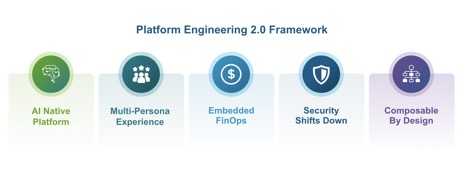
First: AI-native infrastructure. AI workloads — AI agents, models, inference pipelines, training jobs — must run as first-class citizens, not as side projects bolted onto general compute. Agents specifically require MCP gateways, governance, bounded autonomy guardrails, and policy enforcement for the decisions they make on the platform’s behalf. The evolved IDP is increasingly called the Agentic Development Platform, built to enable collaborative software development between humans and AI agents.
Second: serving more than developers. The enterprise software team in 2026 includes data scientists, ML engineers, security teams, and platform operators — each with distinct workflows and context. A platform that only serves application developers is already leaving capability on the table.
Third: cost intelligence embedded in the platform. Cloud sprawl has been a challenge. AI infrastructure spend is a different animal. GPU costs, token spend, and model inference fees accumulate fast and silently. The answer isn’t more FinOps training — it’s platform design that surfaces cost at the point of action, making every developer a cost-aware decision-maker by default. Think of it as moving from rear-view-mirror reporting to provisioning-time decisioning.
Fourth: security that lives in the platform, not on top of it. AI introduces attack surfaces that conventional developer tooling cannot catch: prompt injection, model poisoning, inference data leaks, shadow AI sprawl. Shifting security down means embedding it into the infrastructure itself — not as an overlay, but as an immutable property. When infrastructure is built with security as a first-class feature, developers inherit compliance rather than configure it.
AI workloads get exposed to all the enterprise’s data. Hence, pipelines and guardrails need to be built on how data is handled, processed, and exposed to the AI models. This involves building automated data pipelines that detect and redact sensitive data, contextual access control for RAG privacy through access control for the vector databases, and prompt & output governance with privacy filters. Both infrastructure and data privacy are sacrosanct and hence need to be protected.
Fifth: composability over monoliths. The AI tooling landscape moves faster than any architecture can keep up with. Composable platforms let teams swap model serving implementations, CI/CD engines, or observability stacks without cascading changes — keeping your infrastructure adaptive rather than brittle.
The CIO’s Strategic Angle
Here’s the lens that matters for CIOs: Platform Engineering 1.0 solved the developer productivity problem. Platform Engineering 2.0 must solve the enterprise artificial intelligence problem. What started as a developer productivity function is now the centralized governance layer for the entire enterprise — enforcing cost discipline, security posture, and AI readiness across every team.
That’s a mandate expansion most IT leaders haven’t formally acknowledged yet.
The organizations that will move fastest on agentic AI are not the ones with the most ambitious AI strategies. They are the ones with the platforms capable of supporting autonomous agents as first-class infrastructure consumers — with the guardrails, governance, and cost controls to do it responsibly.
What to Do Now
The action here is not a rip-and-replace of your existing platform. It’s an extension. Three moves matter most:
Tie a platform engineering business case to concrete metrics: developer velocity, cloud cost reduction, AI readiness. Make the value visible. Establish a Platform P&L with FinOps-grade cost attribution so AI infrastructure spend has the same accountability as any other line item. And ask your platform engineering team directly: can our platform provision and govern an AI agent today? The answer will tell you everything about your readiness gap.
The teams that built your IDPs and golden paths now hold the substrate for your enterprise’s agentic future. That’s not a technology decision to delegate. It’s a strategic asset to invest in.
For a deeper dive into the five pillars and a practical framework for modernizing your platform, read the full whitepaper: Platform Engineering 2.0: An Evolution for the AI Era, co-authored by Broadcom and PlatformEngineering.org.
Read More from This Article: What every CIO needs to know about platform engineering in the age of AI
Source: News