

Your CFO has a simple question. “We’re spending more on AI. What are we getting for it?” Most CIOs cannot answer it — not because AI isn’t creating value, but because the accounting systems we inherited were built before AI existed as a category of labor.
This June, the conversation shifted from token maxing to token cutting. The New York Times reported that Meta, Uber, Walmart and Amazon are capping employee AI usage. Uber blew through its 2026 AI budget in four months. Satya Nadella started framing it as human capital versus token capital.
All of that is true. None of it answers the CFO. Capping tokens is an input lever, not an output measure. And the human-versus-token framing names two sources of labor when the reality is four.
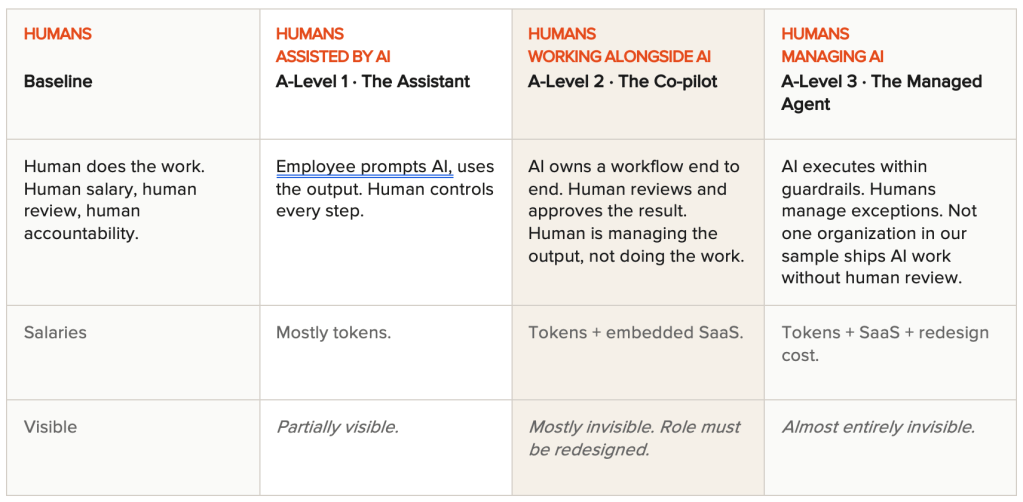
The enterprise now has 4 sources of labor
There are humans. There are humans assisted by AI. Humans are working alongside AI. And humans are managing AI. Sources two through four are all supervised machine labor at different intensities — none of them have a line item, a manager or an hourly rate. In our 2026 AI Labor Report, 78% of leaders view AI as both software and a labor force. The org chart has not caught up. Neither has the P&L.
Lexi Reese
Most enterprises are stuck at A-Level 1 with no accounting for any of it, while quietly sliding into A-Level 2. The job descriptions have not caught up. The budget has not caught up. You cannot upskill into a role that has not been named.
AI is the only category of work the modern enterprise has ever bought without a system of record for what it produced.
What you are actually running is supervised machine labor
The model does a first pass. A human makes it usable. One hundred percent of leaders we surveyed said AI work requires human review before it ships; 34% said substantial editing. That is a workforce with no manager, no hourly rate and no line on the income statement.
The accounting breaks in 3 places at once
Under GAAP: COGS if it helps produce the product, OpEx if it does work for you. The same workflow can hit all three buckets at once. A tier-one support resolution involves the human’s salary (OpEx), the AI’s tokens (COGS if support is a delivered service), and the supervisor’s review time (OpEx). Three buckets. One piece of work. No reconciliation. The token invoice arrives from Anthropic or OpenAI and gets coded to OpEx-software because that is what the bill looks like. Audit partners will be asking about this by next year.
When you call AI a tool, you book it like software. When you call it labor, you have to ask which kind and what it is producing.
The per-employee number is the wrong unit
Per-employee AI spend collapses a workforce into a per-head average. It hides the only number that matters: What AI is producing inside each workflow.
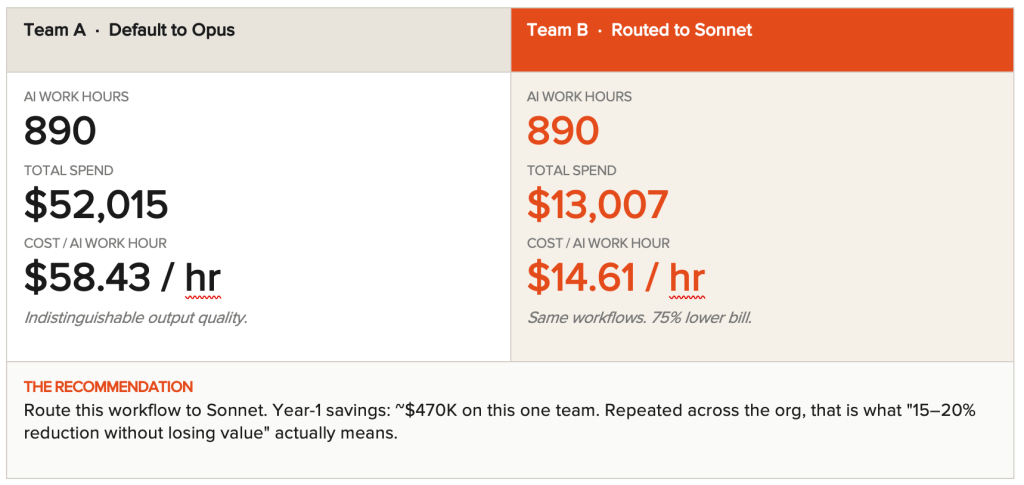
Lanai measured two teams inside the same finance organization. Same monthly prep and variance analysis. AI took the same amount of time to produce outputs of similar quality. The only variable was the model each team reached for by default — a choice nobody had made deliberately and nobody had seen until it was measured.
Lexi Reese
The gap existed for months before anyone saw it.
Faith-based budgeting — the organizational equivalent of putting money in the collection plate and hoping God handles the ROI — is what made it invisible.

Lexi Reese
AI labor orphaning
That is not a measurement problem. It is a category error. We call it AI Labor Orphaning. AI does the work. The output gets credited to the human who approved it. The token bill lands in OpEx-software. The supervision time absorbs into salaried hours nobody is auditing. Eighty-seven percent of leaders admitted AI output is sometimes or always credited entirely to the human employee. This is the last-click attribution problem of the AI era, running in reverse.
What fills the vacuum? Belief. Forty-three percent assume that if AI was involved, it contributed. Only twelve percent have a clear methodology. Seventy-nine percent are worried AI budgets will be cut because they cannot connect spend to results. The cuts are not coming because AI does not work. They are coming because nobody can prove that it did.
Capping tokens may look like responsible governance, but it is like turning off a staticky radio rather than tuning the dial. The companies cutting AI budgets in 2026 will discover in 2027 that they cut the workflows that worked alongside the ones that did not.
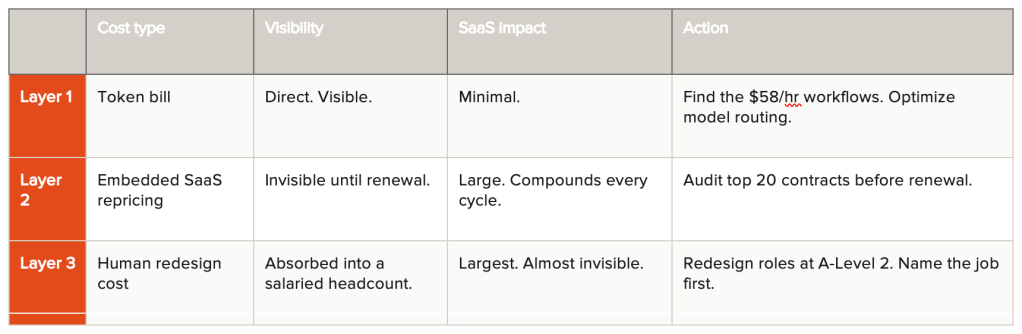
The real cost of AI is not the model. It is the redesign
Three layers. Most organizations only manage the first.
Lexi Reese
What to actually do
The 12% of organizations that can answer the CFO treat AI like every other category of labor — with a cost per AI Work Hour that is accounted for by a set of AI assistants, co-pilots and agents that are held accountable to performance standards.
- Audit the four sources separately. Each A-Level has different token economics, SaaS implications and human redesign requirements.
- Find the embedded SaaS repricing before your next renewal. Pull your top 20 contracts. Ask whether AI features previously included are now priced incrementally.
- Redesign the human role at A-Level 2 before you scale it. You cannot upskill into a role that has not been named.
- Build a system of record before you build the next agent. Start with one department. Two weeks. You will find something that surprises you.
- Stop calling it a tool. Start calling it labor. The language determines the chart of accounts.
When your blended AI rate is $22 an hour, the conversation shifts from ‘we spent $340,000 on AI’ to ‘we acquired a skilled workforce at $22 an hour.’ That sentence is defensible. A vendor invoice is not.
The CIOs who will have a defensible AI story in 2027 are the ones who renamed the work in 2026. Not because technology changed. Because they finally built the accounting to see it.
Findings are drawn from the 2026 AI Labor Report, fielded by Wakefield Research with 200 senior technology leaders at US enterprises of 1,000-plus employees, March 20–April 8, 2026 (±6.9pp at 95% confidence).
This article is published as part of the Foundry Expert Contributor Network.
Want to join?
Read More from This Article: The AI bill is the easy part. The hard part is everything it changed
Source: News