

Voice AI. Conversational AI. You’ve seen both terms everywhere—sometimes in the same sentence, sometimes used as if they mean the same thing.
They don’t. But they’re not opposites either.
One is a category of technology. The other is a specific way to deliver it.
Mix them up and you end up making the wrong platform decisions, building the wrong workflows, and losing 45 minutes in a meeting that didn’t need to happen.
Here’s the difference between voice AI and conversational AI, minus the jargon.
Conversational AI: The intelligence layer
Conversational AI is the broader category. It refers to any AI system designed to understand human language, reason about what was said, and respond in a way that feels natural and contextually relevant. That exchange can happen through text, voice, or any other medium.
What defines conversational AI is the intelligence underneath the interaction:
- Natural language understanding that interprets intent rather than matching keywords
- Dialogue management that tracks what’s been said and what still needs to be resolved
- Response generation that produces output appropriate to the context.
Conversational AI shows up in a lot of forms. A chatbot on a support page is conversational AI. An AI assistant that helps a sales rep draft follow-up emails is conversational AI. A virtual agent that handles inbound customer inquiries is conversational AI.
The intelligence layer makes the interaction feel like a conversation rather than a database lookup.
The channel, the modality, the interface: those are separate from the intelligence. Which brings us to voice AI.
Voice AI: The delivery method
Voice AI is conversational AI delivered through spoken language. It’s the application of conversational AI intelligence to voice-based interactions where the input is speech and the output is speech.
A voice AI system:
- Takes spoken words
- Converts them to text via speech-to-text (STT)
- Runs that text through a conversational AI layer to understand intent and generate a response
- Converts that response back to spoken audio via text-to-speech (TTS)
And it does it all fast enough that the conversation doesn’t feel like it’s buffering.
Voice AI isn’t a fundamentally different kind of intelligence from conversational AI. It’s conversational AI with a voice interface wrapped around it. The reasoning, the context tracking, the dialogue management—those are the same capabilities.
What voice AI adds is the ability to operate through spoken language in real time, with all the additional complexity that introduces: handling interruptions, managing turn-taking, producing natural-sounding speech, and doing all of it with sub-500ms latency.
Ultimately, conversational AI is how the system thinks. Voice AI is how it talks.
How they relate
Voice AI depends on conversational AI to be useful. Without the intelligence layer (intent recognition, context tracking, and coherent response generation), a voice system is just a phone menu with better audio.
The voice interface makes the interaction accessible through speech. The conversational AI makes the interaction worth having.
The relationship goes one way, though.
Every voice AI system uses conversational AI underneath it. But conversational AI doesn’t require voice. A text-based chatbot, messaging bot, or AI assistant embedded in a ticketing system are conversational AI without any voice component.
It’s not really a question of whether you need conversational AI or voice AI. It’s better to ask: does your use case require voice?
- If yes, you need voice AI—which means you also need conversational AI as the foundation.
- If the interaction is text-based, you need conversational AI without the voice layer.
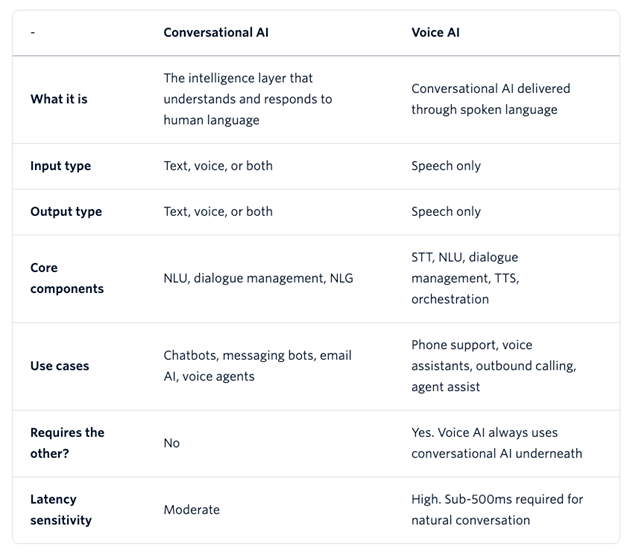
Voice AI vs. conversational AI: Key differences
Side by side, the differences get a lot clearer. Here’s the breakdown across the criteria that matter most for teams building or buying AI for customer service.
When to use conversational AI without voice
Text-based conversational AI makes sense when your customers primarily engage through chat, messaging, or digital channels. And when the nature of the interaction doesn’t require the immediacy of a phone call.
- Support chat on a website
- WhatsApp automation
- AI-assisted email triage
- Messaging bots for transactional notifications
These are all conversational AI use cases where voice doesn’t add much and may introduce unnecessary friction. Not every customer wants to speak out loud, especially in public, at work, or when the question is simple enough to type in thirty seconds.
Text-based conversational AI is also typically faster to deploy, easier to test, and simpler to update. You can iterate on response quality, test new flows, and review transcripts without dealing with audio quality, latency optimisation, or the additional infrastructure that voice requires.
If your primary support and engagement channels are digital and your customers are comfortable typing, starting with text-based conversational AI often makes more sense than jumping straight to voice.
When you need voice AI specifically
Voice AI makes sense when the use case is inherently telephonic, time-sensitive, or requires the kind of nuance that text alone doesn’t capture.
- Inbound phone support: Customers call because they want to talk to someone, or because they’ve always called, or because the issue feels urgent enough that they don’t want to wait for a chat response. An AI that can answer that call, understand the issue, and resolve it in the same interaction replaces one of the most expensive and frustrating moments in customer service.
- Outbound calling: Appointment reminders, fraud alerts, lead follow-up, proactive outreach for at-risk customers. These interactions are harder to execute over text because they require real-time dialogue.
- Context: Tone, urgency, frustration, hesitation—these are signals that a voice AI system can detect and respond to. A customer who speaks with audible frustration is communicating something beyond the literal words, and a well-designed voice AI system can adjust its approach accordingly.
Finally, voice AI matters when your customers are less likely to engage through digital channels. These might be older demographics, industries where phone is still the primary contact method, or use cases where hands-free interaction is a practical requirement.
Do you need both?
For most businesses building serious customer engagement infrastructure: yes.
The customers who prefer chat aren’t going away. Neither are the customers who pick up the phone. A complete AI engagement strategy handles both with a single connected experience rather than two separate systems that don’t know about each other.
And that’s where Twilio Conversations can help.
- Conversation Orchestrator connects voice, SMS, WhatsApp, and chat into one continuous conversation record.
- Conversation Memory gives every agent (AI or human) persistent customer context across channels.
- Conversation Relay handles the voice AI layer: low-latency STT and TTS, bring-your-own-LLM, HIPAA-eligible.
- Agent Connect lets you plug your own AI agents into Twilio channels without rebuilding your communications infrastructure.
Your customers are going to use both voice and text. The question is whether your stack connects them.
Start for free or contact sales to talk through your use case.
Frequently asked questions
What’s the difference between voice AI and conversational AI?
Conversational AI is the intelligence layer that understands human language and generates contextually relevant responses, regardless of channel. Voice AI is conversational AI delivered through spoken language. It adds speech-to-text and text-to-speech components so the interaction happens via voice.
Is voice AI a type of conversational AI?
Yes. Voice AI is a specific application of conversational AI that operates through spoken language. The reasoning, intent recognition, and dialogue management capabilities come from conversational AI. Voice AI adds the speech interface on top to convert spoken input to text, process it through the conversational AI layer, and convert the response back to speech.
Can conversational AI work without voice?
Yes. Text-based chatbots, messaging bots, AI assistants in ticketing systems, and email AI are all forms of conversational AI that don’t use voice.
Does Twilio support both voice AI and conversational AI?
Yes. Twilio Conversation Relay handles voice AI, combining low-latency STT and TTS with bring-your-own-LLM flexibility. The broader Twilio Conversations platform connects voice, SMS, WhatsApp, and chat into a single conversation layer, so the conversational AI intelligence and customer context are shared across every channel.
To learn more about Twilio conversations, visit here.
Read More from This Article: Voice AI vs conversational AI: What’s the difference?
Source: News