

Drowning in hype and under pressure from top leadership, CIOs are racing to operationalize strategic AI initiatives in an effort to demonstrate — and more importantly, deliver — measurable ROI from this equally disruptive and transformative technology.
The perpetual pipeline of AI pilots and rampant experimentation are giving way to a new mandate to prioritize and scale AI solutions with the greatest propensity to deliver business value and impact the bottom line.
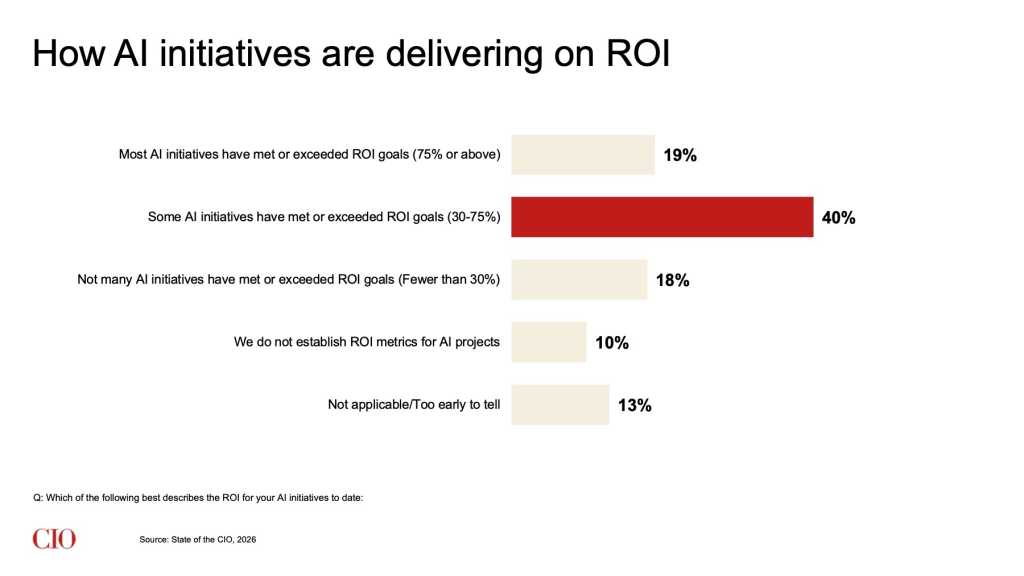
Yet the ability to achieve quantifiable ROI from AI projects remains somewhat elusive for many CIOs as they spearhead AI’s next chapter. According to CIO.com’s 25th annual State of the CIO survey, which canvassed 662 IT leaders and 249 line of business users, less than a fifth (19%) of respondents say AI initiatives have met or exceeded business goals, and 18% admit fewer than a third of AI use cases are meeting defined expectations.
CIO.com / Foundry
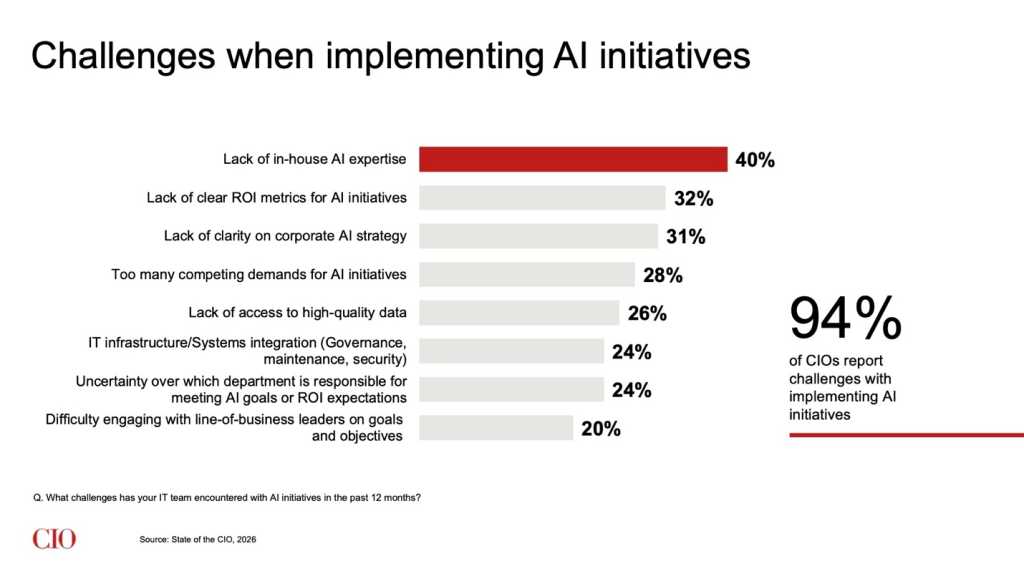
Lack of clarity around business strategy and metrics is proving to be a major barrier to advancing CIOs’ AI agendas. Almost a third (32%) of this year’s State of the CIO respondents called out ill-defined ROI metrics as a hurdle to scaling AI, along with murky corporate AI strategy (31%) and a lack of in-house expertise, cited by 40% of this year’s respondents.
“No one is measuring ROI on an ongoing basis because we are facing counterpressures from every vice president and line-of-business domain looking to implement AI for their own optimization,” notes Andrea Ballinger, CIO at Rensselaer Polytechnic Institute (RPI). “We are saying yes to everyone without stepping back and focusing on the business cases that show real value.”
CIO.com / Foundry
Creating the infrastructure to achieve AI ROI
The dynamic is starting to shift as organizations prioritize targeted use cases and lay the groundwork for scalability and ROI. Cross-functional steering committees and specialized task forces are emerging as critical building blocks to identify, prioritize, and align use cases to enterprise goals. Eighty-three percent of IT leaders surveyed confirmed their organizations either have such structures in place or are planning to implement them within the year. IT is the dominant player on these committees with other functional areas well represented, including corporate leadership and security and risk teams, and to a lesser degree, business-oriented domains such as finance, legal, and HR.
Formal processes for approving AI projects are far less evolved. Slightly more than half (53%) of 2026 State of the CIO respondents have established some type of official approval process, with 28% planning to activate something within the next 12 months.
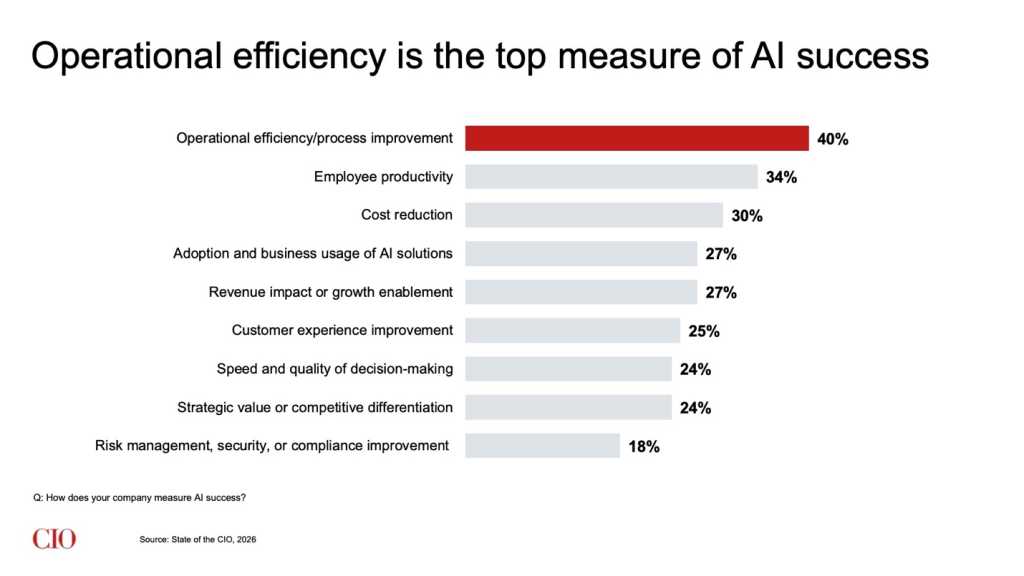
KPIs, another critical milestone for AI success, are also not well defined in most enterprises. Less than half (47%) of respondents have established formal metrics, with another 34% planning to do so within the year. For those measuring AI success, operational efficiency and process improvement rank as the top metric, cited by 40% of respondents, followed by employee productivity (34%) and cost reduction (30%). AI’s impact on revenue or growth is less of a factor today, cited by only 27% of respondents.
CIO.com / Foundry
First Student, a leading provider of school bus transportation services, has stood up a well-defined innovation framework and AI-specific council — two moves CIO Sean McCormack credits to the firm’s early success scaling AI initiatives aligned to key business goals. The AI council, with representation across business leaders and the C-suite, meets regularly to review AI use cases and identify those with most potential for payback.
“We have more discipline around business cases than most companies,” says McCormack. “Everything is metrics-driven and dependent on proving value. By the time we put something into production, it’s been through a series of proof of concepts, there’s been a deep dive on financials, and we are able to move quickly and demonstrate value.”
Three years into its AI journey, TIAA has a rich stable of generative AI and agentic AI use cases spanning fraud detection and prevention along with call center companions and a litany of other tools. The majority (85%) of the financial services firm’s workforce uses TIAA Gate, its internal AI platform. Yet even with all the right structures in place — investment in training, robust governance frameworks, steering committees, an AI center of excellence (CoE), and an enterprise mandate for strategic use of AI as part of everyone’s performance goals — ROI remains a challenge.
“What’s on paper sometimes doesn’t turn into real ROI given the reality of operational costs,” notes Sastry Durvasula, TIAA’s chief operating, information & digital officer. “Something may prove to be a successful pilot, but you need to understand the full cost of operations — for example, the efficiencies of running tokens or how you’re handling traffic or RAG [retrieval augmented generation].”
Thomas Prommer, a longtime CTO, CIO, and CAIO, makes three recommendations to facilitate the quest for AI ROI. First, establish joint accountability at the project level with a named technical and business sponsor for each project, both of whom co-own outcomes. His firm had success replacing a centralized AI CoE with embedded AI squads that live inside individual business units. The CoE model created a clearinghouse that nobody owned, whereas embedded teams force accountability at the point of business impact, he explains.
Prommer’s third recommendation is to implement stage-gated funding tied to outcome milestones, not deliverable milestones. “We don’t fund ‘build a model,’ we fund ‘reduce returns by 8% on this category’ with checkpoints at 90, 180, and 270 days,” he explains. “Projects that miss two checkpoints gets killed. We kill roughly a third of what we start and that’s healthy.”
Developing a keen understanding of business workflows and engineering the experience layer for the people tasked with executing AI-enriched workflows is essential to creating value and effective adoption at scale.
“If someone on the data science team builds a great model that provides insights on improving manufacturing efficiency, but it’s so far removed from what the shop floor supervisor does in day-to-day life, it will never be used at scale,” says Sriram Krishnasamy, the former chief digital information and transformation officer at FedEx.
The CIO as chief AI orchestrator
Who better than the CIO to usher in the organizational structures and business practices that help identify the right AI use cases and establish metrics for success. IT leaders’ in-depth knowledge of AI and the broader technology stack is a plus. But the reason top executives are leaning on CIOs as critical orchestrators of AI is their proven ability to work effectively across business functions and serve as change management champions.
Almost half (46%) of this year’s respondents view the CIO as a business leader who proactively identifies business needs and opportunities and follows up with technology and provider recommendations that align with stated business goals. The vast majority (83%) view CIOs as a changemaker.
Much like last year, the top CEO priority for IT leaders is to research and implement AI products and projects, cited by 27% of respondents. IT leaders are meeting the mandate by working far more closely with lines of business on AI applications, according to 79% of respondents.
“AI requires so much executive engagement — in our case, it made the most sense for me to lead the charge,” says First Student’s McCormack, also a member of CIO.com’s Hall of Fame.
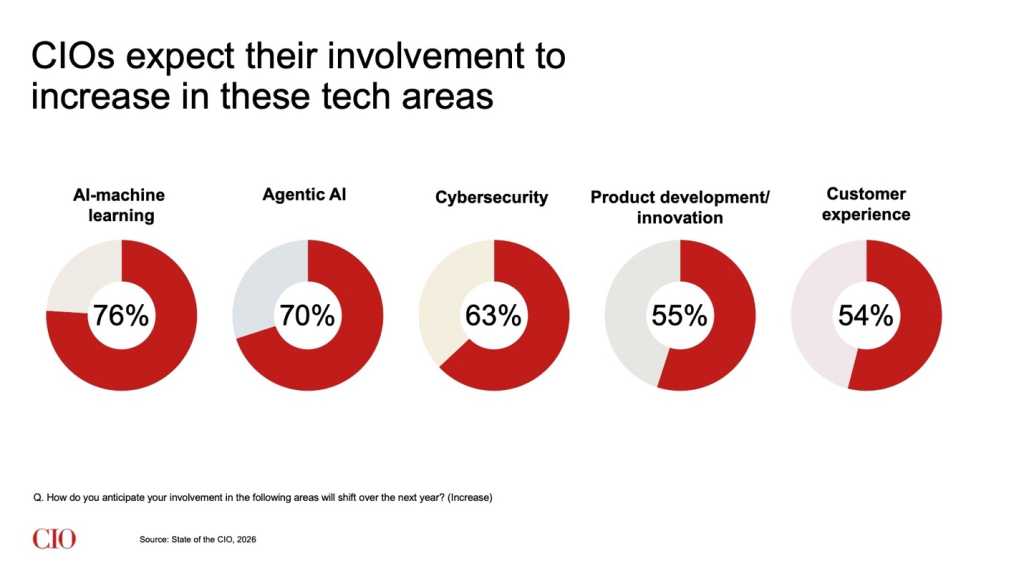
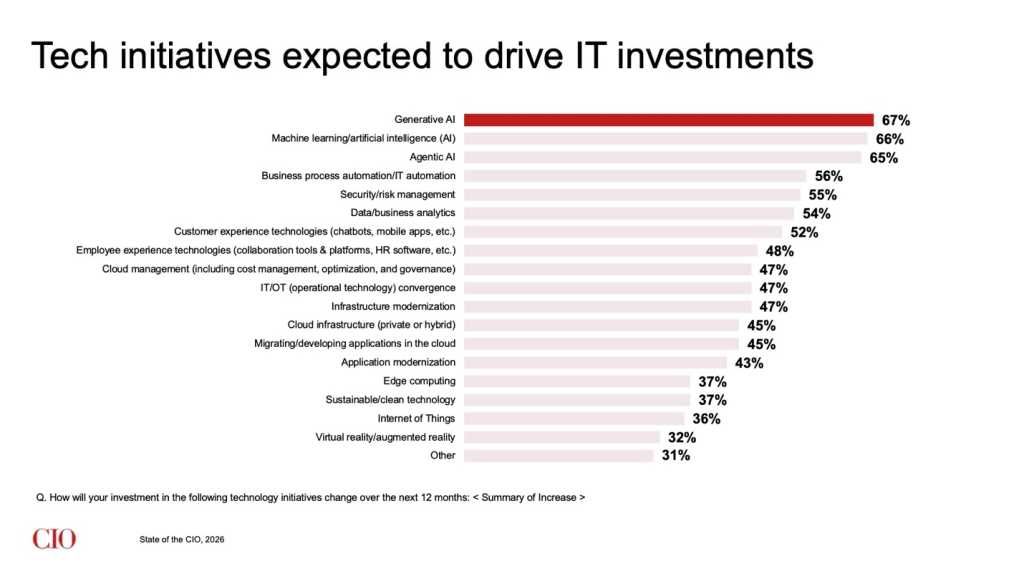
This year’s IT leader respondents expect to accelerate and expand involvement with AI/machine learning (76%) and agentic AI (70%), as well as cybersecurity (63%). Responding organizations anticipate a boost in investments across the full complement of AI technologies, including generative AI (67%), machine learning (66%), and agentic AI (65%) over the coming year.
CIO.com / Foundry
First Student is currently running AI in production at scale across multiple use cases, including for predictive maintenance, fleet and driver safety, contract development, automated hiring, agentic software development, and agentic voice bots that assist internal users with help desk and HR issues. As the company builds out its portfolio of AI-enabled use cases, McCormack says it’s critical to ground everything in a flexible architecture.
“It’s such a changing landscape; it’s difficult to pick a solution,” he explains. “We’re building our own architecture so we can quickly switch models” and not be dependent on one system, he says.
The rest of the IT agenda
While AI commands an all-hands-on-deck approach, it’s not the only CEO directive for CIOs this year. Cyber and data security remain top-of-mind in the C-suite, with a quarter of State of the CIO respondents noting it as a top CEO priority for 2026, up from 20% last year. CEOs are also looking for CIOs to strengthen IT and business collaboration, cited by 23% of 2026 respondents.
To achieve those directives, CIOs are expanding technology initiatives in areas such as business process and IT automation (56%), security and risk management (55%), and data and business analytics (54%).
CIO.com / Foundry
Building a solid data and governance foundation is the most important agenda item at RPI, primarily in preparation for more extensive AI deployment and adoption. Ballinger, 70 days into her tenure as RPI CIO, concedes the educational institution is not aiming to be on the first adopter wave of AI innovation. Rather, its strategy is to adapt, grow, and transform organizational structures and its data ecosystem in pursuit of maximizing AI’s promised advantages.
Ballinger is currently shopping an RFP that encompasses a data fabric layer, secure containerization, and a data factory approach. “We are designing the ecosystem with strategy and KPIs in mind,” she says. “The entire process is predicated on deciding what business cases are valuable before they hit the data ecosystem. We’re not looking to put something into the ecosystem and hope it gets a return.”
With the pace of change growing more intense and the stakes surrounding AI innovation soaring higher, the CIO role continues to be more business-oriented and less straight technology focused. Eighty-four percent of this year’s IT leader respondent pegged the CIO position as more digital and innovation focused while 82% confirmed that CIOs are more likely to actively lead digital transformation efforts compared to their business counterparts.
With the average CIO now juggling 1.6 positions, including chief security officer, CISO, CAIO, and other business-related posts, the job continues to become more expansive, highly strategic, and more fulfilling, especially for leaders willing to close the door on the traditional “keeping the lights on” CIO model and embrace new challenges.
“The CIO of 2026 is a hybrid — half operating architect, half risk officer,” Prommer says. “The technology choices are getting easier, but the business and ethical choices are getting harder. CIOs who only know the tech stack will be reporting to CIOs who know both.”
Read More from This Article: State of the CIO, 2026: CIOs set the course for AI ROI
Source: News