When it comes to artificial intelligence projects — even amid challenges related to staffing, power, and cooling — enterprises still have aggressive plans for growth, according to a Deloitte survey of 515 IT and business executives conducted in Q4 2025.
Respondents, all from companies with revenues of $500 million or more, expect to rapidly scale both AI factories and AI edge deployments, roughly doubling current levels over the next 3 years. By 2028, 73% of respondents expect to have at-scale deployments of AI factories, and 72% expect the same for AI at the edge, up from 36% (each), respectively, in late 2025.
Growth of AI-related computing capacity, as measured by AI tokens, is likewise expected to double. In three years, a majority of respondents (61%) expect to consume 10B+ tokens per month by 2028.
This will support a bevy of AI applications that are steadily moving from pilot into production. In 2025, just under 50% of organizations had 31 or more AI pilots; respondents expect that number to grow to nearly 70% by 2028. Similarly, the percentage of respondents with 31 or more production-ready use cases is expected to rise from 44% in 2025 to 67% by 2028.
Such changes will make hybrid AI and distributed AI a requirement for CIOs, requiring significant transformation.
“What the data shows is consistent with what we’re seeing across enterprise clients: Token economics is becoming unavoidable, and hybrid AI strategies are gaining ground as organizations seek highly performant solutions with more control and lower cost,” says Nicholas Merizzi, AI infrastructure leader at Deloitte.
“IT in many organizations is being asked to run AI across cloud, neo-cloud, on-premises, and edge environments at once,” says Iram Parveen, an assistant manager at the Deloitte Center for Integrated Research. “That requires re-engineering the whole tech stack, which increases architectural complexity, cost pressure, legacy constraints, and workforce gaps.”
Gating factors loom
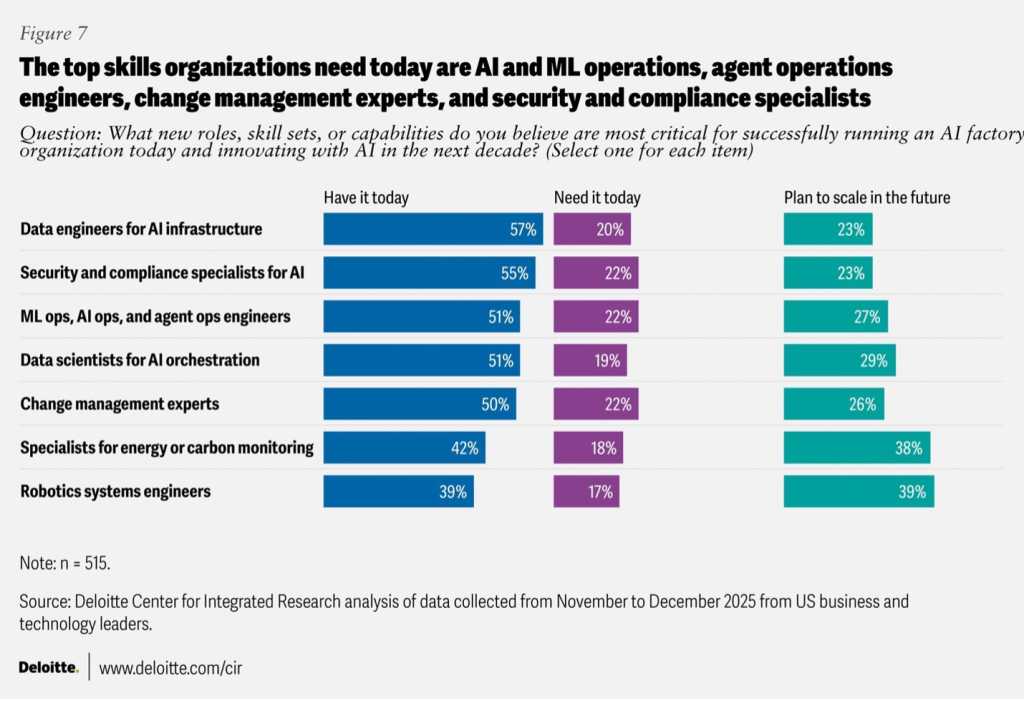
To achieve such growth, organizations will have to overcome challenges, including skills gaps. More than half of respondents indicate their organizations currently have sufficient numbers of data engineers, security and compliance specialists, AI and ML operations engineers, and data scientists (Figure 1). But the talent needed to scale and innovate with AI isn’t fully met, as the “Plan to scale” column indicates.
Deloitte
Capabilities in areas that may currently be lacking, such as robotics, and carbon and energy monitoring, are likely to increase in importance, Parveen says. “As current in-demand AI skills become baseline, these forward-looking capabilities could become the next real differentiators,” she says.
The Deloitte survey also shows 81% of respondents believe their IT teams have the technical and financial acumen to scale AI, but only 65% think their business and product teams do –– a 16% point gap in respondent confidence levels.
“Technical readiness is necessary, but it is not enough. To close the gap, companies need a more cross-functional leadership model that brings business teams deeper into technology decisions and aligns incentives around enterprise-wide outcomes,” Parveen says. “Scaling AI responsibly also requires governance integration across not just IT but business, finance, risk, and operations.”
Data center power and cooling likewise loom large, stressing the grid and energy supply chains all the way to the enterprise. Whereas once IT teams simply purchased power from a public utility, the demands of AI have them considering acquiring third-party power generation facilities or even building their own –– areas that Parveen notes sit well beyond the traditional role of enterprise IT.
It’s a similar story with cooling, which Parveen says will become a major issue as AI factories scale. As enterprise energy consumption moves from MW (megawatt) to GW (gigawatt) levels, new management approaches will be required, including liquid cooling and other next-generation solutions, along with specialized skills in energy and sustainability that only 42% of respondents say they currently have.
Key takeaways
The Deloitte survey makes clear that enterprises are likely to need help filling gaps in expertise across areas such as technology strategy, robotics, power, cooling, and more. Cost dynamics is another, including ensuring that rising token costs reflect truly useful AI capabilities, not just design inefficiencies.
“The investment spigot is open as organizations scale AI as quickly and thoughtfully as possible. Those that get there by 2028 will be the ones who figured out the economics early,” says Chris Thomas, hybrid cloud infrastructure offering leader at Deloitte.
Success will mean getting help where you need it, whether with strategic planning or staffing –– from sources such as the experts at Deloitte.
Learn more about how your peers are approaching AI. Read the full Deloitte enterprise AI infrastructure survey report.
Read More from This Article: Enterprises plan rapid growth for AI factories and AI at the edge, survey finds
Source: News