

In the world of EdTech, where I have had the fortune to design and scale numerous platforms for higher education and enterprise environments alike, one shift is occurring at an increasing rate in 2026 for corporate learning.
It is shifting from being programmatic to becoming a continuous system built with AI to identify the needs of the corporation and workforce and to provide the training required to ensure that the workforce develops the necessary skills.
Many enterprises are adopting AI-powered learning ecosystems to address the needs of their organizations in real time, according to CIO analysis. However, what is emerging now goes a step further to address those needs with subscription-based learning environments that adapt to the needs of the organizations themselves.
Architecting the subscription learning economy
Through my experience working with executive education and enterprise platforms, I have found that traditional learning models fail not because of content quality but because of delivery architecture.
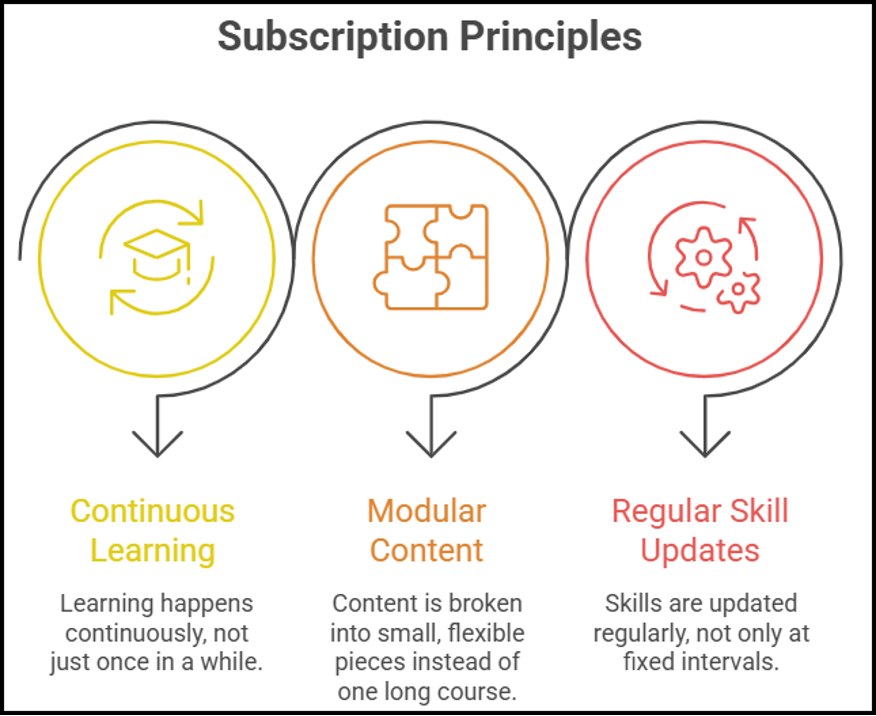
The subscription model for learning emphasizes continuous learning, modular content and regular skill updates rather than traditional fixed courses.
Vishal Shukla
This model enables organizations to deploy micro-credentials that align directly with evolving business priorities such as AI adoption, digital transformation and data-driven decision making.
More importantly, though, and even beyond the change in the way that learning content is delivered, such changes can represent changes to the way that companies and platform view revenue and growth. For instance, subscription-based models can help to keep learner engaged with their learning and create recurring engagement loops that support both learner motivation and organizational values.
Engineering personalized learning pathways with AI
One of the most significant contributions I have seen in this space is the application of AI to dynamically orchestrate learning journeys.
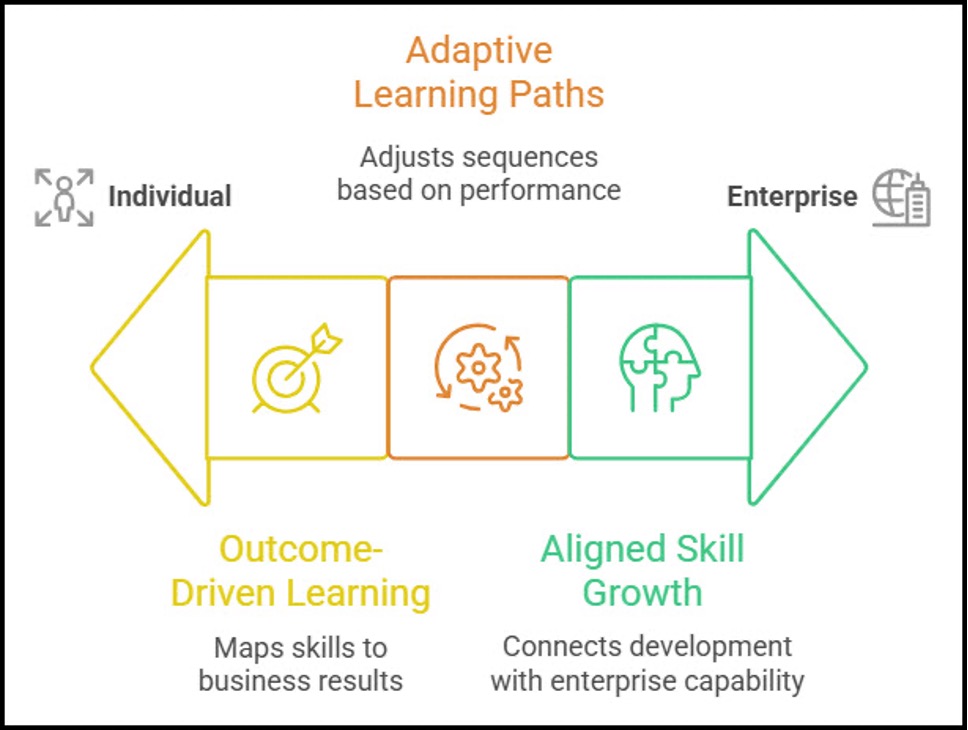
In platforms I have led, AI systems do not simply recommend courses. They:
- Outcome-driven learning: Maps skills directly to business outcomes.
- Adaptive learning paths: Adjusts learning sequences based on performance signals.
- Aligned skill growth: Connects individual development with enterprise capability frameworks.
Vishal Shukla
This transition represents moving from content recommendation engines to capability orchestration systems.
Further, there’s also the benefit of increased efficiency. While the ability to drastically improve skills and capabilities is reason enough for workers to employ AI tools in their educational endeavors, evidence shows that learning can also become 57 percent more efficient, according to Training Providers Statistics 2025. This CIO perspective highlights how learning is repositioned as a strategic lever in this article.
Activating learning through private cohort networks
While AI enables personalization, I have consistently observed that behavioral transformation happens in groups.
This is where private cohort learning is emerging as a critical layer in B2B education. In enterprise implementations I have supported, curated cohorts of leaders create high-impact learning environments where knowledge is contextualized through peer interaction.
The growing adoption of cohort models is driven by measurable outcomes:
- Organizations are prioritizing learning tied to real business results, not just completion metrics.
- Cohort structures close the gap between knowing and doing — faster than self-paced formats ever could.
- Engagement and retention hold significantly stronger when learners move through content together.
- Learning ecosystems are evolving into a hybrid model — Netflix-style accessibility with the accountability of a cohort.
In my view, the convergence of subscription access and cohort-based engagement represents a hybrid learning architecture that balances scale with depth.
From content platforms to capability engines
The table below provides mapping between learning dimension and platform features, and what those changes mean in relation to workforce outcomes.
| Dimension | Legacy learning model | AI-driven subscription model | Strategic outcome |
| Learning architecture | Program-based delivery | Continuous subscription ecosystem | Sustained workforce readiness |
| Content strategy | Static curriculum | Modular micro-credentials | Rapid skill deployment |
| Personalization | Role-based segmentation | AI-orchestrated pathways | Precision learning at scale |
| Engagement model | Individual consumption | Cohort-driven collaboration | Behavioral and performance change |
Case in point: Scaling AI learning in executive education
In one of the executive education platforms I helped design, we introduced AI-driven subscription learning paths focused on digital and AI transformation.
What we observed was not just increased participation, but a shift in how leaders engaged with learning:
- They moved from passive consumption to active problem solving
- Learning cycles aligned directly with business initiatives
- Peer cohorts reinforced accountability and execution
This model enabled organizations to translate learning investments into measurable outcomes, bridging a gap that has historically limited the impact of corporate training.
Research on what actually motivates learners to commit to online courses backs this up — people engage when the learning feels relevant to their real work, not when it’s assigned to them.
Defining the next generation of corporate education
Based on my work across enterprise and higher education ecosystems, I believe the future of corporate learning will be defined by three foundational shifts:
- From learning delivery to capability engineering
- From static programs to adaptive ecosystems
- From completion metrics to business impact measurement
Organizations that operationalize these principles will not only upskill their workforce but also build resilient, future-ready talent systems.
Conclusion: Designing learning systems that learn
The most important realization from my work in this space is that modern learning platforms must themselves become intelligent systems.
They must learn from users, adapt to organizational needs and continuously evolve. Subscription models, powered by AI and reinforced through cohort dynamics, are making this possible.
In 2026, corporate education is no longer about providing access to knowledge. It is about designing systems that enable organizations to continuously generate capability — at scale, in real time and aligned with business transformation.
This article is published as part of the Foundry Expert Contributor Network.
Want to join?
Read More from This Article: Subscription model: How AI is reshaping corporate education
Source: News