

AI is accelerating analytics at unprecedented speed. But organizations that mistake AI adoption for analytics capability development are discovering that technology alone does not scale into value.
For CIOs, the real differentiator is not AI sophistication, but the strength of the analytics capability that governs how AI is embedded into purposeful decision-making.
AI as the dominant emerging technology
AI is the most prominent emerging technology in the world today. No other technology matches its breadth of impact, speed of adoption or level of executive attention. Across healthcare, finance, government, manufacturing, defense, education and the creative industries, AI is reshaping how organizations operate, compete and create value.
What sets AI apart is how deeply it is now embedded in everyday business activity. Advances in generative AI have moved AI beyond routine internal processes into frontline decision-making, customer engagement and operational execution. Global investment and widespread adoption have firmly positioned AI at the center of the CIO agenda.
The evolution of AI within analytics
Over the past decade, analytics has evolved significantly. What began as descriptive reporting through dashboards and historical metrics progressed into predictive and optimization-driven analytics as data volumes increased and analytical techniques matured.
Machine learning became embedded in standard analytics practice, enabling forecasting, pattern discovery and optimization across increasingly complex datasets. At the same time, advances in data engineering, modeling techniques and cloud platforms pushed analytics closer to operational decision support. Insights could be generated faster, applied more broadly and integrated directly into business workflows.
The emergence of genAI in the early 2020s marks the most significant inflection point in this evolution. Analytics systems are no longer limited to structured data or static outputs requiring expert interpretation. They now engage with unstructured information, automate analytical tasks, generate narratives and visualizations and support scenario exploration and simulated outcomes.
AI did not arrive as an external disruption to analytics. It emerged as the next phase in its evolution, extending analytics from insight generation into adaptive, decision-oriented intelligence.
The coevolution of AI and analytics capability
AI and analytics are often discussed as separate — and sometimes competing — technologies. In practice, their relationship is better understood as one of coevolution. Each advances in response to the other and each amplifies the value of the other over time.
AI enhances analytics by accelerating pattern discovery, automating insight generation and extending analysis into problems that were previously too complex or data intensive. Generative and agentic approaches allow analytics to scale faster, moving from isolated use cases to broader organizational impact.
At the same time, the value organizations realize from AI is constrained by their analytics capability. Disciplined problem framing, well-governed data, model validation and integration into decision processes provide the foundations AI depends on to operate effectively in organizational contexts. Without these capabilities, AI systems tend to remain experimental and difficult to embed into core business operations.
This reciprocal dynamic means AI does not replace analytics, nor does analytics merely feed AI. They evolve together. As AI becomes more sophisticated, it raises expectations for how analytics is governed, embedded and trusted. As analytics capability improves, it enables AI to be applied reliably and at scale.
In this sense, AI increasingly acts as a stress test for analytics capability. Because AI operates at speed and scale, weaknesses in data ownership, decision rights, skills and trust surface far more quickly than they did in earlier generations of analytics.
For CIOs, the implication is clear. AI accelerates outcomes, but analytics capability determines whether that acceleration produces value or risk.
AI is a resource, not a capability
Many organizations struggle to scale AI because they treat it as a capability in its own right. In doing so, they misidentify where value is actually created.
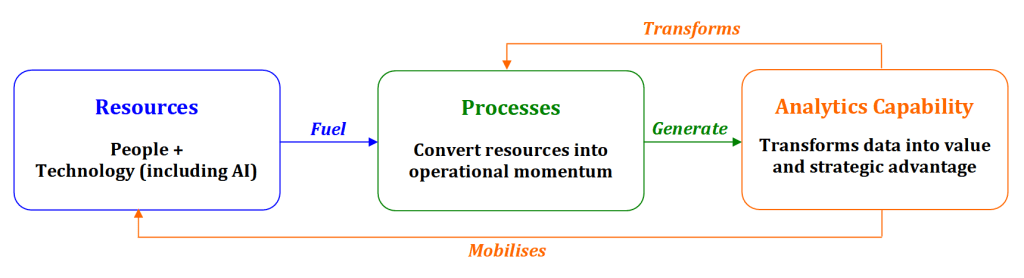
Within an analytics capability framework, the distinction is straightforward. Resources enable processes. Processes shape capability. Capability determines value. AI sits within the resources domain, alongside data, platforms, tools and technical skills. It enables analytics processes, but it does not constitute a capability on its own.
Ranko Cosic
Capabilities emerge only when resources are applied consistently through well-designed processes. In analytics, this includes disciplined problem framing, data governance, model validation, integration into decision workflows and feedback mechanisms that connect insight to action. Without these processes, AI initiatives remain isolated and fail to deliver consistent enterprise-wide impact.
This distinction explains why comparable investments in AI produce vastly different outcomes across organizations. Where analytics capability is strong, AI accelerates insight generation and improves decision quality. Where capability is weak, AI amplifies fragmentation and risk, creating the appearance of progress without delivering enterprise-wide value.
From a CIO perspective, the implication is practical rather than theoretical. AI should be managed as a high-impact resource. Analytics capability is the organizational mechanism that converts that resource into value.
Why CIOs should invest first in analytics capability
For CIOs, the central question is not whether to invest in AI, but where investment will most reliably translate into business value. Analytics capability determines whether AI becomes embedded in decision-making or remains a collection of disconnected tools, pilots and proofs of concept.
Analytics capability is the ability to consistently convert data into insights that inform decisions and action. It encompasses disciplined problem framing, trusted and well-governed data, appropriate analytical techniques and the integration of insights into everyday business processes. Together, these elements determine whether AI outputs are understood, trusted and acted upon.
When analytics capability is weak, AI amplifies existing problems. Insights fail to influence decisions, outputs are misunderstood or mistrusted and value remains localized rather than enterprise-wide. When analytics capability is strong, AI accelerates what already works, improving decision quality, reducing decision cycle time and scaling impact across the enterprise.
CIOs should invest first in analytics capability. AI provides acceleration, while analytics capability provides direction and control.
10 lessons CIOs should know about analytics capability and AI
Analytics capability determines whether AI scales into sustained value or stalls at experimentation. The following lessons translate that reality into practical guidance for CIOs.
- AI amplifies analytics capability. It does not create it. AI delivers sustained value when governance, data quality, business engagement and decision ownership are already in place.
- AI assets are not analytics capability. Tools, platforms, skills and models are resources. Treating them as capability obscures where value is created.
- Analytics capability matters more than AI sophistication. Clear roles, decision rights and repeatable practices consistently outweigh model complexity.
- AI shifts the bottleneck from insight generation to decision-making. As insight production accelerates, accountability and decision processes become the constraint.
- Weak analytics governance turns AI into a risk multiplier. Poor governance scales flawed assumptions, bias and compliance risk.
- AI expands analytics access when analytics capability is built by design. Analytics literacy, standards and decision clarity determine whether AI creates value or noise.
- Strong analytics capability allows AI to scale beyond pilots. Established workflows and governance enable enterprise-wide adoption.
- Decision quality, not more AI tools, determines analytics capability. As AI becomes commoditized, organizational performance depends on consistently better decisions.
- AI exposes analytics capability gaps faster than previous technologies. Speed and scale reveal weaknesses that slower analytics once concealed.
- AI success requires CIO leadership beyond technology deployment. CIOs need to treat analytics as an organizational system, not merely a technical function.
Final takeaway for CIOs
As AI becomes faster, cheaper and more accessible, differences in performance are increasingly driven by analytics capability rather than technology adoption. AI does not level the playing field. It widens the gap between organizations that can consistently convert insight into decisions and those that cannot.
For CIOs, the question is not how quickly AI can be deployed, but how well the organization’s analytics capability equips it to use AI effectively. AI will accelerate whatever capability already exists. Where that capability is strong, AI compounds value. Where it is weak, AI compounds risk.
In the age of AI, competitive advantage belongs to organizations that invest deliberately in analytics capability and allow AI to amplify it, rather than those that pursue the technology in isolation.
This article is published as part of the Foundry Expert Contributor Network.
Want to join?
Read More from This Article: Why CIOs need analytics capability to scale AI
Source: News