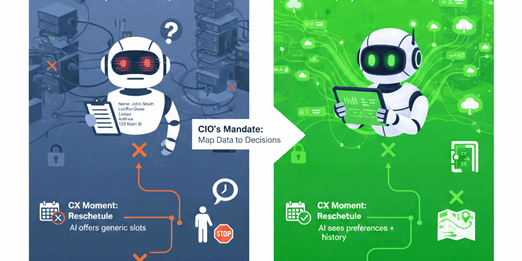
Millions spent on AI platforms. Flat retention. Your best customers are quietly walking out the door. The problem is not algorithms or effort; it is the data.
While many organizations focus on AI efficiency, a broader strategic shift is underway toward adaptive intelligence — a trend championed by leaders at EY and others. The future of CX is not about loud technology, but about quiet, real-time support that recognizes individual needs the moment they arise. Yet you cannot have adaptive intelligence if your data is static.
Previously, I explored the data supply chain as a foundational liability; the rise of agentic AI has shifted the stakes. It is no longer enough to have a clean supply chain; it must now deliver real-time, contextual signals that allow AI to move beyond text prediction to a state of responsible autonomy — taking independent actions that reduce friction and create continuity.
The root cause: The data trap
Up to 40% of AI-enabled CX initiatives fail. The CX tools themselves are rarely the problem; more of the challenge is the data feeding the tools. The data trap is the growing gap between the static master data IT manages and the real-time, experiential truth AI-enabled CX needs to actually work.
For decades, CIOs focused on master data management — centralized repositories, governance frameworks, golden records. The goal was to answer operational questions:
- Who is the customer?
- What did they buy?
- Is their address correct?
Here is the trap: Believing this is enough for AI.
Agentic AI does not just need transactional truth. It needs experiential truth — answers to questions that shift from moment to moment:
- What is the customer trying to do right now?
- Where did they hit friction on mobile or web?
- What constraints or context apply in this exact moment?
Feed AI only clean master data and you create artificial stupidity: The system knows a customer’s name, but not their intent. That is where experiences break down — and where your most valuable customers quietly leave.
The agentic shift: From prediction to presence
Modern CX strategy is moving away from static personas toward presence: understanding what an individual is trying to achieve in this exact moment.
Agentic AI is the engine that makes presence actionable by shifting from models that simply predict text to systems that can take independent actions toward a specific goal.
- The Predictive Era (old CX): AI identifies that a customer might churn based on past data — the trap of static records.
- The Agentic Era (new CX): AI proactively intervenes to solve the problem in real time.
If a flight is delayed, a traditional system sends a notification. An agentic system evaluates the passenger’s current location, final destination and travel preferences — and rebooks them before they reach the gate.
If your data models only capture that a customer is a platinum member but fail to capture that they are currently stuck in a loop on your mobile app, the AI agent cannot act. It is blind to their presence.
The cost of the data trap: Financial reality
Data acquisition and governance are expensive and CFOs often see them as infrastructure overhead. But that lens misses the point: The data trap silently leaks revenue.
Research from Bain & Company and Harvard Business Review shows that improving retention by just 5% can increase profits by 25%–95%. Lose customers because your data cannot keep up and that value is gone forever. The trap also drives operational waste: research shows shifting from high-effort to low-effort experiences can reduce cost-to-serve by 20%–37%.
Economic contrast
| Caught in the Data Trap | Closing the Gap (Experiential Design) |
| High AI spend, low adoption | Targeted investment, high confidence |
| Journey resets, high friction | Continuous, fluid journeys |
| Rising support costs | Lower cost-to-serve |
| Revenue leakage | Revenue retention |
The question is not “Can we afford this data project?” It is: “Can we afford to let our best customers walk because our data could not keep up?”
The escape route: The data-to-experience map
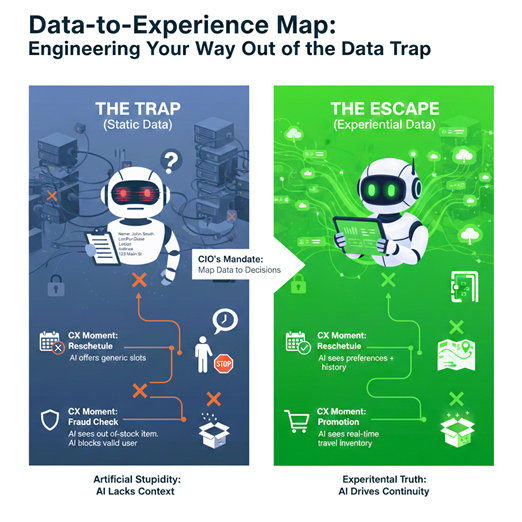
CIOs can close the gap by mapping data to decisions, not systems.
David Angelow
Ask:
- Which moments affect revenue?
- What decisions must AI make in those moments?
- What data does AI need to make those decisions safely?
Data-to-experience map
| CX Moment | The Trap (Missing Data) | The Escape (Required Data) |
| Reschedule | AI offers generic slots | AI sees preferences and history |
| Fraud Check | AI blocks valid user | AI sees location and travel patterns |
| Promotion | AI offers out-of-stock item | AI sees real-time inventory |
Without this map, AI is flying blind. With it, CIOs provide a blueprint for retention.
Grounding autonomy in data: Why trust matters
As AI systems gain the ability to act independently, responsible autonomy becomes the new standard for trust. This is where the data trap becomes a strategic liability.
Agentic AI requires contextual guardrails to make safe decisions. Without real-time data on a customer’s current status — such as a pending fraud alert or a recent negative support interaction — an autonomous agent might offer an inappropriate promotion or make a promise the company cannot keep.
Trust is not built by the algorithm; it is built by the data that constrains it. Data is not only fuel for AI; it is the ethical and operational boundary that prevents an autonomous agent from creating a negative moment of truth (NMOT).
How the data trap shows up in practice
The NMOT is that split second when an AI agent either proves it knows you — or proves it does not.
Banking: Omni-channel amnesia
AI is deployed for proactive outreach, yet experiences reset across channels. A customer starts a mortgage application online, then the call-center assistant treats them as a stranger. 56% of customers repeat themselves due to disconnected channels; 62% want smooth transitions but banks fail to deliver.
Result: Frustration and lost business.
Healthcare: Context silo
AI scheduling is live, but clinical and admin data remain siloed. Patients must re-explain sensitive symptoms to a bot that does not know them. AI scheduling fails when not integrated with full patient context, creating friction that drives patients to bypass digital channels entirely.
Result: Increasing risk and call volume.
Retail: The inventory disconnect
AI-powered personalization delivers promotions, but marketing data is not linked to supply chain. 51% of retailers lack real-time inventory visibility, yet consumers rank inventory as a top friction point. Customers receive exclusive offers for out-of-stock items.
Result: Trust erodes instantly.
The CIO’s mandate: Close the gap
If your best customers are leaving, the fix is not a better AI model — it is better data design. Agentic AI cannot reduce friction, build trust or create continuity without data built intentionally for those outcomes.
Shift governance from block to enable. Traditional governance is defensive. To support experience-led growth, governance must empower flow — ensuring privacy and security without suffocating real-time access across silos.
Audit processes for data exhaust. Operational processes that do not naturally produce the data AI needs are traps. CIOs must redesign processes, so every interaction captures intent and outcomes — turning data exhaust into fuel for the next experience.
Tie data spend to friction reduction. Stop framing data projects as modernization. Frame them as churn prevention and cost-to-serve reduction. That is a language the board already understands.
The bottom line
The data trap is not solved by better algorithms or more governance theater. It is solved by treating data as a product — managed in real time, with the right talent for agentic systems. Data is the experience. Closing the gap between static records and experiential truth is the highest-leverage move a CIO can make to turn AI from a cost center into a growth engine.
Diagnostic: Are you in the trap?
- Do your data models capture intent or just transactions?
- Can your AI access cross-channel history in real time to prevent journey resets?
- Is your governance focused on blocking risk or enabling flow?
If you cannot answer yes to all three, you are likely in the trap — and your best customers know it. The good news: This is a trap you can engineer your way out of.
This article is published as part of the Foundry Expert Contributor Network.
Want to join?
Read More from This Article: CX, AI and the data trap: Why your best customers are slipping away
Source: News