A recent keynote and a seemingly unrelated white paper, together, tell a story that should fundamentally change how you think about your software development organization.
In December at AWS re:Invent, Werner Vogels delivered his final keynote. Instead of announcing services, he spent his time on something far more valuable: telling us who developers need to become in the AI age.
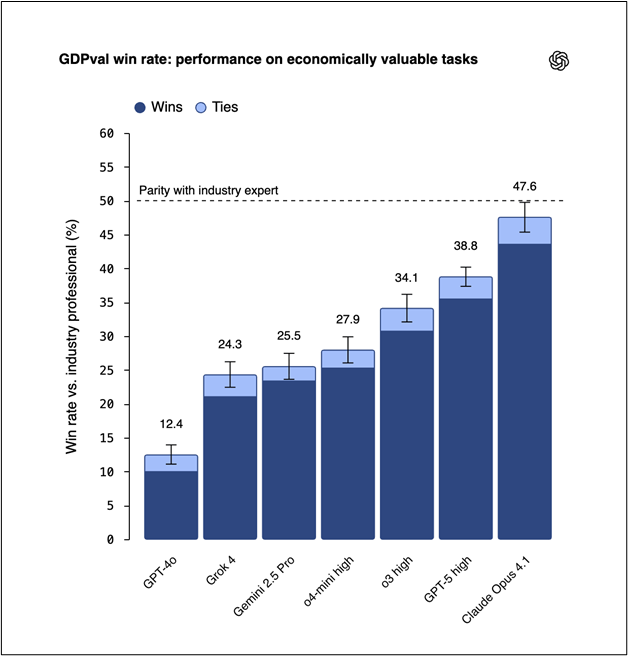
In September, OpenAI released a white paper called GDPval that measured how AI performs against human experts across 44 occupations. The headline everyone noticed in the accompanying blog was that Claude Opus 4.1 hit 47.6% parity with human experts on economically valuable tasks, suggesting that Artificial General Intelligence (AGI) is around the corner. But the chart everyone should have noticed didn’t make it to the blog. It demonstrated how leaps in productivity are possible when AI works with a human-in-the-loop.
Here’s the punchline: Software development is absolutely being disrupted by AI. But if your response is “great, we can cut headcount,” you’re wasting a monumental opportunity.
What OpenAI’s GDPval actually shows
The headline chart of OpenAI’s GDPval blog showed AI models approaching parity with human experts on isolated tasks.
Pete Johnson
This framing is supposed to show how close we are to AGI and AI replacing humans.
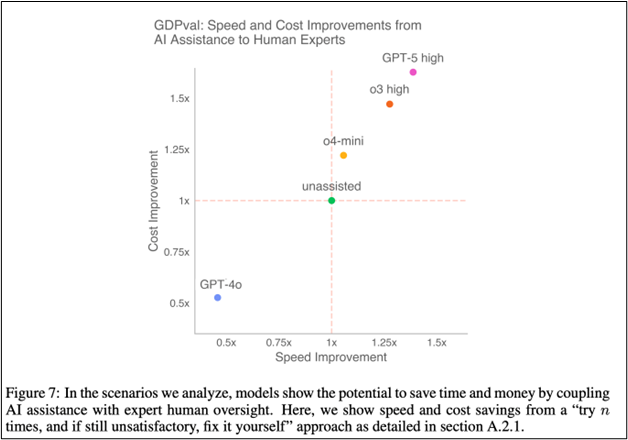
However, there’s a more telling diagram and message on page 7 of the white paper that didn’t make it into the blog article:
Pete Johnson
This shows something different: what happens when you use AI with human oversight rather than as a replacement.
Under a “try n times, then fix it yourself” scenario where an expert uses AI, reviews the output, resamples if needed, and steps in to complete or fix the work when necessary, GPT-5 high delivers about 1.6x cost improvement and 1.4x speed improvement compared to an unassisted human expert.
That’s not “AI is taking your developers’ jobs.”
That’s “AI can make your developers significantly more productive.”
Let me give you a concrete example from my own work. Late last summer, a colleague asked me to analyze a particular submarket: identify key players, funding, valuations, headcount, and metrics. In the old days, this would have meant three to four hours of manual research. Instead, I had Claude Desktop pull the information in about 20 minutes.
It didn’t get everything right the first time. I had to provide additional context and refine the prompts. Then I had Gemini verify accuracy and produce a structured output. And the next step is where I focused my time: on the high-value analysis–interpreting the data, connecting insights, and providing context based on my expertise. I used AI to accelerate the data collection and organization, not to replace my strategic thinking and expert analysis.
Now multiply that across your entire development organization.
The Renaissance developer and your developer strategy
In his keynote, Werner invoked the Renaissance, that explosive period after the Dark Ages when people like Leonardo da Vinci combined art, science, engineering, and curiosity into something transformative. His argument: we’re entering a similar moment for developers. But golden ages don’t just happen to you. You must adapt to become the kind of person who can thrive in them.
As leaders, we must build the kind of organizations that encourage developers to become what Werner calls the “Renaissance Developer.”
Here are the five traits of a Renaissance Developer that he laid out, translated into strategic implications for your organization:
Trait 1: Be curious
Werner celebrated curiosity as foundational, not just tolerating failure, but embracing it as the only path to learning. Question everything. Experiment freely. Treat failures as data, not defeat.
Strategic implication: Your developers need time and permission to explore AI tools, even when those explorations don’t produce immediate results. The organizations that figure out how to use AI effectively won’t do it through mandates from above; they’ll do it through thousands of small experiments by curious people trying new things.
Trait 2: Communicate
The way we communicate with LLMs and agents is similarly ambiguous to how we communicate with people. We’ve spent decades learning that specificity reduces ambiguity in human collaboration. Now we’re interacting with AI systems that need clear, structured communication to produce useful output.
Strategic implication: The developers who level up their communication skills (both human to human AND human to machine) are going to have a significant advantage. This isn’t about prompt engineering tricks. It’s about being the kind of clear thinker who can express intent precisely.
Trait 3: Be an owner
Werner directly addressed vibe coding, the increasingly popular approach where developers describe what they want and let AI generate the code. His take: fine if you watch closely. But you don’t get to use it as an excuse to abdicate responsibility.
Own the quality. Own the security. Own the functionality.
Strategic implication: AI will help your developers ship code faster. Without oversight, that means shipping bugs faster, too. The organizations that maintain human accountability for quality, while using AI for velocity, will massively outperform those that let AI become an excuse for reduced rigor.
Trait 4: Think in systems
Werner used the Yellowstone wolves as his illustration on this point. Reintroducing wolves to the area triggered a domino effect. The reduced elk population stopped overgrazing riverbanks, vegetation returned, erosion decreased, and the physical geography of the park shifted.
Strategic implication: Your developers need to lift their heads up from the code in front of them and see the bigger picture. How does their service interact with the twelve other services it touches? What happens when their database gets slow, not just to their app, but to everything downstream? When they’re working with AI systems, what feedback loops are they creating?
Trait 5: Be a polymath
Werner illustrated this with a progression: I-shaped people (deep expertise in one area), T-shaped people (deep expertise plus broad familiarity), and polymaths (deep expertise across multiple domains, like da Vinci). The future belongs to the polymaths.
Strategic implication: The architects who build the most elegant systems aren’t just good at infrastructure; they understand the business domain, the user experience, the organizational dynamics, the economics. AI handles the routine cognitive tasks; humans add value through cross-domain connections. Build teams that can make those connections, because AI will struggle to do so.
The real opportunity: Projects you couldn’t previously afford
Here’s what I want you to take away from all of this.
If you treat AI as a pathway to eliminate developer headcount, sure, you’ll capture some cost savings in the short term. But you’ll miss the bigger opportunity entirely. You’ll be the bank executive in 1975 who saw ATMs and thought, “Great, we can close branches and fire tellers.” Meanwhile, your competitors have automated the mundane teller tasks and are opening new branches to sell higher-end services to more people.
The 1.4-1.6x productivity improvement that GDPval documented isn’t about doing the same work with fewer people. It’s about doing vastly more work with the same people.
That new product idea you had that was 10x too expensive to develop? It’s now possible. That customer experience improvement that could drive loyalty that you didn’t have the headcount for? It’s on the table. The technical debt you’ve been accumulating? You can start to pay it down.
When development teams become more efficient, the economically viable project portfolio expands dramatically, revealing new opportunities to ship more features, enter new markets, and build competitive moats.
What this means for your AI strategy
What struck me about Werner’s final keynote wasn’t the content, it was the intent. This was Werner’s last time at that podium. He could have done a victory lap through AWS’s greatest hits. Instead, he spent his time outlining a framework of success for the next generation of developers.
For those of us leading technology organizations, the framework is both validating and challenging. Validating because these traits aren’t new. They have always separated good developers from great ones. Challenging because AI amplifies everything, including the gaps in our capabilities.
What can you do?
First, stop framing AI investments primarily as cost reduction initiatives. Frame them as productivity multipliers, and your employees will stop living in fear.
Second, invest in the Renaissance developer traits across your organization. Curiosity, communication, ownership, systems thinking, polymathy. These capabilities separate high-performing AI-augmented teams from teams that just ship bugs faster.
Third, expand your project portfolio to match your expanded capacity. What projects have been sitting in the backlog because you didn’t have the headcount? Tackle them now.
Fourth, maintain human accountability for quality. AI-generated code still needs human verification. AI-assisted analysis still needs human judgment. Don’t let the velocity gains seduce you into removing human oversight.
Your development organization isn’t a cost center waiting to be optimized. It’s a productivity multiplier waiting to be unleashed. The only question is whether you’ll see it that way before your competitors do.
This article is published as part of the Foundry Expert Contributor Network.
Want to join?
Read More from This Article: Your dev team isn’t a cost center — it’s about to become a multiplier
Source: News