Uncertainty is an integral aspect of business operations. Conventional business intelligence tools can be helpful for historical data reporting, but fail to anticipate future risks and opportunities with accuracy. To develop more effective business and financial strategies, enterprises employ predictive and prescriptive analytics.
Predictive analytics involves the use of statistical modeling and machine learning techniques to forecast potential outcomes, while prescriptive analytics recommends optimal courses of action that can enhance business revenue. However, the absence or limited cross-functional integration hinders the businesses from fully utilizing the perks of these two analytics techniques.
AI agents can play a critical role in overcoming the challenges associated with predictive and prescriptive analytics. This article explains in detail how AI agents can improve predictive and prescriptive analytics by presenting an architectural framework that is not only efficient but also ensures data security and regulatory compliance.
Predictive analytics vs prescriptive analytics
Predictive analytics is a data analysis technique that helps find correlations between data points and understand business trends beforehand. Historically, statistical models, including regression models such as linear and logistic regression, along with time-series forecasting models like autoregressive integrated moving average (ARIMA), were used for predictive analytics.
At present, machine learning models such as decision trees, random forests, and gradient boosting machines aid in performing predictive analytics in large-scale enterprises. On the other hand, prescriptive analytics is useful for deciding what action to take based on the results obtained by predictive analytics.
The prescriptive analysis assists in developing strategies to optimize operations, increase profitability, and reduce risks. Traditionally, linear and non-linear programming models are used for resource allocation, supply chain management, and portfolio optimization.
Nowadays, reinforcement learning (RL) has become a popular technique for prescriptive analysis. It involves the usage of a trial-and-error approach wherein the machine learning models take feedback from each output and improve their outcomes continuously. Adaptive medical treatment and dynamic pricing in the retail sector are the most common applications of reinforcement learning.
In enterprise decision-making, both predictive and prescriptive analytics play an important role. Predictive analytics enables forecasting possible business outcomes, while prescriptive analytics uses these forecasts to create a strategy to maximize business profits. However, enterprises often fail to integrate these two analytics techniques in an effective way for their own benefit. The data science teams generate predictive forecasts while finance or operations teams make end-point decisions, creating a gap. It is critical for businesses to pay attention to leveraging both predictive and prescriptive analytics in a unified way.
The rise of AI agents in analytics — and the challenges that come with it
AI agents are autonomous GenAI-powered systems that can perform a set of assigned tasks by designing their own workflow. They observe their environment and figure out the best possible way to attain desired objectives. In analytics, AI agents help with data ingestion, exploration, pattern recognition, and insight generation. These systems are highly helpful for context-aware and dynamic analytics. As a result, you can use AI agents for predictive and prescriptive analytics at the enterprise level.
However, there are certain challenges associated with the use of AI agents in data analytics. Long-term memory management, explainability, and data security are some of the factors that need to be taken care of while utilizing AI agents in your data-driven workflows. In order to do this, there is a need for a robust AI agentic framework that can help in overcoming challenges associated with predictive and prescriptive analytics.
Using AI agents for predictive and prescriptive analytics: A conceptual framework and architectural overview
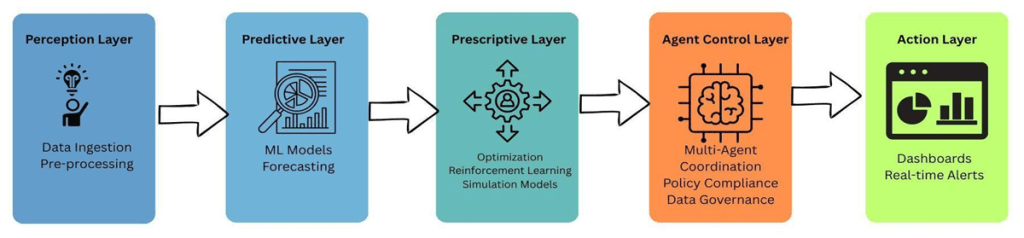
The integration of AI agents in predictive and prescriptive analytics workflows has not been explored much by data science professionals. However, a consolidated AI agentic framework can be developed that makes integrated use of predictive and prescriptive analytics in a combined way. Here is a visual of such a framework that is easy to adapt for businesses:
Naveen Kolli
Let’s look at each architectural layer one-by-one:
- Perception layer: This is the first layer where data ingestion and pre-processing are carried out. You can ingest data from various sources, including enterprise resource planning, customer relationship management (CRM), supply chain management, and human resource platforms. After extraction, data can be migrated using APIs, middleware connectors, or by building ETL/ELT pipelines.
- Predictive layer: This layer comprises tools and software to perform predictive analytics. This includes advanced AI/ML models such as gradient boosting machine, as well as deep learning models like LSTMs. The outcomes of predictive analytics are used as input for prescriptive analytics, combining both the analysis techniques for business improvements.
- Prescriptive layer: Taking outputs of predictive analytics as inputs, this layer leverages simulation models and reinforcement learning to deliver prescriptive results. Due to the use of RL-based models, the prescriptive layer is highly resilient against dynamic business conditions.
- Agent control layer: This layer is critical for multi-agent coordination and policy compliance. You can use a domain-specific agentic framework for different sectors such as healthcare, finance, e-commerce, or HR. To comply with regulatory guidelines of GDPR, HIPAA, or industry-specific standards, you can implement policy-as-code frameworks in the agent control layer.
- Action layer: Lastly, the action layer is the final layer where the results generated through analytics are integrated into business decision-making. The consolidated outputs can be in the form of decision-support dashboards or real-time alerts. For instance, an agent may flag supply chain disruption as well as trigger an automated procurement adjustment workflow.
Additional aspects critical for AI-powered predictive and prescriptive analytics
Adaptive memory mechanism
The adaptive memory mechanism forms an important component of AI agentic analytics. It aids in retaining and retrieving knowledge just like human cognition. Here are three types of adaptive memory structures:
- Episodic memory: This type of memory helps in recalling past events and case-specific experiences. Using episodic memory, AI-based finance agents can refer to previous instances of market downfall and the strategies that were used to overcome the situation.
- Semantic memory: The semantic memory is useful for storing domain-specific knowledge, such as finance, healthcare, or e-commerce. Through semantic memory, the AI agentic framework supports explainability and provides domain-specific prescriptions.
- Working memory: Working memory is critical for extracting instantaneous task-related information. For example, working memory gives information about current stock prices and market updates in the finance sector.
Retrieval mechanisms for better decision-making
- Embedding-based search: Unstructured data is stored as vector embeddings in vector databases. These vector databases can be integrated with AI agents to enable embedding-based data retrieval. Such integration helps produce contextually and semantically correct predictive and prescriptive results.
- Retrieval augmented generation (RAG): The RAG mechanism comprises information retrieval from generative AI models or LLMs. For instance, you are building an AI agent that must prescribe actions after predicting supply delays. In such a scenario, the RAG mechanism enables the retrieval of the occurrence of past disruption events with respect to the same supplier. It can also help in finding data such as contract terms, including penalty clauses, and details of other suppliers that provide the same product.
- Graph-based reasoning: Graph-based reasoning involves the usage of knowledge graphs that illustrate relations between various entities, including objects, events, or situations. Such a type of retrieval mechanism is imperative for multi-hop reasoning. This facilitates the retrieval of data from multiple sources, documents, or knowledge bases.
In addition to the use of predictive and prescriptive models along with an AI agentic framework, we use evaluation metrics such as root mean squared error (RMSE) and mean absolute error (MAE). The integrated architecture utilizes AI agent toolkits such as LangChain, FAISS, and LLMs like GPT.
In addition, there is also a requirement for cloud-based AI platforms such as Azure AI, AWS SageMaker, and Google Cloud Vertex AI. To ensure trustworthiness, the framework also involves data governance and compliance risk mitigation measures.
Vertical industry impact
To understand how efficient AI is in predictive and prescriptive analytics, case studies were conducted across various verticals. Let’s have a brief look at some of them:
- Finance: Using AI agents, we can ingest financial transaction data, credit details, and external macroeconomic indicators to predict loan defaults. Reinforcement learning proves to be of help in generating recommendations for adjusting lending strategies. It is found that such a framework can help in reducing loan default risk by 25%.
- Healthcare: An AI agentic framework for predictive and prescriptive analytics can aid in understanding patient readmission probabilities. Based on this information, healthcare institutions can make arrangements, including infrastructure, beds, medical equipment, and other such resources in advance. LSTM and transformer-based architectures can analyze patient health records and diagnostic histories for predicting readmission probabilities. Prescriptive agents then generate care optimization pathways, medication adjustments, and personalized treatment programs. Using the agentic framework for patient readmission improved readmission prediction by 30% and reduced overall care costs by 20%.
- Supply chain: The challenges of demand variation and logistic uncertainty can be resolved using an AI agentic framework in predictive and prescriptive analytics of supply chain data. To study this, predictive models were used to analyze IoT sensors, sales, and supply contract data. Moreover, prescriptive models such as MILP solvers and Q-learning help in making logistical decisions, including inventory management and shipping route selection. This practice led to 35% reduction in stockouts and 15% reduction in logistics costs.
On implementing the AI agentic framework, the industries experienced better forecasts through efficient predictive analytics. On the other hand, prescriptive analytics helped businesses in making their workflows more adaptable. Despite this success, high computational costs and explainability still remain a major challenge.
To overcome these setbacks, an enterprise can further invest in developing multi-modal predictive-prescriptive AI agents and neuro-symbolic agents. These agents use statistical models and symbolic learning for better explainability and compliance.
Conclusion
AI agent-driven predictive and prescriptive analytics can transform enterprise workflows by enabling proactive decision-making. By introducing AI in daily operations, there can be an improvement in decision-making quality under uncertainty and a reduction in operational friction. Sectors such as finance, healthcare, retail, and e-commerce can easily include AI-powered predictive and prescriptive analytics for better business outcomes.
This article is published as part of the Foundry Expert Contributor Network.
Want to join?
Read More from This Article: Predicting the future is easy — deciding what to do is the hard part
Source: News