

The mimicry trap
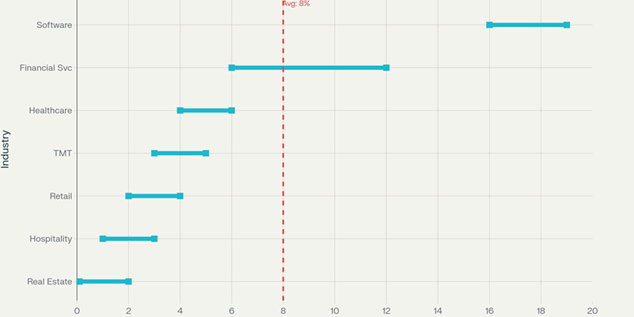
CIOs today face unprecedented pressure from board, business and shareholders to mirror big tech success stories. The software industry spends 19% of its revenue on IT, while hospitality spends less than 3%.
In our understanding, this isn’t an anomaly; it’s a fundamental truth that most CIOs are ignoring in their rush to emulate Big Tech playbooks. The result is a systematic misallocation of resources based on a fundamental misunderstanding of how value creation works across industries.
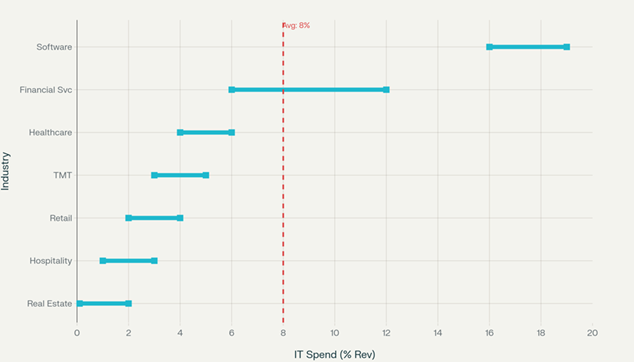
(Source: Collated across publications – industry & consulting)
Ankur Mittal, Rajnish Kasat
- The majority gap: Five out of seven industries spend below the cross-industry average, revealing the danger of benchmark-blind strategies
- Context matters: Industries where technology is the product (software) versus where it enables the product (hospitality, real estate) show fundamentally different spending patterns
The gap reveals a critical flaw in enterprise technology strategy, the dangerous assumption that what works for Amazon, Google or Microsoft should work everywhere else. This one-size-fits-all mindset has transformed technology from a strategic asset into an expensive distraction.
| Year | IT Spend Growth Rate (A) | Real GDP Growth Rate (B) | Growth Differential (A-B) |
| 2016 | -2.9% | 3.4% | -6.3% |
| 2017 | 2.9% | 3.8% | -0.9% |
| 2018 | 5.7% | 3.6% | 2.1% |
| 2019 | 2.7% | 2.8% | -0.1% |
| 2020 | -5.3% | -3.1% | -2.2% |
| 2021 | 13.9% | 6.2% | 7.7% |
| 2022 | 9.8% | 3.5% | 6.3% |
| 2023 | 2.2% | 3.0% | -0.8% |
| 2024 | 9.5% | 3.2% | 6.3% |
| 2025 | 7.9% | 2.8% | 5.1% |
Table 1 – IT Spend versus Real GDP differential analysis (Source: IT Spend – Gartner, GDP – IMF)
According to Gartner, “global IT spend is projected to reach $5.43 trillion in 2025 (7.9% growth)”. IT spending has consistently outpaced real GDP growth, based on IMF World Economic Outlook data, IMF WEO. Over the past decade, global IT expenditure has grown at an average rate of ~5% annually, compared to ~3% for real GDP — a differential of roughly 2 percentage points per year. While this trend reflects increasing digital maturity and technology adoption, it also highlights the cyclical nature of IT investment. Periods of heightened enthusiasm, such as the post-COVID digital acceleration and the GenAI surge in 2023–24, have historically been followed by corrections, as hype-led spending does not always translate into sustained value.
Moreover, failure rates for IT programs remain significantly higher than those in most engineered sectors and comparable to FMCG and startup environments. Within this, digital and AI-driven initiatives show particularly elevated failure rates. As a result, not all incremental IT spend converts into business value.
Hence, in our experience, the strategic value of IT should be measured by how effectively it addresses industry-specific value creation. Different industries have vastly different technology intensity and value-creation dynamics. In our view, CIOs must therefore resist trend-driven decisions and view IT investment through their industry’s value-creation to sharpen competitive edge. To understand why IT strategies diverge across industries shaped by sectoral realities and maturity differences, we need to examine how business models shape the role of technology.
Business model maze
We have observed that funding business outcomes rather than chasing technology fads is easier said than done. It’s difficult to unravel the maze created by the relentless march of technological hype versus the grounded reality of business. But the role of IT is not universal; its business relevance changes from one industry to another. Let’s explore how this plays out across industries, starting with hospitality, where service economics dominates technology application.
Hospitality
The service equation in the hospitality industry differs from budget to premium, requiring leaders to understand the different roles technology plays.
- Budget hospitality: Technology reduces cost, which drives higher margins
- Premium hospitality: Technology enables service, but human touch drives value
From our experience, it’s paramount to understand and absorb the above difference, as quick digital check-ins serve efficiency, but when a guest at a luxury hotel encounters a maze of automated systems instead of a personal service, technology defeats its own purpose.
You might ask why; it’s because the business model in the hospitality industry is built on human interaction. The brand promise centers on human connection — a competitive advantage of a luxury hotel such as Taj — something that excessive automation actively undermines.
This contrast becomes even more evident when we examine the real estate industry. A similar misalignment between technology ambition and business fundamentals can lead to identity-driven risk, such as in the case of WeWork.
Real estate
WeWork, a real estate company that convinced itself and investors that it was a technology company. The result, a spectacular collapse when reality met the balance sheet, leading to its identity crisis. The core business remained leasing physical space, but the tech-company narrative drove valuations and strategies completely divorced from operational reality. This, as we all know, led to WeWork’s collapse from a $47 billion valuation to bankruptcy.
Essentially, in real estate, the business model is built on physical assets with long transaction cycles pushing IT to a supporting function. Here, IT is about enabling asset operations and margin preservation rather than reshaping the value proposition. From what we have seen, over-engineering IT in such industries rarely shifts the value needle. In contrast, the high-tech industry represents a case where technology is not just an enabler, it is the business.
High Tech
The technology itself is the product as the business model is built on digital platforms, and technological capabilities determine market leadership. The IT spend, core to the business model, is a strategic weapon for automation and data monetization.
Business model maze
While software companies allocate nearly 19% of their revenue to IT, hospitality firms spend less than 3%. We believe that this 16-point difference isn’t just a statistic; it’s a strategic signal. It underscores why applying the same IT playbook across such divergent industries is not only ineffective but potentially harmful. What works for a software firm may be irrelevant or even harmful for a hospitality brand. These industry-specific examples highlight a deeper leadership challenge: The ability to resist trend-driven decisions and instead anchor technology investment to business truths.
Beyond trends: anchoring technology to business truths
In a world obsessed with digital transformation, CIOs need the strategic discernment to reject initiatives that don’t align with business reality. We have observed that competitive advantage comes from contextual optimization, not universal best practices.
This isn’t about avoiding innovation; it’s about avoiding expensive irrelevance. We have seen that the most successful technology leaders understand that their job is not to implement the latest trends but to rationally analyze and choose to amplify what makes their business unique.
For most industries outside of high-tech, technology enables products and services rather than replacing them. Data supports decision-making rather than becoming a monetizable asset. Market position depends on industry-specific factors. And returns come from operational efficiency and customer satisfaction, not platform effects.
Chasing every new frontier may look bold, but enduring advantage comes from knowing what to adopt, when to adopt and what to ignore. The allure of Big Tech success stories, Amazon’s platform dominance, Google’s data monetization and Apple’s closed ecosystem has created a powerful narrative, but its contextually bound. Their playbook works in digital-native business models but can be ill-fitting for others. Therefore, their model is not universally transferable, and blind replication can be misleading.
We believe, CIOs must resist and instead align IT strategy with their industry’s core value drivers. All of this leads to a simple but powerful truth — context is not a constraint; it’s a competitive advantage.
Conclusion: Context as competitive advantage
The IT spending gap between software and hospitality isn’t a problem to solve — it’s a reality to embrace. Different industries create value in fundamentally different ways, and technology strategies must reflect this truth.
Winning companies use technology to sharpen their competitive edge — deepening what differentiates them, eliminating what constrains them and selectively expanding where technology unlocks genuine new value, all anchored in their core business logic.
Long-term value from emerging technologies comes from grounded application, not blind adoption. In the race to transform, the wisest CIOs will be those who understand that the best technology decisions are often the ones that honour, rather than abandon the fundamental nature of their business. The future belongs not to those who adopt the most tech, but to those who adopt the right tech for the right reasons.
Disclosure: This article reflects author(s) independent insights and perspectives and bears no official endorsement. It does not promote any specific company, product or service.
This article is published as part of the Foundry Expert Contributor Network.
Want to join?
Read More from This Article: Stop mimicking and start anchoring
Source: News