

AI adoption tends to reach every boardroom agenda faster than expected, propelled by urgency, competitive pressure, and a growing sense of FOMO. This article captures highlights from a recent discussion between Mike Zamarski, Digital Transformation Consultant, and Adam Grabek, Solutions Architect at Future Processing, where they explored in full what it means to be AI-ready, why legacy doesn’t have to be a blocker, and how organisations are already achieving results such as 2.5x faster response times with AI.

Future Processing
Stakeholders expect fast answers from decisionmakers: which platforms to use, which vendors to choose, and which tools to implement to generate quick wins.
The pressure to just start with something, and start with it fast, overrides any assessment of whether the organisation is ready to make their next big AI initiative actually work.
The wrong starting point
Meanwhile, the market reality is harsh. According to industry data, 70 to 80% of AI initiatives fall short of their stated objectives, a figure consistently echoed in analyses by McKinsey or Gartner.
When organisations prioritise execution over preparedness, AI becomes less a lever for transformation and more a catalyst for existing inefficiencies. The true source of the problem lies elsewhere.
AI is a multiplier of what you already have…
…and this dynamic cuts both ways. When pursuing AI adoption without a stable operational baseline, the tech serves as an amplifier of inconsistency rather than a force for resolution. Without visibility into your operations, AI stays detached from the levers that drive performance and value. You can’t efficiently optimise what you can’t see or align what no one agreed to track in the first place.
Modernising for AI without metrics is like asking Google Maps for directions without enabling GPS on your phone.
It’s not the algorithms that bring AI projects down, but the absence of a shared view of the current state, and of what measurable progress should look like.
Legacy, too, doesn’t have to be a blocker, provided it’s addressed through structured modernisation approach, where visibility and metrics form the groundwork for both quick wins and sustainable value.
And a total metrics-driven approach offers the structure needed to define, track and align both quick wins and sustainable value.
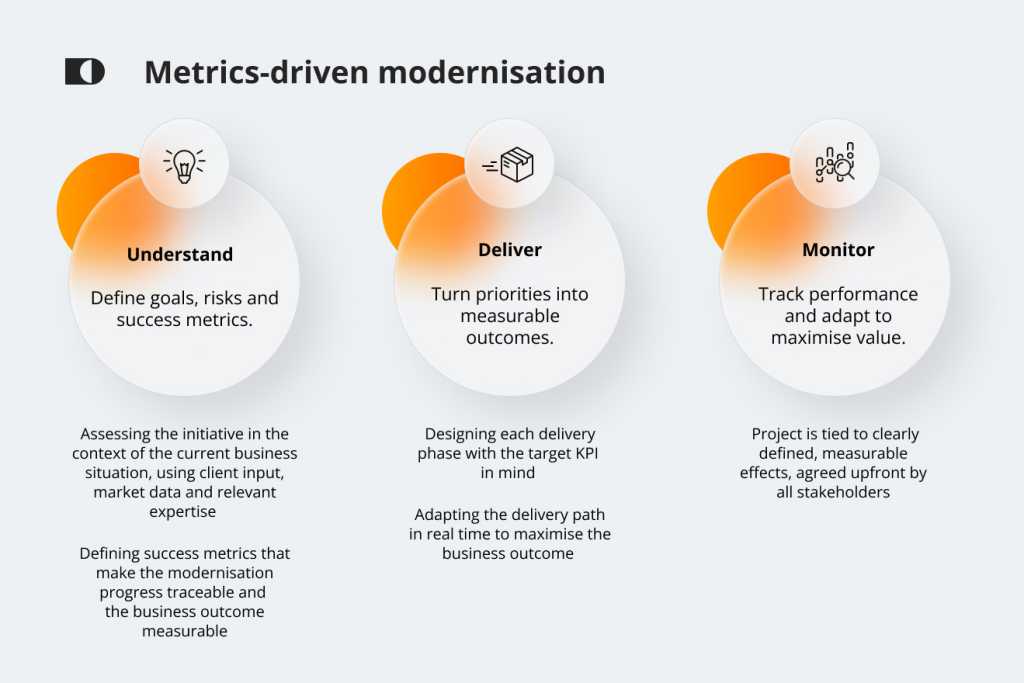
Total-metrics driven approach to AI adoption
A metrics-driven approach gives leadership something to steer by and course-correct along the AI adoption process, with clear visibility into current operations, measurable progress, and the remaining ground to cover.
Future Processing
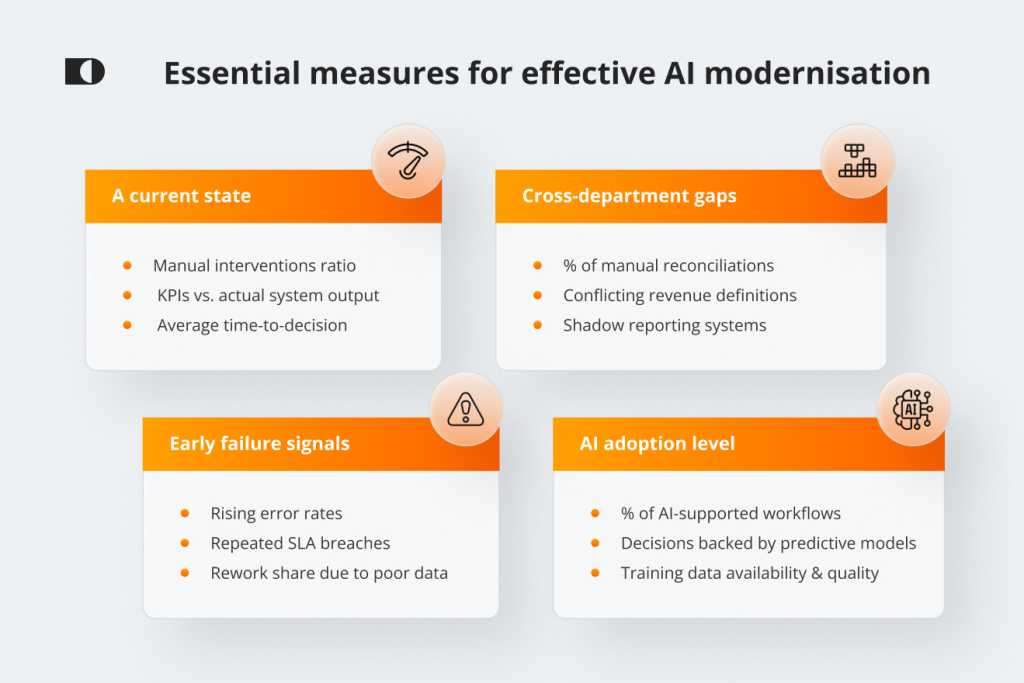
What needs to be measured before AI can be adopted for value
- A current state
Gain clarity on how systems function, how processes run, and how decisions are made across teams.
Relevant indicators include manual interventions ratio, KPIs alignment with actual system output, and average time-to-decision.
- Cross-department gaps
Identify inconsistencies in workflows, data definitions, and accountability.
Useful metrics might cover the percentage of manual reconciliations, conflicting revenue definitions, and shadow reporting systems.
- Early failure signals
Define what failure means as clearly as success criteria. Set it at the start of every initiative. That way it serves as the early signal of drift, not the closing note of a post-mortem.
Key measures could include rising error rates, repeated SLA breaches, or an increasing share of rework caused by poor data quality.
- AI Adoption level
Those metrics help you acknowledge uneven readiness and enable phased, observable rollout.
Track it through the share of AI-supported workflows, growing number of decisions backed by predictive models or availability and quality of training data.
These metrics expose whether the organisation is genuinely prepared to operationalise AI or merely engaging in optimistic spending without the necessary foundations.
Future Processing
AI can’t deliver without measurable foundations
In FOMO-fuelled boardrooms, a metrics-first AI strategy may seem slow, cautious or even counterintuitive. In the long run, however, it’s the only path to durable value, where decisions are traceable and outcomes endure way beyond the project launch.
The webinar expands on this perspective, showing how metrics can turn AI adoption from cautious experiments into accountable transformation, with results already visible in leading organisations.
About the author: Mike helps companies turn ambition into measurable outcomes. With over a decade of experience partnering with C-level executives worldwide, he drives business transformation through strategy, AI implementation, and scalable collaboration models. His work includes designing change frameworks, leading GenAI adoption initiatives, and co-creating an internal consulting guild to strengthen advisory capabilities.
Read More from This Article: Why a metrics-driven approach is critical to meaningful AI adoption
Source: News