

To win in the Agentic Age, don’t chase return on investment. Instead, build a data foundation first. Only once that foundation is built can a company begin to unlock real value.
It’s an approach that goes against the instincts of most companies and executives. The common instinct is to identify a high-profile project with the potential for a fast return on investment.
Too often, that is a recipe for disaster, said Mihir Shah, a former Fortune 500 CIO, tech executive, and current member of the Reltio Advisory Board, who has helped companies navigate these challenges for more than 30 years.
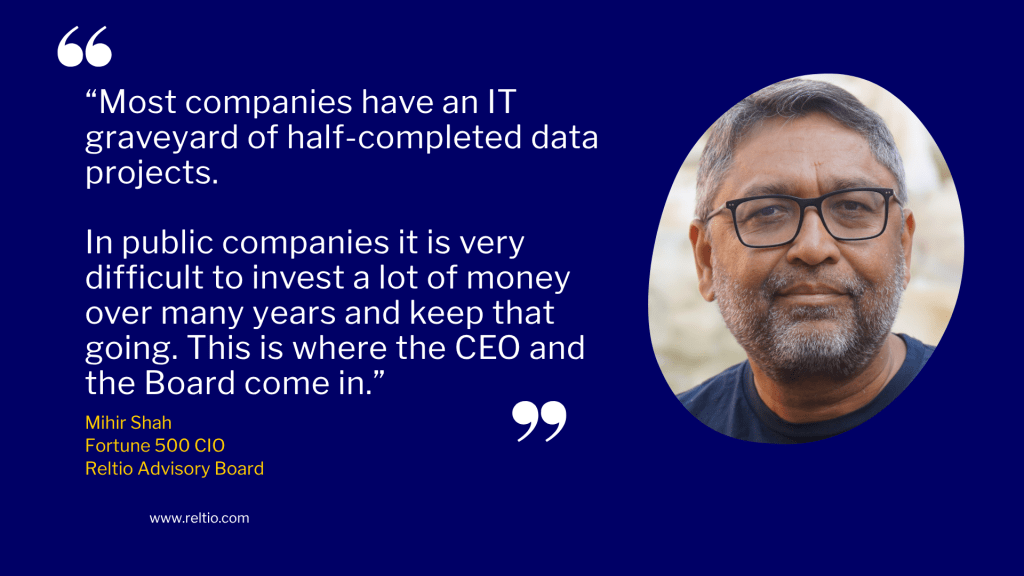
“Most companies have an IT graveyard of half-completed data projects,” he said. “In public companies, it is very difficult to invest a lot of money over many years and keep that going. This is where the CEO and the Board come in.”
Begin with a foundational data model
The first use case every company should tackle is building a foundational data model with unique IDs for its customers, products, clients, and other key pieces of data, he said. Only once that taxonomy has been established, and all data has been unified in one location, can leaders across the business identify use cases that grow revenue or margin.
There are natural allies within most companies who will support this kind of foundation work, Shah said. CFOs are often the first to turn to, as they and their teams understand best how hard it is to aggregate financial information across business silos. Compliance teams also need visibility into the entire business across business units. Both are often early adopters of unified data strategies.
When leading a foundational effort, though, a chief data officer must show progress along the way, Shah said, who led a similar effort at a large financial institution earlier in his career.
“In my case, I had a four-year program, but within two quarters, you have to show use cases that offer not necessarily the highest ROI but something to show that we are making progress and creating value for the business,” he said.
Real-time personalization drives success
In today’s market, competitive advantage no longer hinges on brand loyalty, product features, or price. It depends on delivering hyper-personalized, real-time experiences that anticipate and adapt to customer needs.
Take these two examples:
- A global hotel chain uses AI agents to unify data from booking systems, loyalty programs, and guest preferences. When a frequent traveler books a room, the system instantly customizes the experience—assigning a preferred room, offering tailored upsells, and notifying staff of personal preferences. The result: higher satisfaction, increased revenue per booking, and deeper loyalty.
- A medical device company deploys agents to monitor real-time sensor data from field equipment. When anomalies are detected, the agents proactively initiate a service order, alert the customer, and dispatch a technician—often before the user even knows there’s a problem. Downtime is avoided, and trust is reinforced.
These are not future visions—they’re today’s reality, powered by agentic AI and data in motion. Unlike batch-processed, siloed data, real-time, unified data allows agents to personalize interactions, automate decisions, and act with foresight, driving both profitability and customer loyalty at scale.
Businesses that unify and activate data in real time can meet customer expectations in the moments that matter most. It’s no surprise that companies leading in personalization generate 40% more revenue than their peers. The common thread: data mastery drives market leadership.
C-suite leadership is required at this moment
To seize the advantage, C-level leaders must act now and reimagine their data strategy. This is not a departmental issue. It is also not just a CIO or CDO agenda—it’s a CEO and Board-level imperative. Enterprise data is becoming the most valuable asset that a company has. Leaders must ask: Are our decisions—human or AI—based on the freshest, most complete data? If the answer isn’t a confident “yes,” it’s time for change.
That means breaking down silos, unifying core data domains (customer, product, operations), and replacing batch-based processes with real-time data pipelines. It also means implementing robust governance and observability so AI systems can make trusted, automated decisions.
Enterprises need to build robust data pipelines, AI-driven insights, automation frameworks, and real-time decision-making engines as the foundation for agentic AI.
But technology alone isn’t enough. A cultural shift is essential. Data must be recognized as a strategic asset at the highest levels. Every executive must become a data leader:
- CEOs should view real-time data as a strategic growth lever, essential for spotting market shifts, delivering a premium customer experience, and enabling agility.
- CMOs and CX leaders should push for unified customer data platforms that enable personalization at scale, because irrelevant engagement kills loyalty. (Companies using real-time data have seen up to a 40% increase in customer retention.)
- CFOs and risk leaders should demand live data for financial reporting and risk mitigation, catching anomalies before crises occur.
- CIOs and CDOs must champion flexible, cloud-based architectures that support agentic AI enterprise-wide.
Winning in this new era requires data-driven leadership that cuts across roles, silos, and disciplines.
Your data strategy is your business strategy
For years, companies have chased digital transformation. Now, the shift is toward autonomous transformation, where intelligent agents and automation drive decisions and actions in real time. In this new era, success hinges on delivering the right data to the right place at the right moment.
Organizations that can do this will operate like real-time nervous systems—sensing change, making informed decisions, and taking instant action. They’ll delight customers, optimize operations, and outpace competitors. Those clinging to static data and delayed systems will find themselves running the race while staring into the rearview mirror—outmaneuvered and out of time.
The message to CEOs, COOs, CIOs, CDOs—and especially CFOs—is clear: Make your data move, or risk being moved aside.
The future belongs to companies that treat unified, trusted, real-time data as the fuel for continuous intelligence and innovation. Moving from data at rest to data in motion is not a technical upgrade.
It’s a strategic necessity.
Because in the agentic age, your data strategy is your business strategy. Those who excel at it will lead. The rest will be left behind.
Explore the new rules of intelligent data. See how industry leaders are unifying trusted data to stay ahead in the AI era.
Read More from This Article: The most important question in the C-Suite: Can we trust our data?
Source: News