

The way consumers discover, evaluate and purchase products is fundamentally shifting. Traditional commerce experiences — even those considered modern — are built around customers doing the work: searching, filtering, comparing, clicking. But what if the commerce experience could do the work for the customer? That’s the promise of agentic commerce.
As a practitioner leading digital and e-commerce transformation at a leading lifestyle brand, I have seen firsthand how rapidly customer expectations are evolving. They want relevance, speed, simplicity — and they increasingly expect technology to anticipate their needs. Agentic commerce offers a vision of the future where intelligent systems do more than personalize; they participate.
While most customers still rely on filters and categories today, there is a clear shift underway — toward discovery driven by questions, needs and intent-based prompts. Agentic commerce meets them at that moment.
What is agentic commerce?
Agentic commerce refers to a shopping experience powered by intelligent, autonomous and customer-aligned agents. These agents can learn preferences, make suggestions, automate purchases and even negotiate or personalize offers in real time (see Digital Commerce 360’s overview of agentic commerce for online retail).
It moves beyond rules-based personalization or basic chatbots. Think: a proactive shopping assistant that knows your style, budget, calendar and values and helps you make better choices faster.
This isn’t science fiction. From AI-driven recommendations to dynamic bundles and replenishment nudges, we’re already seeing the building blocks of agentic commerce emerge across categories. In my current role, we’re exploring different options in this space, including allowing our product content to be indexed by LLMs like ChatGPT and Perplexity. The goal? Let customers discover and shop directly through intelligent agents, without ever landing on our website.
By making product content discoverable by AI agents, we’re not just enabling new purchase paths — we’re building a new kind of search experience, where the customer starts outside the site and still finds the perfect product.
From personalization to participation: The agentic maturity curve
Retailers have long relied on reactive personalization — “you bought this, so you might like that.” But agentic commerce introduces a more proactive model: systems that anticipate intent and act on behalf of the customer.
Forward-thinking brands are embedding AI into key customer moments — from discovery and bundling to adaptive checkout — building the infrastructure and behavioral trust required for agent-led transactions. These near-term investments are training grounds for a broader transformation.
As agentic commerce evolves, a maturity model is beginning to take shape across the industry:
- Level 1: Personalized nudges. Systems react to prior behavior with basic recommendations.
- Level 2: Predictive guidance. AI anticipates intent and proactively suggests bundles or next-best actions.
- Level 3: Delegated action. Intelligent agents complete purchases, manage fulfillment or negotiate offers on the customer’s behalf.
Most retailers today operate between Level 1 and 2. Advancing to Level 3 will require not only technical enablement but also executive readiness to delegate decision-making and design for trust.
Customers increasingly expect more than suggestions. This shift challenges the dominance of traditional search engines and even on-site search bars. Instead of users typing in what they want, they increasingly expect the system to surface the right product through a dialogue — or simply deliver it.
Checkout innovation: Toward zero-click commerce
One of the clearest near-term use cases for agentic commerce lies at the point of conversion: checkout. Traditional checkout flows are designed around static steps. But intelligent agents can collapse those steps entirely.
Imagine a system where the moment a customer expresses interest through an agent, the purchase is already 90% complete — size selected, payment method confirmed, shipping pre-filled. This is no longer speculative. We’re seeing early momentum through single-click checkout, stored wallet integrations and adaptive checkout pods that preempt customer needs — and the future is clearly pointing toward zero-click checkout, where agents can complete transactions entirely on the customer’s behalf.
In our own work, we’ve focused on streamlining mobile checkout as a foundation for this shift. From single-page flows to one-click experiences, each improvement reduces friction and sets the stage for agents to handle future transactions autonomously.
Just as agentic systems reinvent how customers find products, they also have the power to redefine how purchases are completed — quietly removing friction in the background while trust and relevance take center stage (read Forrester’s take on thriving in a zero-click world).
The technology enablers: A layered stack for agentic commerce
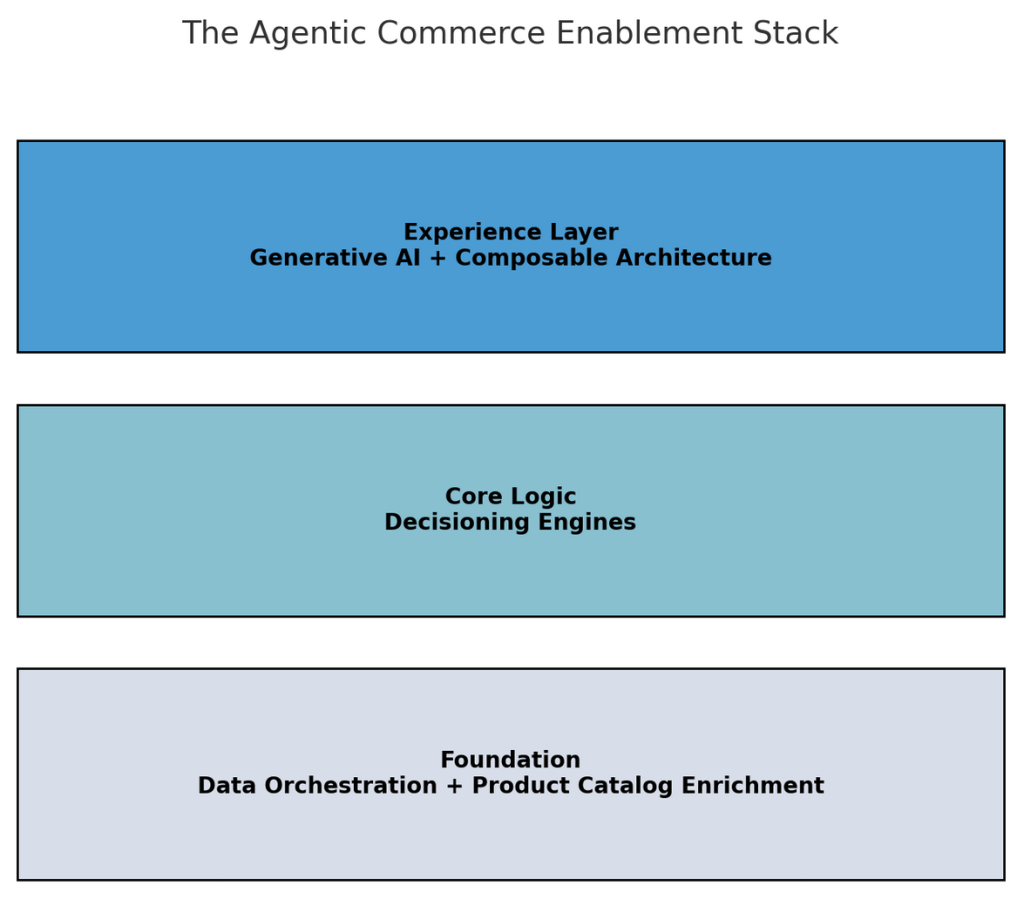
While agentic commerce is still emerging, this layered model reflects my perspective on how it can scale successfully. Powering agentic commerce at scale requires multiple interconnected layers working in harmony — each critical to enabling intelligent, adaptive and autonomous customer journeys. In this model, the website evolves into both an emotional interface for humans and an intelligence surface for machines. These capabilities align across three layers:
Foundation
- Data orchestration: Unifies data from across channels-transactional, behavioral, contextual and third party-into real-time customer profiles that agents can act on instantly.
- Product catalog enrichment: Transforms product data into AI-friendly content using structured attributes, rich metadata and natural language. This ensures agents can match products with intent, power dynamic discovery and drive conversion in conversational or zero-UI environments.
Core logic
- Decisioning engines: Drive journey orchestration by using real-time context to select the next best action, message or recommendation for each customer moment (see MIT Sloan on how ICAs rewrite decision rights).
Experience layer
- Generative AI: Powers natural conversations, dynamic product storytelling and image generation-creating rich, human-like engagement across platforms (read McKinsey’s research on scaling generative AI in retail).
- Composable architecture: Enables rapid innovation through modular, API-first systems-allowing seamless integration of agents into the digital experience.
Not every enabler must be present on day one, but the combination of data readiness, modular systems and enriched content sets the foundation for success. Retailers who invest early in these areas will be better positioned to grow with the pace of agent ecosystem adoption.
Kamanasish Kundu
From signals to stakes: The case for agentic commerce now
Agentic commerce is no longer hypothetical — leading companies are already making bold moves to operationalize it. Walmart recently announced four internal “super agents” and two EVP-level hires focused on enterprise AI adoption. OpenAI is testing hosted checkout inside ChatGPT, hinting at a future where conversational agents complete purchases directly. And PayPal’s CEO has forecast that 25% of e-commerce spend could be agent-driven by 2030.
The stakes are equally significant. According to Bernstein, agent-driven experiences could lift global e-commerce conversion by 1.5–2.5% annually, unlocking over $240 billion in incremental retail revenue.
What this means for retail leaders
Agentic commerce isn’t just a technology shift — it’s a structural, economic and competitive one. And early movers stand to lead it. It changes how teams think about product pages, search, merchandising and loyalty
Instead of optimizing funnels, brands must design systems that think with the customer. This means:
- Less focus on traditional segmentation, more on moment-based intent.
- Less rigid site structure, more adaptive journeys.
- Less push messaging, more collaborative dialogue.
For CEOs and the C-suite, agentic commerce presents both a competitive advantage and a wake-up call. If intelligent agents become the first point of discovery, brands that are not indexed, accessible and API ready — risk becoming invisible. The shift demands executive alignment across marketing, product, technology and legal, building trust-based agent ecosystems that meet customers where they are going, not where they’ve been.
Leaders must also ask tough questions:
- What decisions are we willing to delegate to AI?
- How do we build trust in autonomous systems?
- Where does the brand voice end and the agents begin?
Looking ahead
Agentic commerce isn’t a replacement for human connection. It’s a tool to enhance it. By reducing friction, surfacing better choices and respecting individual preferences, agentic systems can help retailers become more personal at scale (see BCG’s insight on how AI agents herald a “golden era” of customer experience).
We’re just at the beginning. But in a world where traditional search is declining and intelligent agents are becoming the new discovery layer, agentic commerce isn’t just a future play: it may be how your next customer finds you.
This article is published as part of the Foundry Expert Contributor Network.
Want to join?
Read More from This Article: Agentic commerce: How AI is reinventing the way customers discover and buy
Source: News