

Are you overthinking your cloud model? If so, you’re likely in need of a well-defined cloud strategy.
Companies with a clear cloud strategy position themselves to achieve more from cloud computing than those without. A well-defined cloud strategy provides a playbook inclusive of principles, baselines, services, financial models, and prioritization guidelines that enable companies to make informed decisions that support their goals.
In addition, a cloud strategy that is concise, actionable, and reviewed continuously allows organizations to assess current and future states in alignment with security, architecture, governance, compliance, human resources, quote-to-cash processes, and business objectives.
Unfortunately, many organizations mistakenly take their cloud adoption or migration plan as a cloud strategy. Whereas a cloud adoption or migration plan is focused on the “how,” a true cloud strategy is focused on answering the “what” and “why.” A cloud strategy provides a clear decision framework that directly supports business goals and outcomes.
In this article, I’ll share what a cloud strategy looks like, how it helps companies make better decisions, and how to get started.
What a cloud strategy is (and isn’t)
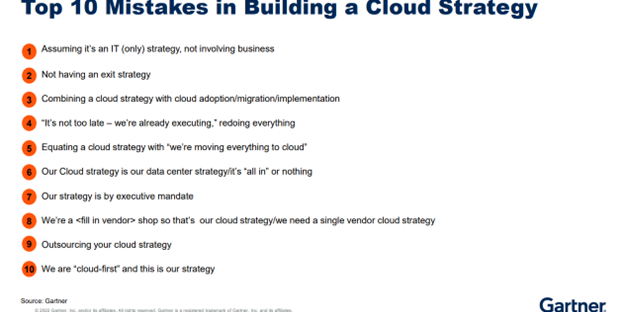
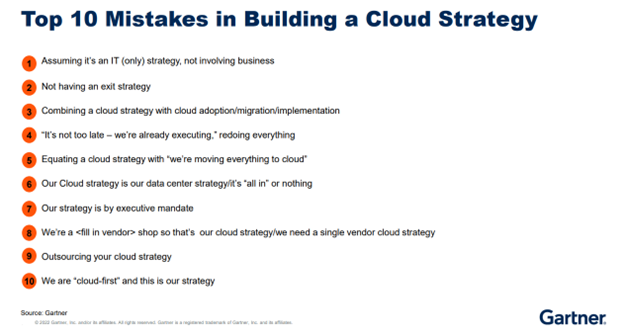
Unfortunately, many misperceptions surround the cloud, as outlined in Gartner’s Top 10 Mistakes in Building a Cloud Strategy. One such misperception is that a cloud strategy is a cloud adoption or migration plan. It’s not. A cloud strategy is not a data center strategy, a cloud-first strategy, or an IT-only strategy. Furthermore, it’s not the execution-level implementation plan many organizations think of. Take a minute to review the top 10 misperceptions that lead to mistakes in building a cloud strategy, as defined per Gartner:
GDT
In The Cloud Strategy Cookbook, Gartner defines a cloud strategy as “…a concise viewpoint on the role of cloud computing in your organization.” A true cloud strategy describes the role of the cloud as a business accelerant. It exists to align stakeholders and establish guardrails for decision-making. It includes leaders across the business, including C-level executives. Most of all, it directly supports whatever your business is trying to achieve.
A formal cloud strategy streamlines decision-making, drives better ROI, and reduces risks in strategy execution. A clearly defined cloud strategy helps businesses maximize their cloud investments and align with other synergetic domains of the business. Ultimately, a cloud strategy reduces frustration, disappointment, overspending, and low-value creation.
Getting started with your cloud strategy
If you don’t have a cloud strategy, you’re not alone. Most organizations don’t start with a strategy. Instead, they may begin with a business driver, such as closing a data center or merging with or acquiring another company. They may start with experimentation or heavier adoption in one silo of the organization. In most cases, it’s not until later that they circle back and create a cloud strategy that is not intermingled with adoption or execution planning.
A cloud strategy playbook does not need to be long or written in stone. In fact, it should be relatively short (10-20 pages) and considered a living document —updated regularly to reflect the shifting needs of your business, changes in the market, or anything that affects a significant organizational change.
For example, if your company merges with or acquires another company, that will impact your principles and R-Lane prioritizations. Or, if a new market opportunity comes along, you may need to revisit your cloud strategy to ensure it will help you drive competitive advantage.
The steps for creating a cloud strategy are simple:
- Secure executive sponsorship.
- Gather the right people and set up a cloud strategy office, business office, or steering committee to help ensure your cloud strategy aligns with other domains in the business, such as security, architecture, data center, compliance, finance, IT service management, HR, and legal.
- Finally, host an iterative assessment series with workshop sessions to define or refine your cloud strategy, including principles and alignment to other domains (architecture, security, procurement, HR, etc.). Establish a cadence to review it regularly.
10 questions your cloud strategy should answer
As part of your cloud strategy definition, you should consider assessment and hands-on workshop sessions to define guiding principles. To do so, be sure that you answer the following 10 foundationally strategic questions:
- What is your delivery and operational model? Align your workload and business objectives to a public, hybrid, private, multi-cloud, distributed, or smart cloud (workload-by-workload decision).
- What is your service model prioritization guideline (for SaaS, PaaS, IaaS, or XaaS)? Use guiding principles to define your service models based on defined guidelines.
- What is your consumption/development model? An example might be buying SaaS before building.
- What is your cloud deployment model? Will it be hybrid, multi-cloud, or cloud-native, distributed cloud?
- What is your R-Lane prioritization model? For example, define if lift-and-shift is the preferred option or last resort as a principle. Should a long-term and short-term R-Lane vision be defined for each workload? For instance, one workload can be a rehost in the short term but a re-architect/refactor in the long term.
- What is your FinOps model? Charge back or show back? Proportional or even split?
- What is your workload analysis model? Is it a workload-by-workload analysis or a big-bang analysis? How sophisticated are the inventory capabilities for workload-by-workload exercises (done outside of the strategy workstream itself)?
- What is your data center (or off-cloud) strategy?
- What is your cloud exit strategy?
- What is your level of strategic alignment with other parts of the business?
Define your cloud strategy with help from GDT
A solid cloud strategy helps ensure your organization makes suitable investments to support your business and streamlines decision-making around your cloud model.
With decades of experience, GDT can help you define your cloud strategy and create a cloud strategy playbook based on Gartner’s principles and best practices. To learn more, contact the cloud experts at GDT today.
Cloud Computing
Read More from This Article: Are You Overthinking Your Cloud Model? You Need a Cloud Strategy
Source: News