

“Such an embarrassment of a flag carrier. I will never fly AC unless I absolutely have to.”
“This is absolutely outrageous.”
These were some of the nicer social media reactions on carrier Air Canada following November 2022, when a well-intended chatbot on the airline’s website confidently invented a refund policy, triggering lawsuits and a reputational crisis far outweighing the chatbot’s original cost-saving ambition. Not unlike Duolingo, Klarna and McDonald’s, Air Canada had not failed because it used AI — but because it failed to align AI with business priorities.
Under huge pressure from boards and markets, organizations now declare themselves AI-first before answering a far more fundamental question: AI for what and what not, exactly? For CIOs, this is no longer a technological question but a strategic one. Organizations too often rush ahead without first properly aligning AI with their business model, established value creation approaches and the risks their company can handle.
We propose a fix: 4 AI strategy archetypes, as we call them. These blueprint-like AI approaches were distilled from our yearslong AI strategy work and help CIOs delineate valuable AI playing fields while balancing both hype (risk blindness) and overcaution (missed opportunities).
By forcing critical appraisal of these extremes, strategy archetypes foster a productive strategy dialogue within the top management team and help organizations avoid their own Air Canada moment.
Incorporating AI strategically
This is important as, despite prominent cautionary tales, too many leadership teams still talk about AI as if there was a single “right” strategy. But this ignores two ways in which organizations profoundly differ: their key levers to create value and the risk degree they can tolerate.
Some firms place bold bets on AI moonshots (as now observable in the chemical industry), accepting failure risks in exchange for potential market-redefining advantages. Others build on industry-proven, incremental AI optimizations of existing processes with predictable returns.
Even more importantly, AI is still too often unaligned with organizations’ competitive strategies. A luxury goods provider such as Hermès focuses on protecting its craftsmanship, brand image and product scarcity. A retailer like Walmart, on the other hand, has built its business model on operational excellence, scale and exceptional cost efficiency. Clearly, it’s strategic nonsense to expect both to leverage AI in the same way. And yet, such crucial differences are precisely what we see AI discussions miss out on too often.
Why do we still lack more established strategy tools helping the C-suite fit AI strategy to their distinctive business models and value creation logics? The answer, our professional practice shows, is not another AI maturity model.
Throughout years of AI advisory, we started to notice something striking. In our and others’ AI strategy work across industries, geographies and organizational maturities, as well as countless conversations with CIOs, CEOs, CFOs and heads of AI and data, we saw some distinctive strategic patterns around AI emerge.
With each month in the trenches of AI strategy, we further realized it was one differentiator putting a few leading AI organizations ahead of the pack: a decisive clarity and explicitness about where to focus AI efforts in value creation while saying no to disproportionate risk.
Observing this choice across organizations, we distilled four distinct AI strategy archetypes that can help leadership teams position AI very deliberately, have a more productive AI strategy dialogue and make smarter bets — before an Air Canada moment forces this conversation.
AI strategy archetypes: How they simplify the AI strategy dialogue
To bring clarity into a company’s AI strategy dialogue, it’s critical to take a step back and recall two fundamental dimensions of business strategy:
The first is the value creation focus: Is AI primarily focused on improving internal processes — i.e., to increase efficiency, productivity and employee capabilities — or is it more externally focused on improving products, services and customer value propositions?
The second dimension is risk tolerance: Does the company deliberately pursue bold, experimental AI bets while accepting uncertainty and failure along the way or does it favor proven AI practices and applications that can be implemented with rather predictable outcomes?
From these two dimensions’ intersection spring four distinct AI strategy archetypes — each with typical strategic measures, each legitimate, each powerful in its own context when aligned with a firm’s business model (see figure 1). It is these two dimensions that anchor the AI strategy dialogue between hype and overcaution.
Gerlinde Zimmermann, Marc Feldmann
Archetype 1: Pioneers
Pioneers operate in the high-risk, externally focused value creation quadrant of the 2 x 2 matrix. They view AI as a vehicle for breakthrough innovation and are willing to place moonshot bets on untested technologies, novel data sources or entirely new AI-enabled products and markets.
Pioneers accept that many initiatives will fail — and budget for that reality — because they know that few successes can redefine industries or create new ones altogether.
Archetype 2: Innovators
Innovators also embrace risk, but they focus on internal AI activities. Their goal is not to disrupt markets, but rather to radically reinvent the way their company works. Innovators use AI to challenge long-established processes, automate complex decision-making processes and fundamentally rethink operating models. They are the cultural antithesis of “but we’ve always done it this way”-organizations.
Going forward, this will often imply exploring agentic AI as a completely new approach to rethinking the operating model.
Archetype 3: Performers
Performers sit at the opposite end of the risk spectrum, with an internal focus on value creation. They pursue AI pragmatically, using a test-and-scale mindset to incrementally improve efficiency, quality and speed.
Performers rely on comparably mature, well-understood AI use cases — some more frequent topics are financial forecasting, predictive maintenance and rule-based process automation — and embed these cases deeply into existing processes to gradually increase performance.
Archetype 4: Pathfinders
Pathfinders combine low risk tolerance with an external focus. Rather than betting on bold invention, they systematically scan their industry and competitors for AI use cases that have already proven their value elsewhere. They prefer learning from the mistakes that others have made first.
Their strength lies in adapting best-practice AI solutions to their own context in small, controlled steps. For pathfinders, AI strategy is less about being first — and more about arriving with minimal bruises.
But how do AI strategy archetypes really look in action?
Case study: Western Rail — strategic repositioning for AI value creation
Imagine a regional public transport provider, Western Rail, being under pressure back in 2024. Ticket vending machines and travel agencies as non-digital sales channels were no longer what travelers wanted, burdening the P&L with idle costs.
Western Rail also faced margin pressures in public tenders from emerging, low-overhead local competitors. AI initiatives (such as an AI customer support chatbot) had been launched here and there, but as lighthouses rather than measures rigorously focused on actual business needs. Money was being burnt and initial AI enthusiasm among staff started to turn into frustration.
When a new CIO entered the firm, he tasked a small team of AI specialists to radically refocus Western Rail’s AI approach. In initial strategy workshops with channel leadership, the specialists introduced AI strategy archetypes as a navigation system for the firm’s AI strategy dialogue. Performer, pathfinder and the other archetypes provided an intuitive language to talk about AI for the mostly non-technical leadership team.
To establish a common departure point, the team probed leadership on Western Rail’s current AI value creation: They asked: “Are we pursuing results with AI more in our internal processes and costs or around traveler satisfaction and product innovation? Did last year’s AI project ideas spring primarily from operational bottlenecks or from transportation market requirements?”
The specialists also made leadership reflect on the firm’s current AI risk tolerance, asking: “How much budget and time for experimentation do we give teams today before demanding tangible business outcomes? Do staff and competitors view our AI project approvals overall as conservative or bold?”
Being pushed on such questions made a diffuse feeling concrete for leadership: Investments in AI had not produced desired results precisely because the firm had been trying to run in many directions simultaneously. Industry-novel, high-risk cases resembling the innovator archetype were being explored (such as AI travel agents on terminals in travel agencies). Simultaneously, customer support teams were dabbling with process automation tools to cut manual ticket routing and processing — a typical performance measure.
This spread resources thin, preventing the focus and learning curves the firm’s AI initiatives would have needed to truly transform Western Rail’s business — either via differentiating digital innovation of traditional ticket sales channels or radical automation, allowing it to compete with lean emerging players based on cost efficiency.
Archetype-driven questioning in the workshops, deepened by follow-up interviews with operational staff, eventually led the leadership team to one shared problem understanding: With its current AI activities, Western Rail was strategically in a classical stuck-in-the-middle situation.
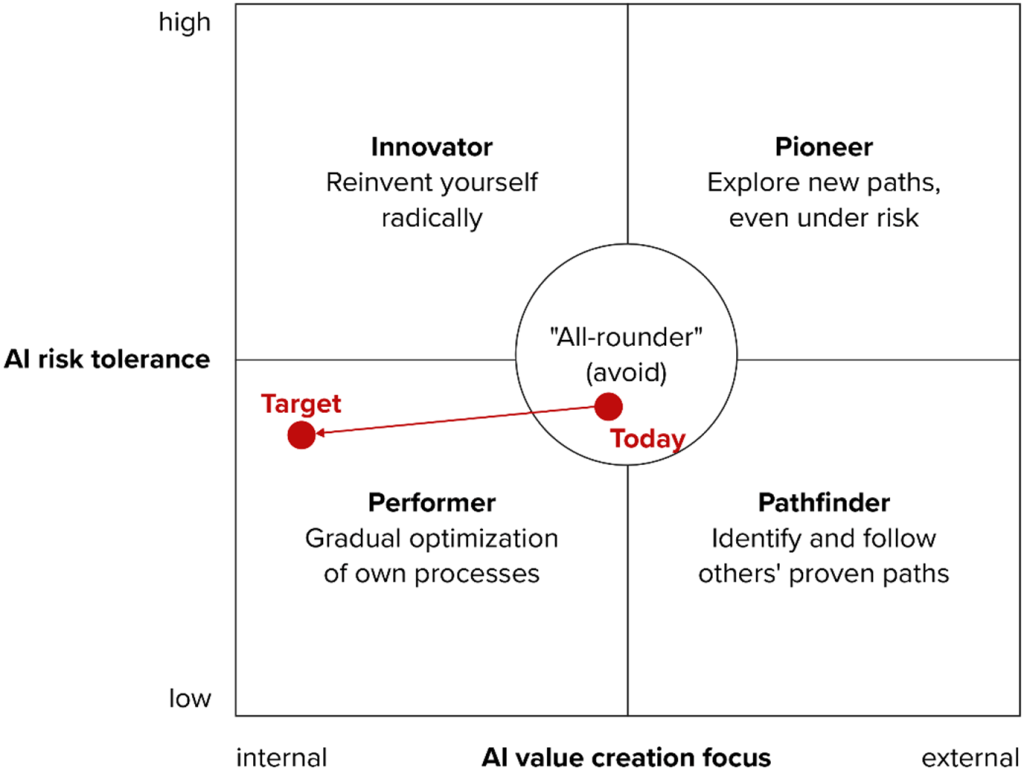
To refocus Western Rail’s AI activities on business priorities, the AI specialists set up another workshop, this time starting with a slide showing the AI strategy archetype matrix. A red dot in the middle marked Western Rail’s current all-rounder (non)position.
The specialists explained each archetype, asking: “What archetype best aligns with our business priorities and should we move toward over the next 2 to 5 years?” With the archetypes right in front of them, leadership had the concrete blueprints to set a direction for the very first time. To some, the performer archetype had an immediate appeal as it seemed to fit well with Western Rail’s need to control costs.
To explore this target position, the AI specialists challenged the group with follow-up questions such as: “Does our future competitiveness really hinge on internal efficiency and incremental process improvements? Or rather, on a differentiating traveler experience? Will expected shifts in market conditions and traveler behavior require bold mobility innovations from us or rather re-emphasize consumers’ price sensitivity and thus affordable tickets?
Gerlinde Zimmermann, Marc Feldmann
During the following discussions, a consensus emerged: a performer approach to AI became seen as a North Star for best leading Western Rail into the future (see Figure 2). The reasons were the performer archetype’s cautiousness and focus on internal process efficiency. Achieving such focus became seen as particularly desirable in the customer service team, due to a recently exploding request volume following government ticket subsidies.
In the following weeks, a roadmap with strategic measures to reposition from all-rounder to performer was developed, focusing on adaptation of industry-proven AI use cases, elimination of high-stakes use cases and experimental research cooperations and declaring automation of labor-intensive travel agency and customer support processes as high-leverage AI application areas.
At Western Rail, which was lacking clarity and focus of AI efforts, the performer archetype became not only a powerful template for sponsors to assess upcoming project ideas (“Will this investment make us more or less of a performer?”), it also became a vivid and practical rationale for helping leaders explain to staff why some projects were started and others postponed, giving orientation in everyday project work (“Would this AI assistant’s proposed functionality scope make agency shift planning cheaper and faster or introduce unjustified complexity?”).
Where AI strategy archetypes help most
AI strategy archetypes — as experience-grounded strategic blueprints — help those firms most that struggle with the early question: “Which AI approach is right for us?” At the same time, AI strategy archetypes are not AI strategy lite and certainly not AI strategy replacement. Instead, AI strategy archetypes help set a fruitful destination early on. In doing so, they can kickstart the development of a fleshed-out AI strategy that spells out how to get there.
While designed with the development of an AI stance for one business unit in mind, the AI strategy archetype framework is also applicable to business unit portfolios. Where different business units have different value creation approaches and risk tolerances, one unit may adapt the performer archetype, while another might need to become an innovator. In any case, each business unit will best be served by having its own dedicated strategy dialogue.
AI strategy archetypes act as a navigation system for AI starters, telling CIOs and other leaders where to look first for AI use cases in their firms and how to clarify the level of acceptable risk. With that, archetypes are a powerful tool that can disentangle organizations’ emerging AI strategy dialogue.
This article is published as part of the Foundry Expert Contributor Network.
Want to join?
Read More from This Article: 4 AI strategy archetypes every CIO should know
Source: News