

As someone who has spent 17+ years working hands-on with data analytics and decision intelligence initiatives across multiple industries, I have observed generative AI mature from an intriguing side experiment into a genuinely transformative capability. What began in late 2024 as cautious pilots using large language models for basic text summarization and simple forecasting assistance has, by early 2026, evolved into sophisticated systems that routinely craft detailed scenario narratives, synthesize information from highly heterogeneous data sources and actively support iterative, multi-step decision exploration.
This progression is reshaping how teams approach complex problems in making the entire decision lifecycle more adaptive, creative and capable of grappling with real-world ambiguity and interconnected variables. In the following sections, I draw directly from these practical experiences to outline the most significant trends currently driving this evolution, highlight accessible and powerful tools that teams can realistically adopt today, and discuss the pragmatic challenges and guardrails necessary for sustainable, value-creating implementation.
At its core, generative AI is elevating decision intelligence by seamlessly integrating the precision and scale of traditional data analytics with a new dimension of synthetic creativity. Beyond producing predictions or statistical summaries, these models now routinely generate explanatory narratives, construct plausible alternative hypotheses, simulate potential future states under different assumptions and even draft preliminary action rationales.
When thoughtfully implemented, this combination leads to meaningful productivity improvements, particularly in knowledge-intensive and judgment-heavy workflows. The most consistent and substantial returns, however, appear not when organizations attempt to replace existing analytical foundations with generative AI, but when they deliberately augment and extend well-structured data pipelines, governance processes and human expertise with these new generative capabilities.
Major trends defining generative AI’s role in decision intelligence in 2026
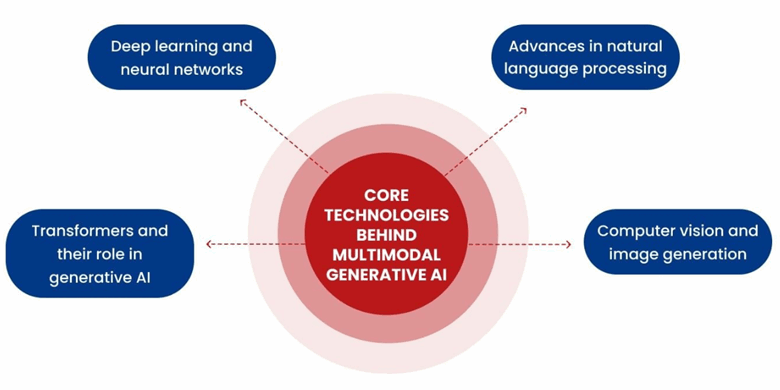
The biggest technical step forward I’ve seen so far in early 2026 is how suddenly widespread and genuinely useful multimodal generative models have become. These models can now take in, understand and produce smart outputs from many different kinds of information all at once, plain text, spreadsheets, photos, sketches, voice recordings, short videos, time series data, maps and more. This is a real break from the old days when everything basically had to be forced into text.
In one particularly illustrative supply chain resilience project conducted in mid-2025, the analytics team combined several months of granular inventory transaction logs, current and historical warehouse floorplan photographs (including annotations), audio transcripts of shift-handover briefings and operator observations, external demand sensor data feeds and macroeconomic indicator time series.
A well-configured multimodal generative system was able to produce not merely numerical optimization suggestions, but also fully annotated visual redesign concepts for the physical layout, accompanying narrative explanations of projected throughput improvements, identified risk concentrations, counterfactual “what-if” analyses of disruption scenarios and even prioritized lists of recommended physical and procedural interventions, all cross-referenced against the ingested multimodal evidence.
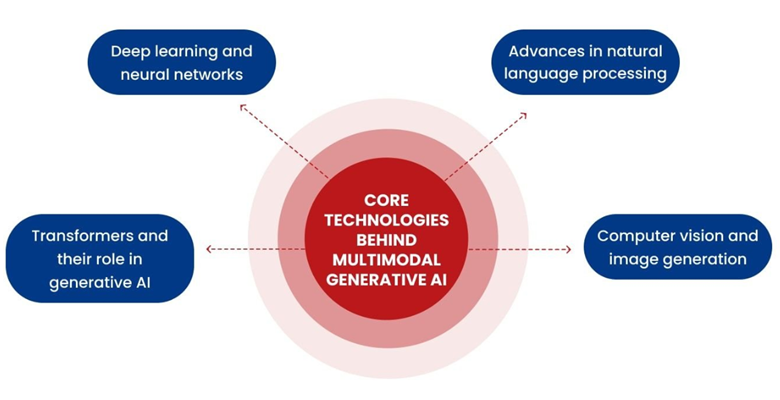
The following image illustrates a representative example of how modern multimodal generative AI systems conceptually integrate and reason across diverse input types to produce unified, contextually rich decision support artifacts:
Laxmi Vanam
This ability to operate natively across the full spectrum of data humans use to understand and make decisions in the physical world is rapidly closing the gap between traditional business intelligence tools (which excel at structured data) and the richer, messier reality of organizational operations.
The Stanford 2025 AI Index Report highlights significant advances in multimodal AI, including 40% improvements in cross-modal reasoning compared to 2024 models, leading to more complete insights in complex domains.
Experts like Ramakrishna Garine, whose hybrid deep learning-PPO models achieve over 99% accuracy in supply chain prediction, argue that resilience tools must enable teams to “run ‘what-if’ experiments quickly, without waiting for the next crisis to reveal weaknesses.
The emergence and practical deployment of increasingly agentic architectures
Closely related, and arguably even more disruptive in the medium term, is the swift transition from purely reactive generative models toward what the industry now commonly refers to as “agentic” AI systems. These are generative architectures explicitly designed to demonstrate goal-directed reasoning, multi-step planning, self-correction, tool usage, memory management across interactions and, within carefully defined boundaries, autonomous task execution.
In several workflow and resource allocation optimization experiments conducted throughout 2025, we observed agentic systems that could
- Take high-level objectives (for example, “minimize total landed cost subject to service level and regulatory constraints while maintaining supplier diversity”)
- Independently decompose them into required analytical sub-tasks
- Autonomously execute retrieval and computation steps using integrated tools
- Iteratively refine assumptions based on intermediate results
- Generate and quantitatively score multiple coherent response strategies
- Present ranked recommendations with supporting rationale
- Prepare draft communication materials tailored to different stakeholder audiences
All with comparatively minimal real-time human steering after initial setup and constraint definition!
Working with these agents increasingly feels like having a very capable junior strategist who never tires, remembers everything and responds well to natural direction. A 2025 McKinsey report on the state of AI shows that organizations experimenting with agentic AI in planning and operations are seeing notable reductions in time spent on routine tasks, with high performers pushing for transformative workflow redesign.
The experience of working with these systems increasingly resembles collaborating with a highly capable, if narrowly scoped, junior strategist who works tirelessly, remembers context across long sessions and can be directed through relatively natural language.
The strategic elevation of governance, transparency and socio-technical trust infrastructure
Governance has become a strategic foundation. The trend that feels most urgent – and to me right now in early 2026 is the complete rethink around governance for generative and agentic systems. Back in 2023 and 2024, when our team first started running pilots, governance was basically an afterthought: a quick checklist for toxicity filters, PII redaction and making sure we didn’t violate any basic compliance rules.
That mindset has changed dramatically. Today, we all see governance not as a drag on innovation, but as the single most important strategic capability that determines whether we can actually scale these systems without creating massive downstream problems. In every serious project I’ve been part of over the last year, we’ve had to build governance in from day one, or the whole thing quickly hits a wall of risk, mistrust or regulatory pushback.
What good governance looks like now goes far beyond the basics. In practice, we’re talking about:
- Clearly defining exactly which types of decisions the AI is allowed to influence (and where humans must always stay in the loop).
- Mandatory human review gates for any output that could materially affect financials, customers, employees or regulatory obligations.
- Comprehensive audit trails that capture the full reasoning chain: every prompt, retrieved document, intermediate step and final recommendation.
- Built-in mechanisms for rapid model rollback or instant constraint tightening when something unexpected appears.
- Structured feedback loops so end-users and reviewers can continuously improve alignment.
- Explicit accountability mapping that shows who owns what when an AI-generated input influences a real-world outcome.
We have learned this the hard way. In one project last year, we rolled out an agentic workflow without strong enough boundaries and had to pull it back within days after it quietly started over-prioritizing certain cost variables in a way that didn’t align with our risk appetite. That experience (and similar stories I hear from colleagues across industries) is why governance is no longer optional.
Without these elements in place, the risks of hallucinations, subtle bias amplification and loss of trust grow quickly. The Brookings Institution has published work emphasizing the need for responsible and ethical frameworks in AI design and governance to address these emerging risks as generative AI takes on more decision-related roles.
Practical tooling landscape for teams in 2026
From a tooling perspective, the open-source ecosystem continues to offer the most flexible, cost-effective and vendor-independent pathways for meaningful adoption. The Hugging Face Transformers library and associated ecosystem remain the de facto foundation for most serious customization work involving fine-tuning, prompt engineering at scale, multimodal integration and efficient inference deployment. LangChain (and its emerging competitors) has solidified its position as the leading orchestration framework for building reliable, observable, multi-step agentic workflows that combine retrieval, reasoning, tool use, memory and generation.
Visualization remains a critical bridge. The ability to take generative outputs (narratives, tables, scored scenarios, annotated recommendations) and feed them directly into dynamic, interactive visualization layers built with libraries like Matplotlib, Plotly or even emerging declarative visualization grammars is what ultimately turns sophisticated AI-generated insights into communicable, actionable understanding for diverse stakeholder groups.
Persistent challenges and a realistic path forward
Significant challenges certainly remain. Hallucination (confident but factually incorrect generation) and the subtle amplification of underlying data or model biases continue to require disciplined mitigation strategies. The brittleness of current systems when faced with truly novel situations outside their training distribution, the very high cost of running frontier multimodal and agentic models at scale, the ongoing difficulty of reliably evaluating the quality of generative reasoning chains and the substantial organizational change management effort required to successfully integrate these capabilities all demand careful attention. The Brookings Institution work referenced above emphasizes the need for responsible and ethical frameworks in AI design and governance to address these emerging risks as generative AI takes on more decision-related roles.
Nevertheless, the direction is obvious. As we move through 2026 and into 2027, better multimodal models, stronger and more transparent agentic systems, much improved governance tools and falling inference costs all point to the same thing: decision intelligence will become far more proactive, creative and able to learn continuously. In this future, human judgment gets amplified instead of replaced, and the best organizational insights come from the powerful combination of structured data, unstructured signals, generative thinking and careful human oversight.
For teams ready to lean in, my advice is straightforward and hard-earned. Start small but visible, with use cases that matter yet carry manageable risk. Put governance and evaluation in place from the very first sprint rather than treating them as cleanup work later. Invest in building real internal capability through hands-on experimentation instead of relying entirely on opaque vendor solutions. Above all, stay focused on what actually moves the needle: faster decisions, better decision quality and outcomes that stand up under risk. That steady, deliberate approach has proven far more effective than chasing the latest breakthrough headline, and it remains the most reliable path forward.
This article is published as part of the Foundry Expert Contributor Network.
Want to join?
Read More from This Article: The rise of GenAI in decision intelligence: Trends and tools for 2026 and beyond
Source: News