

Although great strides have been made to overcome some of the most common digital obstacles to the adoption of AI, from data cleansing to bias detection, human skills barriers have proven to be the most persistent challenge.
The nagging confluence of talent shortages and lackluster upskilling programs can leave organizations with little idea of where to begin to integrate AI, or how. This attention deficit typically leads to sporadic and siloed model development that can grow costly, quickly, and provide limited visibility into potential returns. While daunting to traditional AI adoption, such challenges can downright choke industrial AI development, which demands far more scrutiny.
This was the concern that fueled the managed services group at Hitachi, to develop its pragmatic approach to industrial AI that views adoption from the inside out – by building AI accelerators for distinct disciplines within distinct industries – rather than bolting AI onto processes from the outside in.
The effort quickly matured into an actual classification of industrial AI building blocks – a grid, not unlike the Periodic Table of Elements – of vertical and horizontal accelerators. With this approach, companies across energy, transportation, manufacturing, and beyond, are provided multiple points of entry for AI, the ability to scale, and a clear vision of the potential return on investment.
This was the making of the Praxis Library of industrial AI accelerators.
Bringing order to adoption
“The reason AI has not been widely adopted in the industrial sectors is that most companies don’t have the resources to build and train a custom model,” says Prem Balasubramanian, chief technology officer and head of AI at Hitachi Digital Services. “It is so costly, and it requires so many training cycles for it to become accurate enough to use in production, that people just don’t have the money or the patience to do it unless it provides tremendous value.”
Hitachi has taken the lessons from its custom industrial AI builds and vast domain expertise from across the company to create the Praxis Library, which includes accelerators for everything from asset digital twins and model-based yield prediction in manufacturing, to energy forecast and consumption and substation image analytics for utilities. It also includes cross-industry, “horizontal” AI accelerators for tasks like monitoring carbon output, tracking asset availability, and detecting collisions.
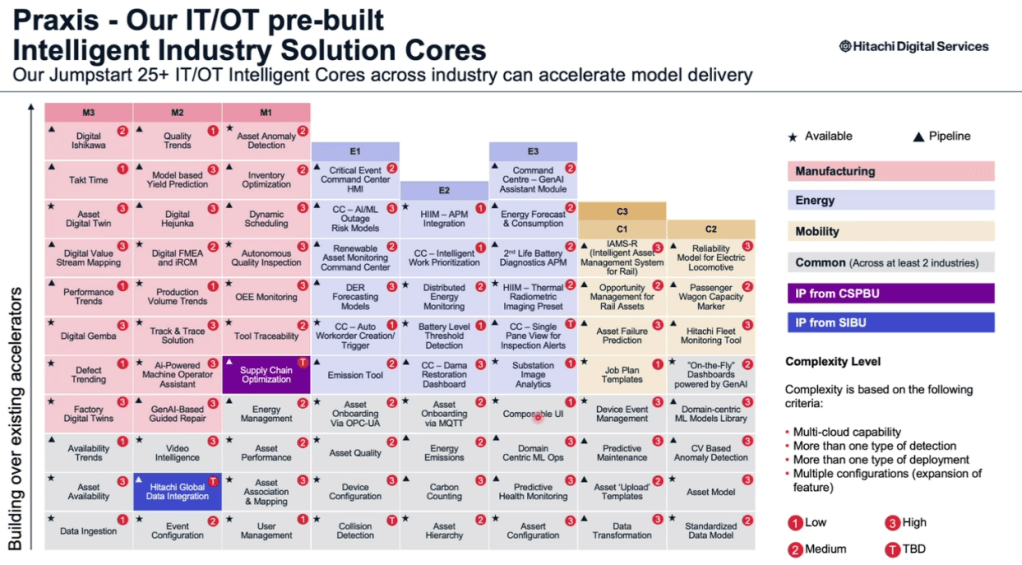
client supplied-art
The result? Dramatically faster and less expensive AI deployment. Although the accelerators must still be tailored to the unique needs of each organization, 40 to 50% of the development work has already been done, Balasubramanian says. Rather than investing significant time and money into AI experiments that may never yield a return on investment, he adds, organizations can opt for solutions with proven success in the field.
“We call it the ‘asset-ization’ of AI,” Balasubramanian says. “Every industrial application requires customization, but we’ve found the commonalities. That provides a jump start, and it’s going to accelerate and reduce the friction to AI adoption.”
“We call it the ‘asset-ization’ of AI. Every industrial application requires customization, but we’ve found the commonalities. That provides a jump start, and it’s going to accelerate and reduce the friction to AI adoption.”
–Prem Balasubramanian, chief technology officer and head of AI, Hitachi Digital Services
Manifesting the library
While the current AI hype cycle largely dates back to the fall 2022 public debut of ChatGPT, Hitachi has many years of experience standing up industrial AI solutions. Large language models (LLMs) like ChatGPT can be probabilistic, meaning that they can generate slightly different answers even if a user asks the exact same question multiple times. These models are also known to “hallucinate,” making up incorrect answers when they can’t find the necessary information in their training data.
By contrast, Balasubramanian notes, industrial AI applications are largely deterministic, meaning that they pull exact answers from highly specialized training data. Many LLM users can tolerate occasional inaccuracies. However, industrial AI applications demand much higher accuracy, especially for use cases involving transportation, heavy machinery, or other scenarios where mistakes could jeopardize the safety of workers and/or the public – not too mention the potentially extensive cost of repairs.
“Industrial AI doesn’t tolerate hallucinations,” Balasubramanian explains. “This is the kind of AI that is for mission-critical systems like trains and energy substations. In these use cases, similarity isn’t enough. The answer has to be the same, every time.”
(For more on the criticality of industrial AI, read: “Industrial AI: Move fast, break nothing.”)
In 2015, Hitachi partnered with a large logistics provider to build out an AI-powered preventive maintenance solution. At the time, truck breakdowns led to an average of two weeks of repair time, creating “huge” productivity losses across the company. With the new “Guided Repair” solution, the company was able to bring repair times down to under an hour. Afterward, the company turned to Hitachi for an AI solution to monitor its fleet (150,000-vehicles under this solution) in real time, gather data from on-board diagnostic (OBD) devices, and predict problems before they occur. The solution, which even generates automatic work orders with fault codes, helps the company get trucks back on the road within 48 hours, on average. And last year, it helped prevent about 90,000 trucks from breaking down in the first place, yielding multi-million-dollar savings annually for the logistics provider, Balasubramanian says.
From there, Hitachi built a robust predictive maintenance framework for aircraft engines. While the aircraft engine and fleet management engagements are tailored to specific operational context—such as the type and volume of data collected or the timing of data transmission—the underlying principles of the two frameworks are consistent. These insights have been distilled into the Predictive Maintenance accelerator within the Praxis library, enabling organizations to jumpstart their own initiatives with a proven foundation.
“The technical implementations may vary, but the strategic approach to solving predictive maintenance challenges is consistent,” says Balasubramanian. “By embedding our learnings into reference architectures and accelerators, we can empower customers to move faster and more confidently—without the burden of starting from scratch.”
Cataloging a partner’s industrial expertise
Looking ahead, Balasubramanian anticipates an “agentification” of existing Praxis accelerators, and even multi-agent workflows in which disparate AI tools automatically coordinate with one another to handle multistep tasks. However, he cautions that optimizing these AI solutions presents a number of challenges that can only be solved by partners with deep expertise in both industry and AI.
For example, he notes, choosing the right model for each AI task can mean the difference between a highly profitable AI deployment and one that costs a company more than it saves. Additionally, enterprise-grade security for AI solutions requires sophisticated guardrails to prevent prompt injections, model jailbreaking, and other AI-specific attacks that could compromise sensitive industrial data.
In October 2024, Hitachi announced its R202.ai framework, which stands for: Reliable; Responsible; Observable; and Optimal. By designing the Praxis library around these four pillars, Hitachi can help organizations skip costly proofs of concept and instead implement solutions that work in their environments from the start.
“Today, there is little barrier for anyone that wants to stand up an AI prototype,” Balasubramanian notes. “Anyone can put something together in two weeks. But if you want to create value for your organization, the solution needs to be reliable and responsible. You need to be able to observe it, and you need to optimize it. If you have these four things, then you can move from prototype to production.”
_______________
Prem Balasubramanian is Chief Technology Officer, Hitachi Digital Services, and a Hitachi Ltd. Global AI Ambassador. Hitachi Digital Services is a Hitachi Group Company and global systems integrator powering mission-critical platforms with people and technology.
For more information about Hitachi’s industrial AI work, visit www.hitachidigital.com/ai-resource-center/
To learn more about Hitachi Digital Services’ AI approach, read: https://www.hitachids.com/service/ai-genai-services/.
Read More from This Article: Driving lower barriers, higher returns in industrial AI
Source: News