

As the evolution of digital technology accelerates and new technologies — such as generative AI — emerge one after another, the environment surrounding businesses is becoming increasingly uncertain. In such an era, the role expected of a CIO has expanded significantly, shifting from how to implement digital technology to articulating what kind of future we want to realize. What becomes particularly important in this context is customer-centricity and vision.
As customer interests and expectations become more sophisticated and diverse, companies cannot continue to be chosen by the market by merely providing functional value, improving operational efficiency or cutting costs. To create experiences that exceed customer expectations, it has become essential for CIOs themselves to envision an exciting future and share that vision with the company and society.
Who are our customers? What is value to our customers?
Peter Drucker, often referred to as the father of management, poses the following five questions to readers in his book “The Five Questions for Managers”:
1. What is our mission?
2. Who are our customers?
3. What is the value we provide to our customers?
4. What are our results?
5. What is our plan?
Of these five, I believe the most important is question 2: Who are our customers? It is important to note that the term customers here refers to the people we need to satisfy in general. This includes not only direct customers who purchase or use our products and services, but also customers as partners, such as staff members who support our organizational activities and external partner companies.
So, who are the customers for the IT department? In addition to management, business departments, employees and group companies that receive IT systems and services, this also includes supervisors, subordinates, colleagues and partner companies who work together in the course of our activities.
Furthermore, when advancing ESG management, we can interpret this to include society and the global environment. This is because customers are the people we must satisfy. Since customers are so diverse and their respective needs, requests and hopes vary widely, I believe it is crucial to empathize with them at the very beginning of any project.
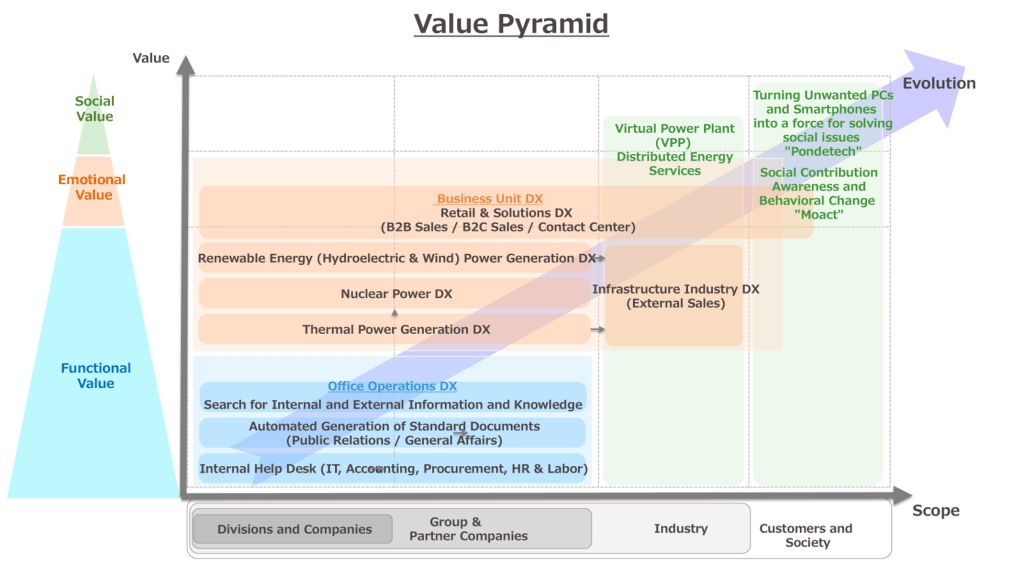
Meanwhile, the term customer also appears in point 3: What is value for the customer? Whenever I use the word value, I always try to visualize the value pyramid. As a concrete example of the value pyramid, I will discuss the value we can provide through the DX (Digital Transformation) initiatives I am currently involved in at Kansai Electric Power.
Akio Ueda
As shown in this diagram, the value pyramid consists of three layers: functional value, emotional value, and social value. Functional value encompasses features, quality and reductions in cost, time and effort; in DX, this value is primarily delivered through the promotion of office operations DX. Emotional value appeals to emotions such as the accumulation of trust, alleviation of anxiety, storytelling and enjoyment; social value refers to societal contributions, self-actualization and service to others.
From this perspective, it becomes clear that to differentiate oneself from competitors and build a competitive advantage, it is crucial not only to enhance functional value but also to improve emotional and social value. Furthermore, the scope of value delivery must be expanded beyond the company or group affiliates to encompass the industry, customers and society as a whole.
Customer-centricity is not simply listening to what customers say
The term customer-centricity has long been used by many companies. In Japan, as evidenced by the saying the customer is god, it is often interpreted as synonymous with responding to customer requests.
On the other hand, my understanding of customer-centricity goes beyond merely responding to the explicit requests and needs that customers are currently articulating. I believe it involves adopting a mindset that delves into the underlying context and meaning — asking questions such as, What are the needs, grievances or dissatisfactions that customers themselves have not yet realized? And why are consumers behaving this way right now?
Taking customer-centricity a step further, customers become more than just users who simply consume products and services; they become fans — partners who co-create the future with us. At Mineo, a budget smartphone service I was previously involved with, we positioned customers as partners and comrades who help shape the future and the brand, and we co-created products and services together with our fans.
In today’s world, where business and IT have become inseparable, digital technology has the power to dramatically enhance customer understanding and the customer experience. By visualizing customer behavior through data, formulating hypotheses and repeatedly testing them, we can arrive at deeper insights and dramatically improve the customer experience. The CIO must not only support this business process from a technical standpoint but also play a role in instilling a customer-centric mindset and way of thinking throughout the entire organization.
Without a vision, customer-centricity cannot be sustained
While many companies proclaim a customer-centric approach, their efforts are often scattered and fail to endure. I believe one of the main reasons for this is the absence of a vision. A vision is not merely a slogan or a declaration of a future state. It is the fundamental blueprint that the entire organization shares to answer the question: For whom do we want to continue providing value, and what kind of value?
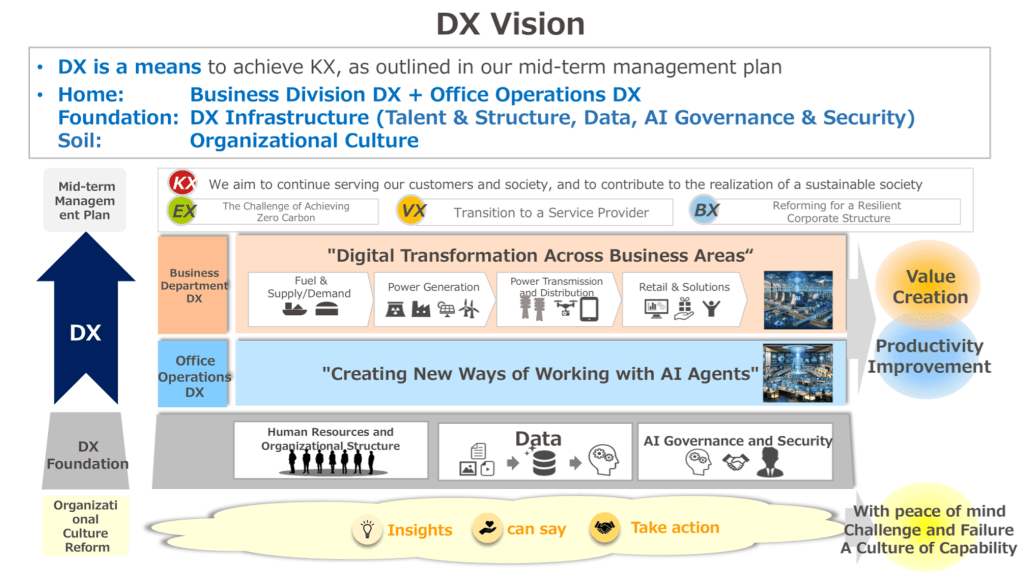
Below is Kansai Electric Power’s DX vision. To use a house as an analogy, we are working toward the realization of our mid-term management plan by advancing the business division DX and office operations DX (which correspond to the house itself), the DX infrastructure (which serves as the foundation), and organizational culture reform (which acts as the soil) comprehensively.
Akio Ueda
The DX and AI vision outlined by the CIO does not need to be confined to technical details. Rather, it is crucial that, when viewed from the perspective of customers and society, it inspires the feeling that I want to use this company’s products and services, I want to do business with this company and maintain a long-term relationship, and I want to support this future. If the vision is clear, I believe the path forward will become apparent: where to allocate and concentrate limited management resources, how to leverage core competencies and strengths to drive DX and AI, and how to establish a competitive advantage or achieve sustainable growth by creating value and improving productivity.
An exciting vision of the future drives the organization
People are not motivated by mere logic that simply explains what is correct or rational. It is only when accompanied by the emotion of I want to try this or I want to see that future that they are convinced and take proactive action.
Whether or not the vision articulated by the CIO conveys a sense of excitement not only increases the buy-in of every individual in the organization but also significantly influences the organization’s driving force and the speed at which the vision is realized. The excitement I’m referring to here does not mean flashy rhetoric or pie-in-the-sky fantasies. Personally, I believe that excitement is the driving force that creates the future and the bridge to it. It is a vision of the future that every single employee can imagine as something that personally concerns them — thinking, if we move in this direction, we’ll be able to do better work than we do now, or we’ll be able to feel that our work is truly benefiting our customers and society.
I believe that when a CIO consistently articulates the customer-centric future they have envisioned in their own words, this cumulative effort generates powerful momentum from within the organization.
The CIO is a storyteller who articulates and communicates customer value and the future
Customer feedback, management’s intentions and the division of roles between humans and AI — these topics tend to be discussed in separate contexts. What is required of the CIO is not simply to organize these elements and solve them as distinct problems or challenges, but rather to reframe them as a single meaningful narrative.
Customers do not evaluate companies based on individual products, services, features or benefits. Rather, they perceive the big picture — what value the company provides to customers and society through its stated mission, vision and values, and what kind of future it aims to build together — as an experiential whole.
The CIO is the person who, starting from customer expectations and concerns, overlays the future direction of management with the potential applications of digital technology, and transforms the future the company should pursue into a narrative.
An exciting vision is not an abstract ideal, but a narrative that makes both customers and employees feel, We want to participate in the activities that create that future. I believe that when a CIO becomes a storyteller of customer value, the vision transforms from mere words into a driving force that moves the entire company.
To be a CIO who can articulate the future
It is by no means easy to maintain a customer-centric approach, paint an exciting vision, articulate it and continuously communicate it to the company and society. In this VUCA era, there are no right answers; the process involves trial and error and is sometimes met with criticism.
Even so, I ask myself, If the CIO doesn’t speak of the future, who will?
I firmly believe there is a future that only a CIO — standing at the intersection of technology and business, and of customers and the company — can envision.
Continuing to paint an exciting vision of the future, starting from customer expectations. That vision will drive the organization and, as a result, create experiences that exceed customer expectations.
A CIO’s vision is the very future of the company. Precisely because we live in a VUCA era, I strongly believe we must return to our roots of customer-centricity and continue to speak of a future that inspires hope.
This article is published as part of the Foundry Expert Contributor Network.
Want to join?
Read More from This Article: Creating an exciting, customer-centric vision
Source: News