

While C-3PO was science fiction in the first Star Wars film in 1977, humanoid robots are now a reality in BMW’s factory halls. Following Figure 2 at the Spartanburg, S.C., plant in the US, BMW is now also introducing humanoid robots at its Leipzig plant.
Figure 2 has already proven what humanoid robots are capable of at BMW’s US plant. During a 10-month pilot phase in body construction, it worked 10-hour shifts and supported the production of over 30,000 BMW X3s. It operated in tandem — while one robot worked, the other charged the vehicles.
In Europe, however, the company is not relying on the US manufacturer for its humanoid robots, but on Zurich-based Hexagon Robotics, a subsidiary of the Swedish Hexagon AB.
Hexagon’s “Aeon” robot, currently being introduced at BMW’s Leipzig plant, is a multi-purpose robot distinguished by one unique feature: Unlike the Figure 2 in the USA, it moves on wheels. According to its developers, this is the most efficient method for covering long distances in a factory, with a speed of 2.5 meters per second.
Intelligent with physical AI
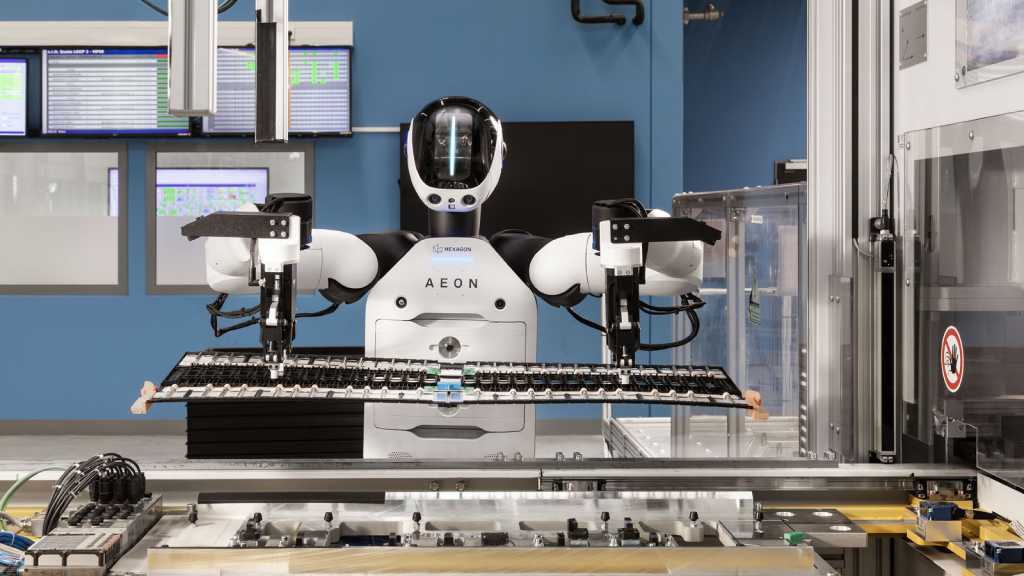
An Aeon in production at the BMW plant in Leipzig.
BMW Group
With 22 sensors and 34 degrees of freedom, Aeon can not only manipulate components, but also perform highly precise quality checks on vehicle doors using integrated scanners. Furthermore, it can independently replace its battery in under 30 seconds to remain operational without lengthy charging interruptions.
Aeon will be used at the Leipzig plant, specifically for battery assembly and component manufacturing. Unlike previous collaborative robots, which often failed in practice due to a lack of intelligence, Aeon features physical AI. This allows this generation of robot to learn through simulations, imitation learning, and world models. For example, Aeon uses 360-degree cameras to react to obstacles or passing employees in real-time.
iFactory on board
Aeon’s AI is powered by the automaker’s iFactory. This allows Aeon to operate within the factory environment without rigid programming. iFactory is BMW’s global master plan for a production system that is radically flexible, sustainable, and, above all, fully digitized.
With the iFactory, the era of legacy systems is over, characterized by isolated databases for quality, logistics, and maintenance that barely communicated with one another. BMW has put an end to this situation. The technical basis is a standardized data foundation and the global networking of all locations.
Four AI maturity levels
At iFactory’s core is a streaming service into which every machine feeds its data in real-time. This data cloud is the fuel for AI. Although BMW began its first forays into AI 15 years ago, today’s system is on a new level. Currently, over 1,100 AI use cases are active across the entire production network, already saving more than €30,000 per case annually.
BMW itself divides the evolution of AI use in the factory into four technical maturity levels:
- Operational routines: Simple camera-computer systems (computer vision) check whether components are correctly assembled.
- Process control: AI no longer just decides on “right or wrong,” but actively controls production processes based on cloud data.
- Planning with generative AI: Large language models (LLMs) enable engineers to perform complex analyses and factory planning more efficiently.
- Autonomous AI: The highest discipline, where AI makes its own decisions and independently navigates through manufacturing requirements.
Autonomous AI agents
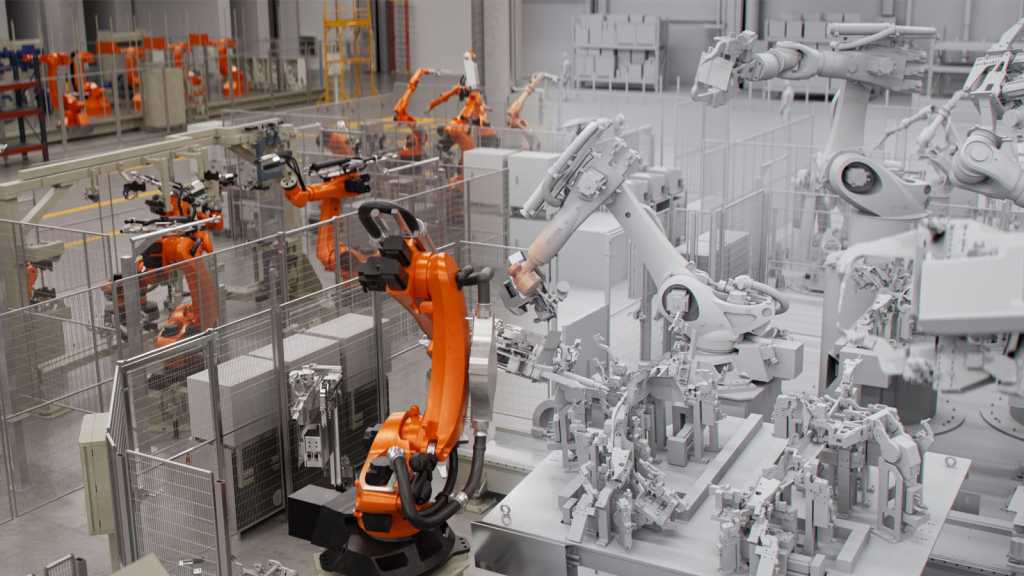
Digital twin of production at BMW.
BMW Group
For BMW, these autonomous AI agents represent the highest level of AI evolution within production. Unlike simpler AI systems, these autonomous agents are designed to be intelligent enough to generate their own decisions and navigate complex manufacturing requirements independently. Furthermore, BMW plans to integrate these agents into the digital twin of its factories to support decision-making in daily factory planning. These virtual agents are based on LLMs and utilize the extensive knowledge database of BMW experts to streamline planning tasks.
The digital twin of the factories was created in cooperation with Nvidia. To achieve this, all plants worldwide were scanned using laser scanners — some manually, some automatically. The result is a virtual world that corresponds to reality down to the millimeter. In this omniverse, engineers from different continents can collaborate simultaneously: They can move robots, simulate logistics flows, or analyze workplace ergonomics before a single screw has been turned. The aforementioned AI agents can also be used in this virtual world to support decision-making processes.
Sustainable and flexible
At BMW, digitalization is not an end in itself, but rather a tool for greater sustainability. Since renewable energy sources like wind and solar fluctuate, BMW uses AI to adapt the energy demand of production to the available supply. Sensors and control systems balance peak loads and optimize consumption in real-time — a process that would be too complex for conventional systems due to the immense number of parameters involved.
Furthermore, the iFactory strategy opens the door to greater flexibility for BMW. For example, the type of drive system installed on a production line can be changed. And the order sequence can be modified up to six days before production starts.
Read More from This Article: BMW brings AI humanoid robots to Leipzig factory
Source: News