

From systems to ecosystems to agents
A shift has been underway for some time as value creation moves from slow, firm-centric to more rapid, co-created across a network of participants. Customers don’t experience systems; they experience outcomes. Those outcomes are assembled across a network of partners, platforms and capabilities that must work together as one.
Consider NVIDIA. Its Blackwell platform is not simply a product; it is an ecosystem. Chips, software frameworks, developer tools and partner innovations combine to deliver AI capability at scale. What appears seamless to the customer is a highly coordinated system of interdependent contributors.
The CIO’s responsibility is to ensure alignment among technology, agents and the ecosystem’s role.
That requires the agentic AI strategy to shift from static alignment to continuous alignment, in which architecture, governance and intelligent systems evolve in real time.
This shift is at the core of Digital Momentum: Architecture that actively shapes how value is created, adapted and delivered in an outcome-oriented world.
Not all agents are created equal
One of the biggest mistakes organizations are making right now is treating agentic AI as a plug-and-play solution, assuming all agents, whether internal or ecosystem-facing, can be designed the same way. Context defines the agent, and context determines how it must be designed.
However, there’s a fundamental difference between:
- Internal agents, which optimize processes and decisions inside the enterprise. These can often assume functional roles.
- Ecosystem agents, which operate across organizational boundaries and participate in value delivery. While these could have functional specialties, they also need to work in the ecosystem.
These ecosystem agents don’t just execute tasks; they negotiate, coordinate and influence results in environments that are partially controlled and partially influenced by stakeholders.
Ecosystem agents must be designed with precision. They cannot be general-purpose actors with broad autonomy or poorly defined functionality. To function effectively, an agent needs to address its role in the ecosystem:
- Limited, purpose-built context so they can act quickly without being overwhelmed or unpredictable.
- Clearly defined responsibilities, tightly aligned to a specific mission.
- Bounded authority, ensuring decisions stay within acceptable risk thresholds.
- Embedded governance, built into how they operate and not layered on afterward.
Research into AI-driven organizations consistently shows that intelligent systems perform well only when aligned with operating models and value delivery. The same principle applies to agentic systems. Without alignment, autonomy doesn’t create value; it creates instability.
4 agentic role types that define agentic strategy
To operate effectively in an agent-driven ecosystem, CIOs must be explicit about the role their organization is playing and how agents fill those roles:
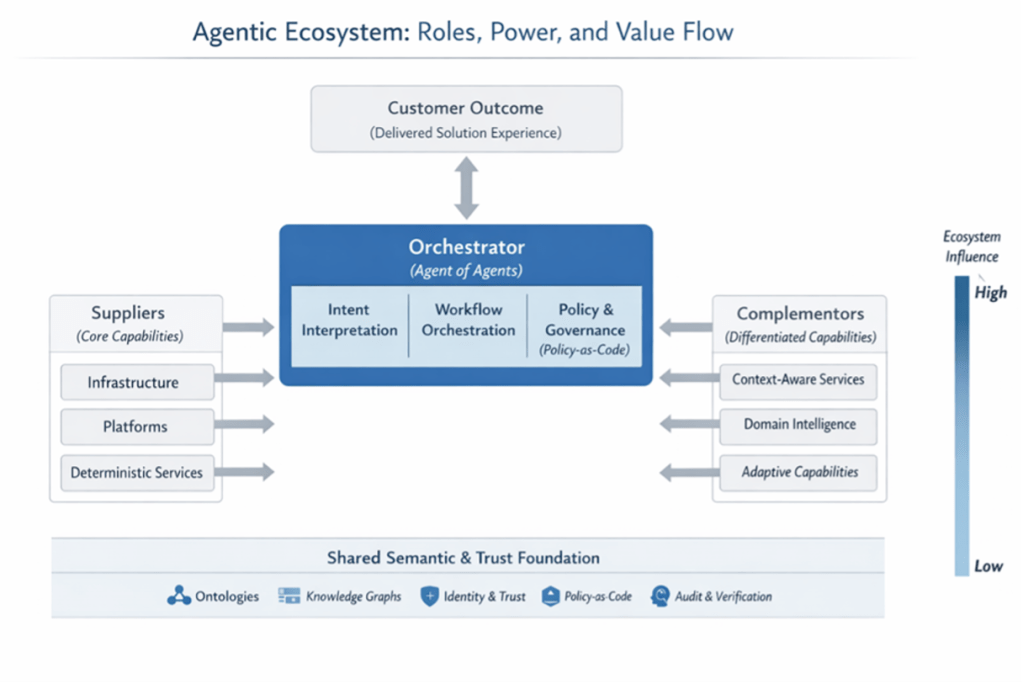
1. Orchestrator agent: Designing the system
Orchestrators define how value is assembled across the ecosystem. They control integration points, set standards and often own the customer relationship.
What it requires
- Strong architectural control over interfaces and workflows
- Coordination of agent behavior at scale
- Governance embedded directly into runtime execution
CIO decision lens
- Where to enforce control vs. allow flexibility.
- How agents interact, trigger actions and make decisions.
- What governance must be codified into the system.
2. Complementor agent: Differentiating at the edge
Complementors extend the ecosystem with specialized capabilities, providing directed experience and domain expertise that matter most.
What it requires
- Deep, defensible domain expertise.
- Context-aware agents that operate within orchestrated workflows.
- Rapid adaptability as the ecosystem’s needs evolve.
CIO decision lens
- Where to differentiate vs. conform.
- How much autonomy agents should have within external systems.
- How to expose capabilities to remain indispensable.
3. Supplier agent: Powering the solution
Suppliers provide the infrastructure and core services that ecosystems depend on.
What it requires
- High reliability and scalability
- Standardized, consumable services
- Consistent performance at ecosystem scale
CIO decision lens
- Where to compete on cost, performance or specialization
- How to expose services for reuse
- Where to invest to avoid commoditization
4. The consumer agent: Using the solution
Consumer agents act as customer proxies, presenting solutions orchestrated solutions.
What it requires
- Flexibility across providers and platforms
- Strong governance over external dependencies
- Trust frameworks for reliable outcomes
CIO decision lens
- How much control to retain vs. delegate
- How to govern external agents
- How to ensure predictable outcomes
The bottom line for CIOs
The mistake many organizations make is designing agents generically. Agent behavior, authority and governance must be shaped by the role you play in the ecosystem.
Get that alignment right, and agentic AI becomes a force multiplier.
Get it wrong, and you introduce instability at the very point where value is created.
Agentic strategy: Aligning AI to your evolving role in the ecosystem
With deployed agents, CIOs need to ask the following question: How will those agents remain aligned to our evolving role in the ecosystem as strategic priorities shift?
AI is a continuous expression of how your organization creates value. As markets shift, partnerships evolve and strategy changes, your role in the ecosystem must evolve as well, and your agents must adapt to it. Figure 1 illustrates these roles and how they interact dynamically across the ecosystem.
Brice Ominski
When organizations fail to realign agent behavior as their role evolves, misalignment sets in and the consequences compound quickly:
- Orchestrators lose control over increasingly complex ecosystems
- Complementors become interchangeable as differentiation erodes
- Suppliers are pushed toward utility status, competing primarily on cost
- Consumers lose predictability in outcomes they depend on
In an agentic world, competitive advantage doesn’t come from deploying agents; it comes from continuously realigning them.
Control value and risk in agentic systems
As ecosystems become agent-driven, risk doesn’t disappear; specifically, CIOs should look for the following risks:
- Platform dependency. Your operating model becomes tied to another organization’s ecosystem
- Value imbalance. Orchestrators capture disproportionate value
- Architectural lock-in. Integration and agent decisions limit future flexibility
- Capability absorption. Differentiated capabilities get embedded into the platform
- Trust gaps. Autonomous agents require stronger identity, auditability and policy enforcement
- Intelligence displacement. Control over data and learning loops shifts elsewhere
Ignoring them doesn’t reduce risk — it delays when it becomes a constraint.
What CIOs should do next to prepare their agentic strategy
The organizations that succeed won’t be the fastest adopters. They will be the most deliberate.
- Make your ecosystem role explicit. Define whether you are orchestrating, extending, supplying or assembling value.
- Map control vs. dependency early. Understand where decision authority resides and where it may erode.
- Design agents as bounded actors. Scope, authority and decision rights must be clearly defined.
- Embed governance and trust into execution. Governance must be codified, enforced at runtime and continuously observable.
Closing perspective
In this environment:
- Orchestrators shape how value is assembled
- Complementors differentiate where it matters most
- Suppliers provide the foundation
- Consumers determine how value is composed
The CIO’s responsibility is to ensure alignment across all three: Technology, agents and ecosystem position.
This shift toward continuous, outcome-driven alignment is at the core of what I explore in Digital Momentum — how architecture evolves from supporting the business to actively shaping value creation in real time.
This article is published as part of the Foundry Expert Contributor Network.
Want to join?
Read More from This Article: Agentic AI is reshaping business ecosystems — CIOs must choose their role carefully
Source: News