

Google’s CEO says vibe coding makes programming “enjoyable” and “exciting again.” Klarna’s CEO prototypes products in 20 minutes instead of waiting two weeks. Collins Dictionary named “vibe coding” its Word of the Year for 2025. The message seems clear: AI has democratized software development. Just describe what you want in plain English and let AI handle the code.
For CIOs managing enterprise software estates, this narrative doesn’t fully capture the complexity of their reality.
I’ve watched clients become captivated by the vibe coding promise. They see demos where AI generates a working prototype in minutes. They imagine their legacy modernization problems solved. Then they try applying these tools to a 25-year-old mainframe application processing millions of transactions daily and discover why speed alone doesn’t solve enterprise problems.
The gap between prototyping a new app and modernizing critical infrastructure isn’t about coding velocity. It’s about preserving decades of undocumented business logic while simultaneously transforming the technical foundation beneath it. That requires a fundamentally different approach than telling AI to “build me a customer portal.”
Dotun Opasina
What vibe coding solves (and what it doesn’t)
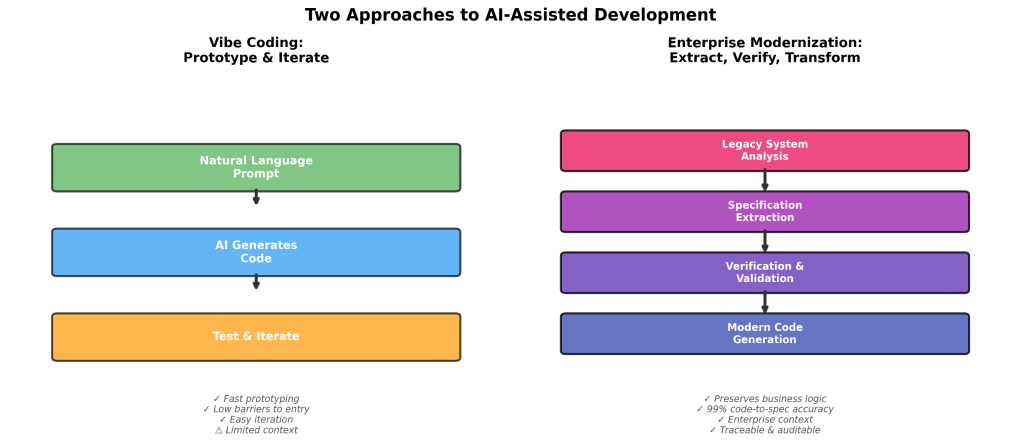
Vibe coding — using natural language to prompt AI into generating code — has legitimate enterprise applications. A product manager can validate an idea without engineering resources. A business analyst can prototype a workflow automation without waiting for sprint capacity. A marketing team can build internal tools without IT tickets.
These are real productivity gains. When Sundar Pichai says vibe coding has “made coding so much more enjoyable,” he’s describing how AI removes friction from exploration and experimentation. The barrier between “I wish we had this” and “here’s a working version” has essentially collapsed.
But enterprise modernization isn’t exploration. It’s surgery on mission-critical systems where the patient can’t be sedated.
Consider the typical enterprise modernization scenario I encounter: A leading health care organization needed to modernize 10,000+ COBOL mainframe screens to improve claims processing and customer service. These systems were built before most current developers were born. The original architects retired years ago. Documentation is incomplete or contradictory. Business rules are embedded in code that nobody fully understands anymore.
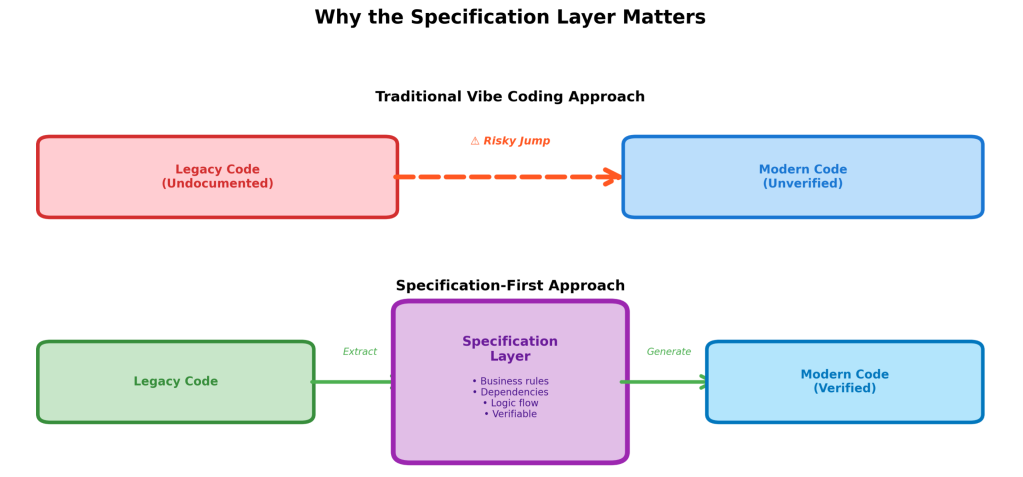
Vibe coding tools can generate modern code quickly. What they can’t do is tell you whether that code implements the same business logic as the legacy system — logic that represents decades of regulatory compliance decisions, edge case handling and institutional knowledge that was never written down.
This is where the “vibe coding hangover” hits enterprise IT. Fast code generation creates new problems when applied to complex, tightly coupled systems.
The specification problem nobody talks about
Here’s the uncomfortable truth about AI-assisted development: AI generates perfect code for poorly defined problems.
I’ve seen this pattern repeatedly in client work. Teams use AI to accelerate development. Code gets written faster than ever. Then they discover the code solves the wrong problem because the requirements weren’t clear enough to begin with.
For greenfield projects building something new, you can iterate quickly. Wrong assumption? Rewrite it. Missed a requirement? Add it next sprint. The cost of mistakes is measured in developer time and missed deadlines.
For legacy modernization, mistakes compound differently. You’re not just building new functionality. You’re replacing systems that process payroll, manage inventory, handle financial transactions, route customer service calls — critical operations where “oops, we missed a business rule” isn’t acceptable.
Traditional modernization approaches tried to solve this through massive requirements-gathering efforts. Armies of business analysts documenting every screen, every workflow, every edge case. These projects took years and often failed because by the time you finished documenting, the business had evolved.
The enterprise-grade AI approach inserts a different layer: specification extraction.
Rather than jumping from legacy code to modern code, systems that work at enterprise scale first extract what the legacy system does — the business rules, the dependencies, the logic flow — into a clear specification. That specification becomes the source of truth for generating modern code. It’s verifiable. It’s traceable. It preserves institutional knowledge that exists nowhere else.
At Publicis Sapient, our proprietary AI platform Sapient Slingshot embodies this specification-first approach. When RWE needed to modernize a 24-year-old application with no source code or documentation, the platform analyzed the running system to extract business logic before generating replacement code. What would have taken two weeks of manual reverse-engineering happened in two days, with human oversight ensuring accuracy.
This isn’t about speed. It’s about preserving what works while transforming how it runs.
Dotun Opasina
Why enterprise context changes everything
The difference between prototyping and production isn’t just scale. It’s context.
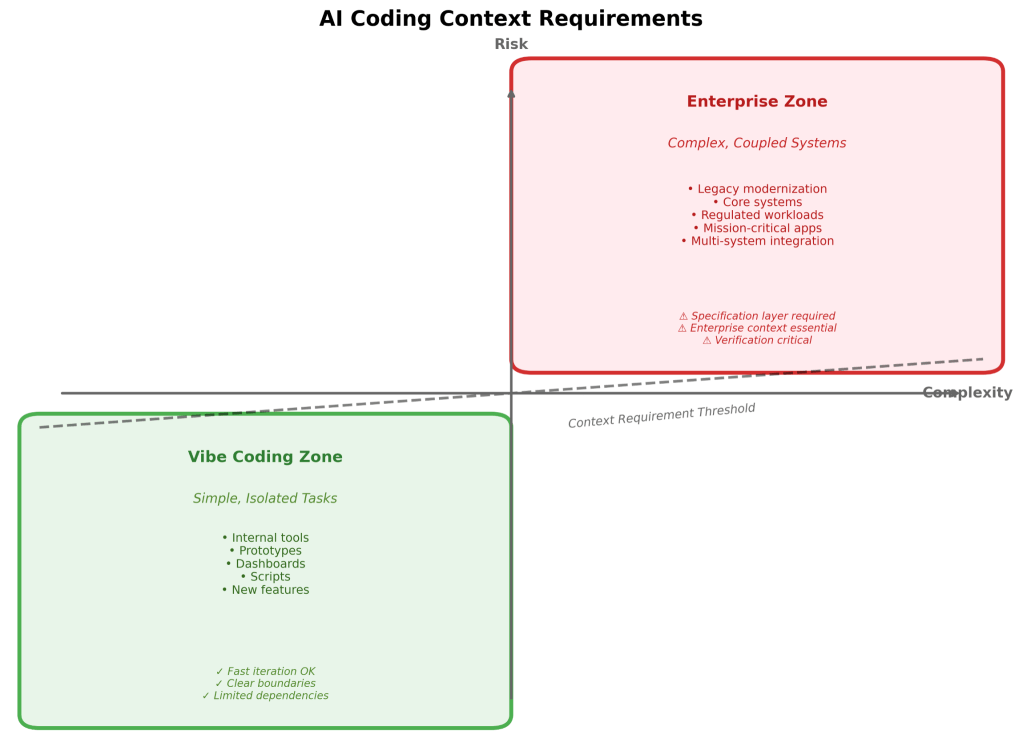
Vibe coding tools work well for isolated problems. Build a dashboard. Generate a data transformation script. Create an internal tool. These tasks have clear boundaries and limited dependencies.
Enterprise systems don’t have clear boundaries. A seemingly simple change to how customer addresses are validated might cascade through order processing, shipping logistics, tax calculation, fraud detection and customer service routing. Understanding those dependencies requires context that exists across thousands of files, dozens of databases and years of incremental changes.
This is where general-purpose AI coding assistants hit their limits. They can read individual files. They can suggest code completions. They can even generate multi-file changes. What they can’t do is understand how your 15-year-old inventory management system integrates with your 10-year-old order fulfillment platform which talks to your 5-year-old customer service tool — and why changing one piece breaks another.
Enterprise-grade AI modernization requires building an Enterprise Context Graph — a living map of how code, architecture, data and business rules connect. This context allows AI to make informed decisions about modernization, not just fast guesses.
When a health care organization used this approach to modernize critical legacy systems, the platform identified hidden dependencies that would have caused production failures if missed. The AI didn’t just generate modern code faster. It generated modern code that worked in the complex environment where it needed to run.
Dotun Opasina
What this means for CIO technology strategy
The vibe coding phenomenon signals something important: AI is changing how software gets built. But for enterprise leaders, the strategic question isn’t “Can AI write code faster?” It’s “Can AI help us escape decades of technical debt while keeping critical systems running?”
The answer is yes — but only with the right approach.
- Stop optimizing for coding speed. Your constraint isn’t how fast developers can write code. It’s how accurately you can understand and preserve business logic while modernizing the technical foundation. Tools that prioritize speed over comprehension will create more problems than they solve.
- Start measuring specification accuracy. The new productivity metric isn’t lines of code generated. It’s code-to-spec accuracy — how reliably the generated code implements verified business requirements. Platforms achieving 99% code-to-spec accuracy enable modernization projects that were previously too risky to attempt.
- Treat institutional knowledge as a strategic asset. Your legacy systems contain decades of business logic that represents real competitive advantage — edge cases handled, regulatory requirements met, customer workflows optimized. Modernization approaches that discard this knowledge to move faster are destroying value in the name of speed.
- Invest in context preservation, not just code generation. The winners in enterprise AI adoption won’t be organizations that generate code fastest. They’ll be organizations that can systematically extract, verify and modernize business logic at scale.
The modernization opportunity hiding in plain sight
Here’s what makes March 2026 different from March 2024: We now have AI systems capable of reading legacy code, extracting business rules and generating verified modern replacements at enterprise scale. The technology matured.
According to the Stanford AI Index 2025, 78% of organizations used AI in 2024, up from 55% in 2023. But adoption and effectiveness are different metrics. Most organizations are still experimenting with AI tools for individual developer productivity.
The strategic opportunity isn’t faster coding. It’s systematic technical debt elimination.
Consider the typical enterprise IT budget: 60-80% goes to maintaining legacy systems. That maintenance cost compounds annually as skills become scarcer and systems become more brittle. Every dollar spent keeping COBOL running is a dollar not spent on innovation.
Vibe coding tools won’t solve this. They’re built for creation, not preservation. Enterprise modernization requires AI that understands what you have before transforming it into what you need.
Organizations applying this approach are seeing 75% faster delivery timelines, 40% higher productivity and up to 50% savings in modernization costs. More importantly, they’re tackling modernization projects that were previously shelved as too risky or expensive to attempt.
The specification-first future
The vibe coding phenomenon will continue to accelerate. More business users will build tools. More prototypes will become products. More organizations will democratize software creation beyond traditional engineering teams.
For CIOs, this creates both opportunity and risk.
The opportunity: Free your engineering teams from routine development by enabling business users to build their own solutions. The risk: Create a fragmented estate of AI-generated tools that nobody can maintain.
The solution requires treating AI-assisted development as a spectrum. Prototypes and internal tools can embrace the speed and accessibility of vibe coding. Mission-critical systems and legacy modernization need specification-first approaches that prioritize accuracy and traceability over velocity.
Your competitors are experimenting with AI coding tools. The question is whether they’re building sustainable transformation capabilities or accumulating a new generation of technical debt at AI speed.
The CIOs who understand this distinction will spend 2026 systematically eliminating legacy constraints, while others remain focused on incrementally improving existing systems. By 2027, that gap will be difficult to close. Vibe coding democratized software creation. Enterprise-grade AI makes transformation predictable. Choose your tools accordingly.
This article is published as part of the Foundry Expert Contributor Network.
Want to join?
Read More from This Article: Vibe coding goes enterprise: What you need to know about AI-driven legacy modernization
Source: News